In trollope galop, I wrote that Anthony Trollope's autobiography was "stashed on my Kindle,"* and not long afterward I started dipping into it. I'll admit that there are some long tedious sections, but along the way I have been moved to read two more of Trollope's novels: Orley Farm and The Way We Live Now. I just started on The Vicar of Bullhampton and am relishing the pace.
Trollope's definition of the novel is something like: "development of character over time."** Though he claims not to plan his plots, each character's story emerges and will be told as long as the author maintains his self-imposed writing schedule.
Much of Trollope's autobiography is taken up with detailing his literary standards and commenting on his contemporaries (he loves Thackeray, hates Disraeli, respects George Eliot, etc.). So far (and I think I am about two-thirds of the way through), one anecdote of Trollope's life has made me laugh out loud, and I must retell it.
After taking an early retirement from the Post Office Department in 1864, Trollope increased the rate of his literary output. Whenever he was in London for more than a day, he would write at his club, The Athenaeum. One afternoon when he was working on The Last Chronicles of Barset, two clergymen came into the room, sat down by the fire, and proceeded to discuss Trollope's novels. The author, of course, perked up his ears and listened very carefully while the two reverend gentlemen complained that he re-used the same old characters too often. In particular, they found Mrs. Proudie (the Bishop's wife introduced in Barsetshire Towers) to be most objectionable. Trollope was incensed. He stood up, introduced himself, and said something like: "Very well. If you don't like Mrs. Proudie I shall kill her off within the week!"
Accordingly, Mrs. Proudie's death scene is horrific. After orchestrating her sudden massive heart attack, and allowing several other characters to feel relieved by her passing, Trollope felt quite guilty, and was haunted regularly by Mrs. Proudie's restless ghost.
Personally, I love the way characters and places recur in Trollope's novels. I am happy to learn that Bullhampton is near the Chiltern estate, which I recognize from the six-volume Pallisers series. I could have handled more of Mrs. Proudie, and in fact was disappointed when Obadiah Slope, her evil minion, left Barsetshire.
- - - - - -
* Now all of Trollope's 47 novels are stashed on my Kindle in a single volume.
** Not a verbatim quote, but this is not a term paper and I'm not going to look these things up.
Showing posts sorted by relevance for query trollope. Sort by date Show all posts
Showing posts sorted by relevance for query trollope. Sort by date Show all posts
Saturday, May 19, 2012
Saturday, October 27, 2012
viewing Trollope in 2012
The following is my submission to a Facebook challenge made by the Anthony Trollope Society. We were to write 300 words on "How I View Trollope in 2012."
In 2012 I view Trollope on my Kindle e-reader.
I know this is not the type of answer the Society expects, but I hope nobody finds it flippant. Buying a Kindle brought me back to Victorian literature after a hiatus of over 40 years.
When I saw that most classic ‘literary’ fiction was available in Kindle format for free, I started amassing it and inserting a Victorian title here and there in my usual regimen of contemporary best-sellers, self-help books, and detective fiction.
George Eliot turned out to be too ponderous, and Thomas Hardy too melodramatic, but, in the immortal words of Goldilocks, Anthony Trollope was “just right.”
Now I carry Trollope’s complete works with me almost everywhere I go. The e-reader simultaneously holds my place in all the books I’m reading, and thus while reading Trollope’s autobiography I was able to segue into novels he mentioned -- “The Way We Live Now,” “Orly Farm,” “The Vicar of Bullhampton” -- and seamlessly return to the autobiography.
Re-reading “Phineas Finn” in August during our ‘Take a Trollope on Holiday ‘activity, I used the Kindle’s search function to look up his references to Belgium. Then I scheduled a side-trip to Blankenberg Beach, where Phineas and Lord Chiltern fought their infamous duel.
Right now, I’m reading “The Claverings,” but when I‘m finished I intend to start researching Trollope’s use of seaside locations for significant events. This project was inspired by a thread in our Facebook discussion of “Marion Fay,” when a Society member posted an old sepia photo of Pegwell Bay.
So how do I view Trollope in the broader sense intended by the Society’s question? I view Trollope as a friend and companion who is always able to delight me with his insights into human character.
I know this is not the type of answer the Society expects, but I hope nobody finds it flippant. Buying a Kindle brought me back to Victorian literature after a hiatus of over 40 years.
When I saw that most classic ‘literary’ fiction was available in Kindle format for free, I started amassing it and inserting a Victorian title here and there in my usual regimen of contemporary best-sellers, self-help books, and detective fiction.
George Eliot turned out to be too ponderous, and Thomas Hardy too melodramatic, but, in the immortal words of Goldilocks, Anthony Trollope was “just right.”
Now I carry Trollope’s complete works with me almost everywhere I go. The e-reader simultaneously holds my place in all the books I’m reading, and thus while reading Trollope’s autobiography I was able to segue into novels he mentioned -- “The Way We Live Now,” “Orly Farm,” “The Vicar of Bullhampton” -- and seamlessly return to the autobiography.
Re-reading “Phineas Finn” in August during our ‘Take a Trollope on Holiday ‘activity, I used the Kindle’s search function to look up his references to Belgium. Then I scheduled a side-trip to Blankenberg Beach, where Phineas and Lord Chiltern fought their infamous duel.
Right now, I’m reading “The Claverings,” but when I‘m finished I intend to start researching Trollope’s use of seaside locations for significant events. This project was inspired by a thread in our Facebook discussion of “Marion Fay,” when a Society member posted an old sepia photo of Pegwell Bay.
So how do I view Trollope in the broader sense intended by the Society’s question? I view Trollope as a friend and companion who is always able to delight me with his insights into human character.

Monday, February 6, 2012
my trollope galop*
After reading twelve Trollope novels in less than six months, I have made a cleansing foray into Nabokov (Laughter in the Dark) and greatly enjoyed the economy of language and tightness of plot. Trollope, writing for serialization and with three volumes to fill for each title, describes every detail of a major character's face, figure, financial status, family heritage, and marital status before s/he is allowed to step into the action. Nabokov, who personally translated Laughter into English, lets these details emerge on a 'need-to-know' basis. Googling Laughter just now, I learned that Tony Richardson made it into a French-British film in 1969. I wonder what Nabokov thought of the movie but will postpone further researches for the time being.
For some reason I feel that I must write more about Trollope before getting back to Nabokov or Doctorow. Maybe there's an ideal balance between input and output, and I must restore it before reading more.
The Barchester and Palliser series provide a very thick slice of life in mid-Victorian England. Politics (both secular and ecclesiastical), architecture, communications, economics, and social mores are treated in great detail, as they must be to develop Trollope's story lines, invariably chronicling the rise and fall of a character's status.
I will admit to being bored by Trollope's long descriptions of fox hunts and parliamentary debates, but I love his ornate vocabulary and am fascinated by his treatment of marriage. From the 'childhood sweetheart' theme, through courtship, wedding ceremonies, honeymoons, everyday intercourse (hey! it meant communication and/or business in those days), obligatory entertaining, and finally widowhood, the reader follows every step.
While the subject of sex is carefully avoided, a reader steeped in political correctness may still feel the guilty frisson that comes from forbidden subject matter, when Trollope descends into the substratum of bigotry underlying his fictional world. Mr. Levy, Mr. Lopez, and the Reverend Mr. Emilius, a bigamous Pole, are treated with broad stereotypes and intense contumely. Italians and Germans fare better unless they are devoted to Roman Catholicism or Judaism, respectively. English people of the better classes can actually live in Italy, Germany, or Switzerland without becoming tainted, but they must return home periodically. Giving birth or dying abroad is to be avoided at all costs.
Trollope wrote 47 novels, some travel books and other nonfiction, some short stories, and an autobiography -- stashed on my Kindle, of course.
- - - - -
*Spelled this way, galop refers to a lively dance popular during Trollope's lifetime.
For some reason I feel that I must write more about Trollope before getting back to Nabokov or Doctorow. Maybe there's an ideal balance between input and output, and I must restore it before reading more.
The Barchester and Palliser series provide a very thick slice of life in mid-Victorian England. Politics (both secular and ecclesiastical), architecture, communications, economics, and social mores are treated in great detail, as they must be to develop Trollope's story lines, invariably chronicling the rise and fall of a character's status.
I will admit to being bored by Trollope's long descriptions of fox hunts and parliamentary debates, but I love his ornate vocabulary and am fascinated by his treatment of marriage. From the 'childhood sweetheart' theme, through courtship, wedding ceremonies, honeymoons, everyday intercourse (hey! it meant communication and/or business in those days), obligatory entertaining, and finally widowhood, the reader follows every step.
While the subject of sex is carefully avoided, a reader steeped in political correctness may still feel the guilty frisson that comes from forbidden subject matter, when Trollope descends into the substratum of bigotry underlying his fictional world. Mr. Levy, Mr. Lopez, and the Reverend Mr. Emilius, a bigamous Pole, are treated with broad stereotypes and intense contumely. Italians and Germans fare better unless they are devoted to Roman Catholicism or Judaism, respectively. English people of the better classes can actually live in Italy, Germany, or Switzerland without becoming tainted, but they must return home periodically. Giving birth or dying abroad is to be avoided at all costs.
Trollope wrote 47 novels, some travel books and other nonfiction, some short stories, and an autobiography -- stashed on my Kindle, of course.
- - - - -
*Spelled this way, galop refers to a lively dance popular during Trollope's lifetime.
Wednesday, February 1, 2012
cheaper by the dozen
In April 2010 and May 2011 I referred in passing to my beloved Kindle. The first of these posts was about an unpleasant encounter on a bus ride, and the second about the development of daily routines. At a time when e-books are being lambasted roundly in various media* due to Jonathan Franzen's screed at the Hay Festival, I feel compelled to write about how the Kindle has influenced my book-buying and reading habits.
Before I had a Kindle, I rarely bought a new book. My modus operandi was to buy virtually all of my reading matter at thrift shops and used book stores (see my post Flight of Fiction for a description of a surprise this procedure brought). Since these books were so cheap (rarely more than $5.00 each) I bought lots of them and piled them on their sides so that I could see at a glance which books I hadn't read yet. After reading each book, I'd pass it along to a friend or give it back to a charity that would re-sell it in another thrift shop -- unless it qualified to be saved on my shelf of exemplary fiction.
Since the e-books available at Amazon for the Kindle are usually $9.99 apiece (maybe $14.95 for best-sellers), it appeared that my book budget was going to go through the roof. I had heard, however, that there were books available in Kindle editions for $1.00, or even for free. I rationalized that my average book purchase might not be higher than it was when I was buying most of my books from Salvation Army or Goodwill stores..
The first thing I noticed on Kindle's lists of free and $1.00 books was a preponderance of Victorian fiction, from which I downloaded a potpourri of George Eliot, Thomas Hardy, and Anthony Trollope, plus a Henry James title (The Outcry) that was totally new to me. These I kept in reserve and, at first, would righteously and parsimoniously read one Victorian title in between each modern title by Margaret Atwood, Douglas Coupland, Sue Grafton, Iain Pears, etc. This regimen lasted until I read Trollope's The Warden.
In college I'd greatly enjoyed Barchester Towers in a Victorian fiction class featuring one book apiece by the major novelists. That must have been in 1962. It all came back when The Warden appeared on my Kindle screen -- mostly through the imaginative, memorable names of characters: the Proudies, the Grantlys, Mr. Obadiah Slope, the Duke of Omnium (builder of Gatherum Castle), Sir Omicron Pi, and on and on. I was hooked, and so embarked on a journey through Trollope's six-book Barchester series, followed by another six in his Palliser series.
I don't think I'd ever have gone back to Trollope if it hadn't been for the way the Kindle changed my book buying habits, and yet this week we are being warned that because of e-books we are accelerating the fall of civilization as we know it.
Meanwhile Jonathan Franzen's acclaimed novel Freedom is available on Kindle for $9.99 (list price $16.00). Maybe I'll order it when I finish E.L. Doctorow's City of God -- if I don't get bogged down in Thackery.
- - - -
*for starters: CBC, Huff Post, Guardian. L.A. Times
Before I had a Kindle, I rarely bought a new book. My modus operandi was to buy virtually all of my reading matter at thrift shops and used book stores (see my post Flight of Fiction for a description of a surprise this procedure brought). Since these books were so cheap (rarely more than $5.00 each) I bought lots of them and piled them on their sides so that I could see at a glance which books I hadn't read yet. After reading each book, I'd pass it along to a friend or give it back to a charity that would re-sell it in another thrift shop -- unless it qualified to be saved on my shelf of exemplary fiction.
Since the e-books available at Amazon for the Kindle are usually $9.99 apiece (maybe $14.95 for best-sellers), it appeared that my book budget was going to go through the roof. I had heard, however, that there were books available in Kindle editions for $1.00, or even for free. I rationalized that my average book purchase might not be higher than it was when I was buying most of my books from Salvation Army or Goodwill stores..
The first thing I noticed on Kindle's lists of free and $1.00 books was a preponderance of Victorian fiction, from which I downloaded a potpourri of George Eliot, Thomas Hardy, and Anthony Trollope, plus a Henry James title (The Outcry) that was totally new to me. These I kept in reserve and, at first, would righteously and parsimoniously read one Victorian title in between each modern title by Margaret Atwood, Douglas Coupland, Sue Grafton, Iain Pears, etc. This regimen lasted until I read Trollope's The Warden.
In college I'd greatly enjoyed Barchester Towers in a Victorian fiction class featuring one book apiece by the major novelists. That must have been in 1962. It all came back when The Warden appeared on my Kindle screen -- mostly through the imaginative, memorable names of characters: the Proudies, the Grantlys, Mr. Obadiah Slope, the Duke of Omnium (builder of Gatherum Castle), Sir Omicron Pi, and on and on. I was hooked, and so embarked on a journey through Trollope's six-book Barchester series, followed by another six in his Palliser series.
I don't think I'd ever have gone back to Trollope if it hadn't been for the way the Kindle changed my book buying habits, and yet this week we are being warned that because of e-books we are accelerating the fall of civilization as we know it.
Meanwhile Jonathan Franzen's acclaimed novel Freedom is available on Kindle for $9.99 (list price $16.00). Maybe I'll order it when I finish E.L. Doctorow's City of God -- if I don't get bogged down in Thackery.
- - - -
*for starters: CBC, Huff Post, Guardian. L.A. Times
Sunday, September 6, 2015
kinsey and me (too), part 1
Years ago, on the advice of a friend, I read G is for Gumshoe, Book 7 in Sue Grafton's alphabetical series of Kinsey Millhone mysteries. Soon thereafter I doubled back to A is for Alibi and kept with it through W is for Wasted -- the last few titles via my Kindle e-reader. Naturally I pre-ordered Book 24 (X [is for whatever]), but what was I to read while I waited?
I noticed that Amazon's Sue Grafton page offered a book of short stories, Kinsey and Me, and so I ordered it even though I prefer longer fiction. The first half of Kinsey and Me features Kinsey Millhone, solving cases lickety-split within the rigid confines of the short-story format. The second features a fictionalized Sue Grafton, coming of age in Kentucky as 'Kit Blue' (née Conway) and coming to terms with the transitions in her alcoholic parents' self-destructive lives. The 'Kit Blue' stories were written during the decade following her mother's death. 'Vanessa' "died of an overdose of sleeping pills after extensive surgery so that the cause of death was probably listed as Despair" (pp. 273-74).
Besides the two groups of stories, Grafton presents three excellent essays which, for me, establish her credentials as a writer of elegant nonfiction. There's a preface in two parts: first describing the important differences between the mystery novel and the mystery short story, and then laying down a rationale for the writing of the more personal second part of the book. Between the two parts, "An Eye for an I" traces Grafton's own development as a reader and writer of crime fiction, alongside a detailed analysis of the genre. Finally the introduction to the second group of stories delves into the relationship between Sue, Kit, and Kinsey, starting with their largely unsupervised childhoods, free to read Nancy Drew mysteries on hot summer nights.
No doubt I could go on forever comparing and contrasting the parts of Kinsey and Me, but I'll stop with a couple of observations about style. The second half is written at what your English teacher would have called 'a higher level of diction' than anything you'll ever see in a Kinsey Millhone novel or story. It's a treat to witness Grafton take flight onto this more abstract level, but it's also a treat to see her come back down to the straightforward level on which Kinsey moves. I think the difference in style and tone is based on the fact that Kinsey is always moving into the future whereas Kit is always moving into the past.
I loved all the stories and essays in Kinsey and Me, but they would not keep me occupied until Book 24 finally downloaded itself onto my Kindle. Again, what was I to read?
Anthony Trollope (1815-1882) rarely disappoints, and the Trollope group on Facebook was discussing his one-volume novel Miss Mackenzie in July and August. I read it quickly while waiting for the group to begin its discussion, and signed up to write summaries for the last three chapters (28, 29, and 30). BTW this was the first time I have been able to stay in sync with the group schedule, and I greatly enjoyed the leisurely second reading, enhanced by comments and background material from other readers. I shared some info on aspects of Victorian life -- mourning attire and dinner-party service à la russe, for example -- and am looking forward to the group's next project.
Just as I stepped away from the rarefied atmosphere of Miss Mackenzie, Sue Grafton's X appeared on the menu of my Kindle Paperwhite. There was no 'is for' clause in the title. Grafton takes up this issue in a USA Today interview:
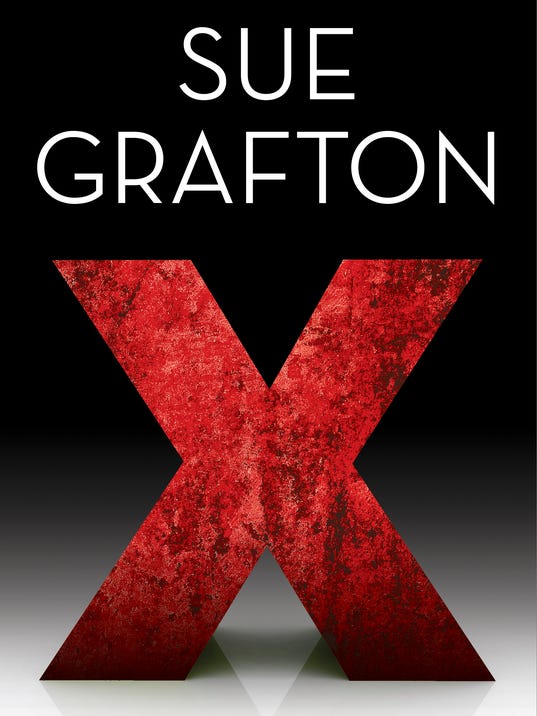
I noticed that Amazon's Sue Grafton page offered a book of short stories, Kinsey and Me, and so I ordered it even though I prefer longer fiction. The first half of Kinsey and Me features Kinsey Millhone, solving cases lickety-split within the rigid confines of the short-story format. The second features a fictionalized Sue Grafton, coming of age in Kentucky as 'Kit Blue' (née Conway) and coming to terms with the transitions in her alcoholic parents' self-destructive lives. The 'Kit Blue' stories were written during the decade following her mother's death. 'Vanessa' "died of an overdose of sleeping pills after extensive surgery so that the cause of death was probably listed as Despair" (pp. 273-74).
Besides the two groups of stories, Grafton presents three excellent essays which, for me, establish her credentials as a writer of elegant nonfiction. There's a preface in two parts: first describing the important differences between the mystery novel and the mystery short story, and then laying down a rationale for the writing of the more personal second part of the book. Between the two parts, "An Eye for an I" traces Grafton's own development as a reader and writer of crime fiction, alongside a detailed analysis of the genre. Finally the introduction to the second group of stories delves into the relationship between Sue, Kit, and Kinsey, starting with their largely unsupervised childhoods, free to read Nancy Drew mysteries on hot summer nights.
No doubt I could go on forever comparing and contrasting the parts of Kinsey and Me, but I'll stop with a couple of observations about style. The second half is written at what your English teacher would have called 'a higher level of diction' than anything you'll ever see in a Kinsey Millhone novel or story. It's a treat to witness Grafton take flight onto this more abstract level, but it's also a treat to see her come back down to the straightforward level on which Kinsey moves. I think the difference in style and tone is based on the fact that Kinsey is always moving into the future whereas Kit is always moving into the past.
I loved all the stories and essays in Kinsey and Me, but they would not keep me occupied until Book 24 finally downloaded itself onto my Kindle. Again, what was I to read?
Anthony Trollope (1815-1882) rarely disappoints, and the Trollope group on Facebook was discussing his one-volume novel Miss Mackenzie in July and August. I read it quickly while waiting for the group to begin its discussion, and signed up to write summaries for the last three chapters (28, 29, and 30). BTW this was the first time I have been able to stay in sync with the group schedule, and I greatly enjoyed the leisurely second reading, enhanced by comments and background material from other readers. I shared some info on aspects of Victorian life -- mourning attire and dinner-party service à la russe, for example -- and am looking forward to the group's next project.
Just as I stepped away from the rarefied atmosphere of Miss Mackenzie, Sue Grafton's X appeared on the menu of my Kindle Paperwhite. There was no 'is for' clause in the title. Grafton takes up this issue in a USA Today interview:
I first thought of using 'X is for Xenophobe' or Xenophobia, which suggests a fear of foreigners, but alas, not one single foreigner materialized in the course of the writing," Grafton says. "There's a box of files with an X on the lid, a Father Xavier, a married couple whose last name is Xanakis, and a missing painting of a xebec which is a three-masted sailing vessel, but none of these seemed to encompass the whole. Finally, it occurred to me that since I was the one who invented this 'rule' about '…is for…' I was surely entitled to break it.Let's wait for another day to talk about reading X with the new insights afforded by Kinsey and Me.
Sunday, September 13, 2015
kinsey and me (too), part 2
Not much is said of the (too) in kinsey and me (too), part 1, unless you surmised that I too would stay awake to "read Nancy Drew mysteries on hot summer nights," as Sue, Kit, and Kinsey did. This post will go back and pick up on the 'me too' thread.
I have always felt a kinship with Kinsey Millhone, although I could never follow her regimen of running three miles a day (five days a week), and I have no training in martial arts or marksmanship. I appreciate to the fullest Kinsey's irreverence for most social mores and I endorse her minimalist lifestyle: small cars, a casual wardrobe (with one good black dress/tunic for emergencies), and readiness to travel at the drop of a hat. I love peanut-butter and pickle sandwiches, but am not addicted to the fast food Kinsey shamelessly devours in her car. Since high school, 3x5 index cards have been my preferred medium for important notes and lists, and Kinsey always carries a big bundle of cards in her shoulder bag.
Having spent memorable times in Santa Barbara, I enjoy the settings of Sue Grafton's novels. Her fictional Santa Teresa and neighboring cities including Colgate, Montebello, Perdido, and Cottonwood are thinly veiled versions of towns in the greater Santa Barbara/Ventura area. When Kinsey travels outside this area, 'real' place names are used: Reno, San Francisco, Bakersfield, Los Angeles, Beverly Hills, Culver City.
Getting to know landmarks and characters through a series of novels makes a reader feel at home. This is true in Anthony Trollope's Barsetshire and Caroline Keene's* River Heights, as well as in Sue Grafton's Santa Teresa. Kinsey's friends are my friends: lovable landlord Henry Pitts, restaurateur Rosie, confidante Vera, the enigmatic Dietz, and a cohort of officers from the Santa Teresa Police Department.
My kinship with Sue Grafton is simpler in a sense, but more complex in others. She was born in 1940, I in 1941; we came along at the tail end of the 'silent generation (1925-1942),'** born before Pearl Harbor yet shaped by our parents' experiences of the Great Depression and World War II.

I have watched Grafton age gracefully through book-jacket photos taken from 1983 to the present, and in each one she looks like someone I would meet at a community event or remember from my high school class of 1958. Just look at those dimples!
With this image in mind it was fun to spot Grafton's dimples on the face of evil Edna Shallenbarger, an embezzler who skips bail to appear in X. Kinsey tells us: "She smiled with her lips together, creating a dimple in each cheek. The effect was curious. Malice surfaced and then disappeared" (pp. 154-55). I sensed that Sue Grafton has used her dimples to great advantage throughout her life, and I now I will continue to look for dimples on the faces of characters in her fiction.
It's tempting, but I do not intend to count the ways that reading Kinsey and Me has informed -- and will continue to inform -- my reading and re-reading of the Kinsey Millhone mysteries, but I do want to comment on the 'me too' effect in Grafton's X. Don't worry. No 'spoiler alert' is needed.
X is set during a serious drought that lasted from 1986 to 1991, and all the households in Santa Teresa are being asked to cut back voluntarily on their water use. Henry Pitts is trying hard to comply by taking out his thirsty lawn, putting in a drip irrigation system, and learning about gray water. At times I felt like I was reading my own blog:
From time to time I have written about my preoccupation with organizing our household effects. Sandra Felton, one of my current gurus in this area, recommends a regimen of three C's to use when decluttering: consolidate, containerize, condense. Following this procedure, I am currently consolidating and containerizing a vast number of things -- mostly yarn and other craft supplies -- into an indexed series of Bankers Boxes (about 30 so far, with no end in sight).
When Kinsey talks about assembling Bankers Boxes I once again feel that I am astride that fine line between fiction and fact. Kinsey uses her knowledge of Bankers Box construction (and deconstruction) to find an important clue about X's worst villain, and I can see just exactly how she did it. Luckily, I don't think I'll need to follow her example. But who knows? Someday I might want to conceal the details of a secret yarnbombing project. Where better than between layers of cardboard in Box Y?
- - - - - -
* collective pen name of a large group of underpaid ghostwriters working through the Stratemeyer Syndicate to create the Nancy Drew mystery series.
** "too young to see action in World War II and too old to participate in the fun of the Summer of Love." See NPR's How Generations Get Nicknames.
I have always felt a kinship with Kinsey Millhone, although I could never follow her regimen of running three miles a day (five days a week), and I have no training in martial arts or marksmanship. I appreciate to the fullest Kinsey's irreverence for most social mores and I endorse her minimalist lifestyle: small cars, a casual wardrobe (with one good black dress/tunic for emergencies), and readiness to travel at the drop of a hat. I love peanut-butter and pickle sandwiches, but am not addicted to the fast food Kinsey shamelessly devours in her car. Since high school, 3x5 index cards have been my preferred medium for important notes and lists, and Kinsey always carries a big bundle of cards in her shoulder bag.
Having spent memorable times in Santa Barbara, I enjoy the settings of Sue Grafton's novels. Her fictional Santa Teresa and neighboring cities including Colgate, Montebello, Perdido, and Cottonwood are thinly veiled versions of towns in the greater Santa Barbara/Ventura area. When Kinsey travels outside this area, 'real' place names are used: Reno, San Francisco, Bakersfield, Los Angeles, Beverly Hills, Culver City.
Getting to know landmarks and characters through a series of novels makes a reader feel at home. This is true in Anthony Trollope's Barsetshire and Caroline Keene's* River Heights, as well as in Sue Grafton's Santa Teresa. Kinsey's friends are my friends: lovable landlord Henry Pitts, restaurateur Rosie, confidante Vera, the enigmatic Dietz, and a cohort of officers from the Santa Teresa Police Department.
My kinship with Sue Grafton is simpler in a sense, but more complex in others. She was born in 1940, I in 1941; we came along at the tail end of the 'silent generation (1925-1942),'** born before Pearl Harbor yet shaped by our parents' experiences of the Great Depression and World War II.
I have watched Grafton age gracefully through book-jacket photos taken from 1983 to the present, and in each one she looks like someone I would meet at a community event or remember from my high school class of 1958. Just look at those dimples!
With this image in mind it was fun to spot Grafton's dimples on the face of evil Edna Shallenbarger, an embezzler who skips bail to appear in X. Kinsey tells us: "She smiled with her lips together, creating a dimple in each cheek. The effect was curious. Malice surfaced and then disappeared" (pp. 154-55). I sensed that Sue Grafton has used her dimples to great advantage throughout her life, and I now I will continue to look for dimples on the faces of characters in her fiction.
It's tempting, but I do not intend to count the ways that reading Kinsey and Me has informed -- and will continue to inform -- my reading and re-reading of the Kinsey Millhone mysteries, but I do want to comment on the 'me too' effect in Grafton's X. Don't worry. No 'spoiler alert' is needed.
X is set during a serious drought that lasted from 1986 to 1991, and all the households in Santa Teresa are being asked to cut back voluntarily on their water use. Henry Pitts is trying hard to comply by taking out his thirsty lawn, putting in a drip irrigation system, and learning about gray water. At times I felt like I was reading my own blog:
Weather pundits warn that California's drought is not over . . . . Water-saving measures abound: days and hours (minutes!) of watering time are severely limited, cities pay $2.00 per square foot and more for residential lawn removal, and courses in xeriscaping appear in college extension catalogs. People joke about the 'water police.'But where Henry's compliance is still voluntary, we in Culver City have moved to the mandatory level. A fine of $250 will be levied any time we are caught running potable water outdoors, at times other than before 8:00 a.m. or after 6:00 p.m. on Tuesdays and Saturdays. One neighbor in particular likes to phone the water company whenever she spots a violation.
From time to time I have written about my preoccupation with organizing our household effects. Sandra Felton, one of my current gurus in this area, recommends a regimen of three C's to use when decluttering: consolidate, containerize, condense. Following this procedure, I am currently consolidating and containerizing a vast number of things -- mostly yarn and other craft supplies -- into an indexed series of Bankers Boxes (about 30 so far, with no end in sight).
When Kinsey talks about assembling Bankers Boxes I once again feel that I am astride that fine line between fiction and fact. Kinsey uses her knowledge of Bankers Box construction (and deconstruction) to find an important clue about X's worst villain, and I can see just exactly how she did it. Luckily, I don't think I'll need to follow her example. But who knows? Someday I might want to conceal the details of a secret yarnbombing project. Where better than between layers of cardboard in Box Y?
- - - - - -
* collective pen name of a large group of underpaid ghostwriters working through the Stratemeyer Syndicate to create the Nancy Drew mystery series.
** "too young to see action in World War II and too old to participate in the fun of the Summer of Love." See NPR's How Generations Get Nicknames.
Saturday, October 13, 2012
the importance of earnestness
Recently my friend Ruth left me a phone message recommending P.D. James' new novel, Death Comes to Pemberley (a sequel to Jane Austen's classic Pride and Prejudice, in James' signature genre, the crime novel).
I was not surprised by Ruth's recommending a book, but I was astounded to learn that P.D. James (aka Baroness James of Holland Park) is alive and productive at age 92 -- picking up the Jane Austen thread as so many novelists, filmmakers, fashion designers, and country dance enthusiasts have done in recent years.
I thought I had read all of P.D. James' works, but in looking up titles available for the Kindle, I found Time to Be in Earnest: A Fragment of an Autobiography and decided to read it right away. Pemberley could wait, I thought, until I caught up with P.D.James and re-read Pride and Prejudice.*
James began Time to Be in Earnest on her 77th birthday, taking the title from Samuel Johnson's observation (via Boswell, of course) that "at seventy-seven it is time to be in earnest." I give the context of this quotation to show that Johnson was being descriptive, not prescriptive, in describing a man who is "not infirm, with a look of venerable dignity excelling what I remember in any other man." Indeed, James herself exudes "venerable dignity."
Time to Be in Earnest is a memoir in motion. Events in the present evoke parallels in the past to show how a long life's themes evolve and overlap. Though James is justifiably famous, this is not a self-centered celebrity memoir.** Within a simple framework of life events, James includes a great deal of commentary on the history and politics of her times, plus some insightful literary analysis grounded in her own development as a reader and writer. For instance, we learn that James read and re-read Jane Austen's works starting in grammar school.
Thus it is not a surprise that Time to Be in Earnest closes with the transcript of a talk James had given to the Austen Society on July 18, 1998: "Emma Considered as a Detective Story." This was more than ten years before the publication of Death Comes to Pemberley, but we can be sure that James remained very much in earnest about Victorian fiction and myriad other topics in the interim.
I wouldn't be surprised if P.D.James is working on a sequel to Emma or Northanger Abbey.
- - - - -
* Though I had seen Becoming Jane when it came out in 2007, I have not re-read any Austen novels since graduate school. Pride and Prejudice has been sitting on my Kindle for months, just waiting for a lull in the recent Trollope onslaught.
** I'm not going to name names here, but I recently started reading one of these and gave up after a second chapter of pure narcissism.
I was not surprised by Ruth's recommending a book, but I was astounded to learn that P.D. James (aka Baroness James of Holland Park) is alive and productive at age 92 -- picking up the Jane Austen thread as so many novelists, filmmakers, fashion designers, and country dance enthusiasts have done in recent years.
I thought I had read all of P.D. James' works, but in looking up titles available for the Kindle, I found Time to Be in Earnest: A Fragment of an Autobiography and decided to read it right away. Pemberley could wait, I thought, until I caught up with P.D.James and re-read Pride and Prejudice.*
James began Time to Be in Earnest on her 77th birthday, taking the title from Samuel Johnson's observation (via Boswell, of course) that "at seventy-seven it is time to be in earnest." I give the context of this quotation to show that Johnson was being descriptive, not prescriptive, in describing a man who is "not infirm, with a look of venerable dignity excelling what I remember in any other man." Indeed, James herself exudes "venerable dignity."
Time to Be in Earnest is a memoir in motion. Events in the present evoke parallels in the past to show how a long life's themes evolve and overlap. Though James is justifiably famous, this is not a self-centered celebrity memoir.** Within a simple framework of life events, James includes a great deal of commentary on the history and politics of her times, plus some insightful literary analysis grounded in her own development as a reader and writer. For instance, we learn that James read and re-read Jane Austen's works starting in grammar school.
Thus it is not a surprise that Time to Be in Earnest closes with the transcript of a talk James had given to the Austen Society on July 18, 1998: "Emma Considered as a Detective Story." This was more than ten years before the publication of Death Comes to Pemberley, but we can be sure that James remained very much in earnest about Victorian fiction and myriad other topics in the interim.
I wouldn't be surprised if P.D.James is working on a sequel to Emma or Northanger Abbey.
- - - - -
* Though I had seen Becoming Jane when it came out in 2007, I have not re-read any Austen novels since graduate school. Pride and Prejudice has been sitting on my Kindle for months, just waiting for a lull in the recent Trollope onslaught.
** I'm not going to name names here, but I recently started reading one of these and gave up after a second chapter of pure narcissism.
Sunday, February 9, 2014
when media collide
This new year I set a goal of reading at least six books in hard copy in addition to the uncounted ones I read on my beloved Kindle. After hearing so many people say they prefer to hold real books in their hands, I'd decided that I shouldn't lose touch with the world of print. (Pun not intended but appropriate, and so I must give thanks for its gratuitous descent from the ether!)
My decision was probably also motivated by a woman in my on-line goal-setting group. She was proud to have read a certain set number of books in 2013, in various formats including audio-books, and had upped her 2014 goal to 30 books.
At the turn of the year, I was reading a hard copy of Ray Bradbury's Zen in the Art of Writing: Releasing the Creative Genius Within You. I had checked it out of the library because it was recommended at Brain Pickings, a favorite blog that makes a 'public library' link for every book it discusses. Often, I'll follow these links and be able to check out a library book in Kindle format, but in this case there was none. Therefore, I used the Internet to request that the book be delivered to my local branch and held there for me -- a lovely process bringing together old and new technologies in a totally efficient way.
I regret to say that I didn't enjoy Bradbury's book as much as I'd expected. It seemed a bit dated (all those references to using the typewriter!) but it did make me feel somewhat righteous to read about writing and make progress toward a stated goal.
My next hard-copy experience was an unauthorized biography of a celebrity. I had picked the book up from the 'free' shelf at the public library after a knitting group meeting there. Though published in 1999, it didn't seem to have been read, and the dust jacket was pristine. Obviously, someone had donated it to the library, which opted not to catalog it. I checked L.A. Public Library's on-line catalog and found that they had six copies distributed throughout their 102 locations. More than enough for a book that was not only sleazy but also poorly written.
So, here I was in the middle of January, one third of the way through my goal of six hard copy books, and not that pleased with my achievement. Furthermore, there was no hint of the tactile gratification I had expected.
Then on January 30, Brain Pickings posted Herman Melville’s Daily Routine and Thoughts on the Writing Life. Just in time, I thought, to get the stale taste of Bradbury out of my mouth! I quickly followed the 'public library' link to "the wonderful 1954 volume Reader and Writer -- a collection of notable meditations on the osmotic arts of reading and writing . . . featuring contributions from such literary titans as Sherwood Anderson, Ernest Hemingway, Francis Bacon, and Henry David Thoreau." Alas! LAPL did not have a copy, nor did any library less than 15 miles away, but Amazon offered a used copy for $6.90 and I snapped it up.
On February 4, Reader and Writer arrived in the mail, and as soon as I unpacked it I was magically transported back to 1959 -- my freshman year in college. This book had the heft and gravitas of The Harbrace College Handbook and so many other textbooks. Indeed, it was a textbook, a fact not mentioned on Brain Pickings but nevertheless welcome, for here at last was the tactile gratification I'd expected to find in hard-copy books.
I do not expect to read all of Reader and Writer, and hence it will not count toward my goal of six hard-copy books, but I do intend to dip into it from time to time, and so will Steve. So far, I've read Edith Wharton's delightful account of Henry James' asking for directions in the English countryside, a piece as silly as a Monty Python sketch, and Robert Benchley's irreverent reminiscence of his college days.
Now here's where the media collide (just in case you were wondering about the title of this post). On February 3 I had ordered a new, improved Kindle and, given the complexities of Amazon's delivery systems, it arrived via UPS a couple of hours after Reader and Writer came in the mail. The Complete Works of Anthony Trollope emerged from 'the cloud,' seemingly untouched by human hands, and I wandered back into Barsetshire.
My decision was probably also motivated by a woman in my on-line goal-setting group. She was proud to have read a certain set number of books in 2013, in various formats including audio-books, and had upped her 2014 goal to 30 books.
At the turn of the year, I was reading a hard copy of Ray Bradbury's Zen in the Art of Writing: Releasing the Creative Genius Within You. I had checked it out of the library because it was recommended at Brain Pickings, a favorite blog that makes a 'public library' link for every book it discusses. Often, I'll follow these links and be able to check out a library book in Kindle format, but in this case there was none. Therefore, I used the Internet to request that the book be delivered to my local branch and held there for me -- a lovely process bringing together old and new technologies in a totally efficient way.
I regret to say that I didn't enjoy Bradbury's book as much as I'd expected. It seemed a bit dated (all those references to using the typewriter!) but it did make me feel somewhat righteous to read about writing and make progress toward a stated goal.
My next hard-copy experience was an unauthorized biography of a celebrity. I had picked the book up from the 'free' shelf at the public library after a knitting group meeting there. Though published in 1999, it didn't seem to have been read, and the dust jacket was pristine. Obviously, someone had donated it to the library, which opted not to catalog it. I checked L.A. Public Library's on-line catalog and found that they had six copies distributed throughout their 102 locations. More than enough for a book that was not only sleazy but also poorly written.
So, here I was in the middle of January, one third of the way through my goal of six hard copy books, and not that pleased with my achievement. Furthermore, there was no hint of the tactile gratification I had expected.
Then on January 30, Brain Pickings posted Herman Melville’s Daily Routine and Thoughts on the Writing Life. Just in time, I thought, to get the stale taste of Bradbury out of my mouth! I quickly followed the 'public library' link to "the wonderful 1954 volume Reader and Writer -- a collection of notable meditations on the osmotic arts of reading and writing . . . featuring contributions from such literary titans as Sherwood Anderson, Ernest Hemingway, Francis Bacon, and Henry David Thoreau." Alas! LAPL did not have a copy, nor did any library less than 15 miles away, but Amazon offered a used copy for $6.90 and I snapped it up.
On February 4, Reader and Writer arrived in the mail, and as soon as I unpacked it I was magically transported back to 1959 -- my freshman year in college. This book had the heft and gravitas of The Harbrace College Handbook and so many other textbooks. Indeed, it was a textbook, a fact not mentioned on Brain Pickings but nevertheless welcome, for here at last was the tactile gratification I'd expected to find in hard-copy books.
I do not expect to read all of Reader and Writer, and hence it will not count toward my goal of six hard-copy books, but I do intend to dip into it from time to time, and so will Steve. So far, I've read Edith Wharton's delightful account of Henry James' asking for directions in the English countryside, a piece as silly as a Monty Python sketch, and Robert Benchley's irreverent reminiscence of his college days.
Now here's where the media collide (just in case you were wondering about the title of this post). On February 3 I had ordered a new, improved Kindle and, given the complexities of Amazon's delivery systems, it arrived via UPS a couple of hours after Reader and Writer came in the mail. The Complete Works of Anthony Trollope emerged from 'the cloud,' seemingly untouched by human hands, and I wandered back into Barsetshire.
Subscribe to:
Posts (Atom)
