With rain predicted for today and tomorrow, I am happy to have finished setting out all six of the tomato plants I bought at last week's farmers market. They have joined two volunteer* plants I've been nurturing for weeks. This is madness, especially when you consider seven biodegradable pots planted with cherry tomato seeds -- the irresistible rainbow mix of colors
When I planted a plethora of tomato plants in Pennsylvania, Lori asked: "What are you going to do, make catsup?"** (She pronounced it CATS-up, as most of the natives did, and so I have spelled it that way in defiance of the spell checker.)
I have never seriously considered making catsup OR ketchup, but I do like to make tomato sauce and tomato soup, and so I have two Roma plants.
My two salad-size varieties are Bush Goliath and San Diego. In spite of a previous failure with San Diego tomatoes, I believe these will be reliable for everyday eating. Liz's uncle Jack was a fan of Pearson Improved, and I would plant it in his memory, but my farmers market plant purveyor does not carry this variety. BTW, Uncle Jack taught me to feed epsom salt to my tomato plants, and wikipedia suggests that the potatoes could use some too.
Hoping for a few whopping slicers, I have one each of Costoluto-Genovese and Brandywine. These are both new to me. Having often wondered what Italian cuisine could've been like before the importation of tomatoes from the New World, I'm looking forward to trying a variety developed in Italy. Brandywine is an American heirloom of Amish extraction.
It looks like my south-side chain-link fence will be pretty well smothered in tomatoes, so where will the rainbow of cherry varieties go? Probably in a narrow strip along the north-side driveway if we can contrive some sort of trellis or invest in some tomato cages. The driveway strip has always been devoted to ornamentals and has never required a fence, but this seems like a good year to make it more productive.
Because of our cool coastal nights, Californians will never be able to grow the prolific tomato plants we remember from the east and mid-west, but we never get tired of trying.
- - - - -
*One of my Pennsylvania colleagues was proud of having pulled out ALL of his volunteer tomato plants before setting out seedlings in the spring. He couldn't bear to have a tomato on his table that he couldn't name.
**My maternal grandmother made wonderful catsup -- replete with "natural mellowing ingredients" long before Garrison Keillor developed the Ketchup Advisory Board -- and tomato juice too, in the cellar kitchen she used for big messy projects.
Wednesday, March 31, 2010

Saturday, March 27, 2010
swan the verb, part 1
"Well, I swan!" my mother-in-law, Alice, would say when she heard or saw something that astounded her. On one of these frequent occasions, Sharon said sotto voce: I'd like to see you do that sometime!
You may be aware (or have guessed) that swan, in the kind of context I'm citing, is a euphemism for swear. I think it's mainly used by WASPs* who have grown up in conservative rural settings** where any kind of swearing is frowned upon, so that golly, gee, darn, etc. are the harshest expletives one hears. Indeed, my pious maternal grandmother, Ono, would not say any of these forbidden words.
A former colleague of Steve's used to say "I swan!" -- not something you often hear in an academic library setting, and quite possibly the kind of gaffe that sent him packing after a stint much briefer than he'd anticipated. Around 1977, I dropped this man's teenage daughter at her paternal grandmother's house in Midland, TX, while on my way to visit a friend in San Antonio. I stayed for dinner, where everyone, including her elderly great-grandmother, swanned repeatedly over the girl's growth, sophistication, and recent attainments in Southern California.
In the decade since Alice's passing, I've taken to saying "Well, I swan!" every once in awhile -- usually when I'm with Steve. Sometimes I'll ask him, "Do you swan, too?" and if he's listening, he'll usually say, "I do swan!"
Families should have these verbal rituals. My own mother, Charlotte, upon getting dressed up for an occasion, used to say: "I look better, how do I feel?" BTW, Google gives me no source for this quotation, but I have a feeling it comes from a Mae West movie, and someday I'll take time to ferret it out. Many of Charlotte's favorite locutions (like, "Two to Metuchen," and possibly "Don't pinch the tomatoes!") have cinematic origins. Still living at age 95 at a fairly pleasant level of dementia, she speaks mostly in phrases that come from her long-term memory.***
I had intended to cover a second sense of swan as a verb in this posting, but I've passed the five-paragraph mark. AudioEnglish.net (new to me) gives three senses (news to me!), but I shall take no notice of the third. I mean to dwell on the etymology of the second sense in the forthcoming swan the verb, part 2.
-----
*I do not use WASP (White Anglo-Saxon Protestant) in a pejorative sense. After all, I am one.
**William Faulkner's fictional Snopes family may provide literary precedent for this sense of swan. Something else to look up.
***In Politics and the English Language, George Orwell tells us not to write with phrases that we're used to seeing in print. It occurs to me now that he's warning against a kind of stylistic dementia. More of this idea later.
You may be aware (or have guessed) that swan, in the kind of context I'm citing, is a euphemism for swear. I think it's mainly used by WASPs* who have grown up in conservative rural settings** where any kind of swearing is frowned upon, so that golly, gee, darn, etc. are the harshest expletives one hears. Indeed, my pious maternal grandmother, Ono, would not say any of these forbidden words.
A former colleague of Steve's used to say "I swan!" -- not something you often hear in an academic library setting, and quite possibly the kind of gaffe that sent him packing after a stint much briefer than he'd anticipated. Around 1977, I dropped this man's teenage daughter at her paternal grandmother's house in Midland, TX, while on my way to visit a friend in San Antonio. I stayed for dinner, where everyone, including her elderly great-grandmother, swanned repeatedly over the girl's growth, sophistication, and recent attainments in Southern California.
In the decade since Alice's passing, I've taken to saying "Well, I swan!" every once in awhile -- usually when I'm with Steve. Sometimes I'll ask him, "Do you swan, too?" and if he's listening, he'll usually say, "I do swan!"
I had intended to cover a second sense of swan as a verb in this posting, but I've passed the five-paragraph mark. AudioEnglish.net (new to me) gives three senses (news to me!), but I shall take no notice of the third. I mean to dwell on the etymology of the second sense in the forthcoming swan the verb, part 2.
-----
*I do not use WASP (White Anglo-Saxon Protestant) in a pejorative sense. After all, I am one.
**William Faulkner's fictional Snopes family may provide literary precedent for this sense of swan. Something else to look up.
***In Politics and the English Language, George Orwell tells us not to write with phrases that we're used to seeing in print. It occurs to me now that he's warning against a kind of stylistic dementia. More of this idea later.
Wednesday, March 24, 2010
beverly grigsby -- my honoree for ada lovelace day
Happy Ada Lovelace Day!
My honoree this year (my 2nd year of participation, and the 2nd year of the event), is Beverly Grigsby. Read Beverly's bio by Jeannie Pool, her fellow member of IAWM, the International Alliance of Women in Music.
When Ada Lovelace suggested that Charles Babbage's Analytical Engine “might compose elaborate and scientific pieces of music of any degree of complexity or extent,” she prefigured the works of Beverly Grigsby, who is known not only for her original compositions but also for her uncanny ability to replicate and stretch or shrink tiny segments of orchestral music and patch them seamlessly into film scores.
Sometime during the 80s, I asked Beverly to speak at a meeting of the L.A. Chapter of Association for Women in Computing (AWC). Naturally, she knocked everyone's socks off with her music and her technical savvy, but the "just for fun" anecdote that has stayed with me ever since was her telling about her pride in her flawless manicure. As a traditional pianist, she had had to keep her nails short, but the midi keyboard's gentle touch allowed her to maintain a fashionable set of long, bright red nails. "Look at these nails, girls!" Beverly said. "And remember, I'm 60, not 30!"
If Ada Lovelace had not died at age 36, I like to think that in her 60's and beyond she'd have been very much like Beverly Grigsby: glamorous, gregarious, productive -- a 'technoid' beyond stereotypes.
My honoree this year (my 2nd year of participation, and the 2nd year of the event), is Beverly Grigsby. Read Beverly's bio by Jeannie Pool, her fellow member of IAWM, the International Alliance of Women in Music.
When Ada Lovelace suggested that Charles Babbage's Analytical Engine “might compose elaborate and scientific pieces of music of any degree of complexity or extent,” she prefigured the works of Beverly Grigsby, who is known not only for her original compositions but also for her uncanny ability to replicate and stretch or shrink tiny segments of orchestral music and patch them seamlessly into film scores.
Sometime during the 80s, I asked Beverly to speak at a meeting of the L.A. Chapter of Association for Women in Computing (AWC). Naturally, she knocked everyone's socks off with her music and her technical savvy, but the "just for fun" anecdote that has stayed with me ever since was her telling about her pride in her flawless manicure. As a traditional pianist, she had had to keep her nails short, but the midi keyboard's gentle touch allowed her to maintain a fashionable set of long, bright red nails. "Look at these nails, girls!" Beverly said. "And remember, I'm 60, not 30!"
If Ada Lovelace had not died at age 36, I like to think that in her 60's and beyond she'd have been very much like Beverly Grigsby: glamorous, gregarious, productive -- a 'technoid' beyond stereotypes.
Saturday, March 20, 2010
potato drum song
In potato soup (January 30, 2010), I wrote that I intended to start planting red-skinned potatoes in an old washing machine drum the next day. Well, it may not have been the very next day, but I did it soon. I placed the drum onto a piece of soil at the west end of the chain link fence and threw in some finished compost. The potato peels and chunks went in next. All was topped off with about three inches of dry leaves. Every few days I add a little water from one of the rainbarrels -- generally when I have some left over from hand watering something else.
Idaho native Steve was skeptical, and I can't say I really blamed him. He's seen how potatoes are grown, after all. He kept asking when I was going to put in the potatoes, and offering to fill the drum with dirt. I kept telling him the potatoes were in there, and that the idea was to add more mulch when they sprouted. The tubers would form on the stems and be easy to harvest because they wouldn't be in soil. Only the roots would be in soil. Unfortunately, I had no documentation to support me -- only the memory of reading about the method years ago, probably in a Sunset or Organic Gardening magazine, or something by Ruth Stout.
At last, a little over a week ago, a healthy potato plant appeared in the drum and I felt vindicated -- especially since in the interim I'd read that supermarket potatoes should NOT be used for planting because they're probably treated with some toxic substance that keeps them from sprouting. OK, but why, then, do we get delicious potatoes from volunteer plants that appear in the compost from time to time?
Steve was amazed to see a potato plant in the washing machine drum, and willing to eat a few words. With the zeal of a convert, he agreed to stop at a nursery last Sunday and buy some seed potatoes. Armstrong's offered a bag of seed potatoes for around $6.00, but it was enough to cover our entire yard, so we moved on to the local farmers market and purchased two organic potatoes for seed, in addition to the ones we bought to eat. One of our seed potatoes is red, and one is purple. Waiting for them to sprout, I'm chanting "One potato, two potato, / Three potato, four, / Five potato, six potato, / Seven potato, more!"
Now that the project seems to be a sure thing, I intend to dig a four-inch hole under the potato drum, so that roots can creep out into the soil and look for water.
Googling for small scale potato culture, BTW, I've learned that five seed potatoes are recommended for a 15-gallon fabric nursery pot and that there are some really labor intensive ways to grow potatoes in small spaces.
Idaho native Steve was skeptical, and I can't say I really blamed him. He's seen how potatoes are grown, after all. He kept asking when I was going to put in the potatoes, and offering to fill the drum with dirt. I kept telling him the potatoes were in there, and that the idea was to add more mulch when they sprouted. The tubers would form on the stems and be easy to harvest because they wouldn't be in soil. Only the roots would be in soil. Unfortunately, I had no documentation to support me -- only the memory of reading about the method years ago, probably in a Sunset or Organic Gardening magazine, or something by Ruth Stout.
At last, a little over a week ago, a healthy potato plant appeared in the drum and I felt vindicated -- especially since in the interim I'd read that supermarket potatoes should NOT be used for planting because they're probably treated with some toxic substance that keeps them from sprouting. OK, but why, then, do we get delicious potatoes from volunteer plants that appear in the compost from time to time?
Steve was amazed to see a potato plant in the washing machine drum, and willing to eat a few words. With the zeal of a convert, he agreed to stop at a nursery last Sunday and buy some seed potatoes. Armstrong's offered a bag of seed potatoes for around $6.00, but it was enough to cover our entire yard, so we moved on to the local farmers market and purchased two organic potatoes for seed, in addition to the ones we bought to eat. One of our seed potatoes is red, and one is purple. Waiting for them to sprout, I'm chanting "One potato, two potato, / Three potato, four, / Five potato, six potato, / Seven potato, more!"
Now that the project seems to be a sure thing, I intend to dig a four-inch hole under the potato drum, so that roots can creep out into the soil and look for water.
Googling for small scale potato culture, BTW, I've learned that five seed potatoes are recommended for a 15-gallon fabric nursery pot and that there are some really labor intensive ways to grow potatoes in small spaces.
Friday, March 19, 2010
hyacinth: bean, bloom, britcom
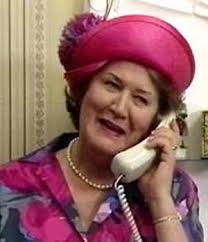
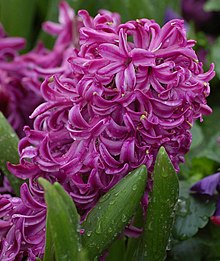
The hyacinth bean is new to me this year, but the bloom and the BritCom, starring Patricia Routledge as Hyacinth Bucket (pronounced BOO-kay) are old friends. (Please do check out these picture links! They present a great progression of colors.)
Mentioned in my seed stories, part 3, the hyacinth bean (HB) is not really a bean but a member of the pea family -- fabaceae. My packet contained only ten seeds, of which I gave five to John. On March 1, I planted my five in biodegradable jiffy pots.* The seeds looked just like this, essentially a black-eyed pea with the colors reversed. All the jiffy pots went outdoors only a couple of days after planting, possibly a mistake since the nights were really cold then.
Alas! Only one HB seed has germinated so far. Now I wish I'd planted only two or three -- or kept them inside while the others went out. After all, HB's natural habitat is mostly the tropical parts of Africa and Asia. We live and learn.
While HB lags, Hyacinthus orientalis (HO) is flourishing in the front yard. It's a well-naturalized garden variety hyacinth with loosely packed, bell-shaped blue flowers, generally not more than twelve to a stalk. Fancier varieties, used for forcing indoors and mass plantings in well manicured beds, produce tight clusters of flowers in a wide range of colors. If I divide the HO bulbs next fall as planned, I may get more bells per bulb.
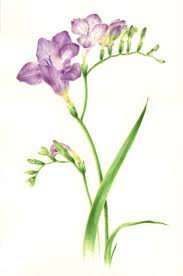
HO starts to open up as Freesia is almost past its prime, so there's a sort of changing of the guard in process. HO is taller and straighter, and the unopened buds look like grape hyacinths on stilts. They provide an interesting contract as they rise above floppy Freesias and the even floppier leaves of Star of Bethlehem (Ornithogalum umbellatum). Star of Bethlehem will end my parade of spring bulbs and leave the surrounding ground morning glory (convulvulus mauritanicus) to cover its subsiding leaves.
Hyacinth Bucket (pronounced BOO-kay) is a character in the BBC comedy Keeping Up Appearances (KUA), originally broadcast from 1990 to 1995 and re-run (I hope perennially) on PBS. What does this have to do with the aforementioned HB and HO? It's just a word association thing, and word association, it seems, is the governing principle of this blog. I can't think of hyacinth (the flower or bean) without thinking of Hyacinth (the character), who instructs her husband Richard to "Smile more when you're gardening, Richard!" The idea is for Richard to look like he enjoys gardening (which he doesn't), so that the neighbors will think the Buckets can afford a gardener but don't hire one because Richard prefers to do it himself.
Looking up links on KUA, I learned that star Patricia Routledge also played the 12th-century nun Hildegard von Bingen in 1994. That reminds me! I must get started on my posting for Ada Lovelace Day, coming up next Wednesday.
-----
*I planted 40 jiffy pots that night. The fastest seeds to germinate were hollyhocks, followed by corn and Swiss chard.
Mentioned in my seed stories, part 3, the hyacinth bean (HB) is not really a bean but a member of the pea family -- fabaceae. My packet contained only ten seeds, of which I gave five to John. On March 1, I planted my five in biodegradable jiffy pots.* The seeds looked just like this, essentially a black-eyed pea with the colors reversed. All the jiffy pots went outdoors only a couple of days after planting, possibly a mistake since the nights were really cold then.
Alas! Only one HB seed has germinated so far. Now I wish I'd planted only two or three -- or kept them inside while the others went out. After all, HB's natural habitat is mostly the tropical parts of Africa and Asia. We live and learn.
While HB lags, Hyacinthus orientalis (HO) is flourishing in the front yard. It's a well-naturalized garden variety hyacinth with loosely packed, bell-shaped blue flowers, generally not more than twelve to a stalk. Fancier varieties, used for forcing indoors and mass plantings in well manicured beds, produce tight clusters of flowers in a wide range of colors. If I divide the HO bulbs next fall as planned, I may get more bells per bulb.
HO starts to open up as Freesia is almost past its prime, so there's a sort of changing of the guard in process. HO is taller and straighter, and the unopened buds look like grape hyacinths on stilts. They provide an interesting contract as they rise above floppy Freesias and the even floppier leaves of Star of Bethlehem (Ornithogalum umbellatum). Star of Bethlehem will end my parade of spring bulbs and leave the surrounding ground morning glory (convulvulus mauritanicus) to cover its subsiding leaves.
Hyacinth Bucket (pronounced BOO-kay) is a character in the BBC comedy Keeping Up Appearances (KUA), originally broadcast from 1990 to 1995 and re-run (I hope perennially) on PBS. What does this have to do with the aforementioned HB and HO? It's just a word association thing, and word association, it seems, is the governing principle of this blog. I can't think of hyacinth (the flower or bean) without thinking of Hyacinth (the character), who instructs her husband Richard to "Smile more when you're gardening, Richard!" The idea is for Richard to look like he enjoys gardening (which he doesn't), so that the neighbors will think the Buckets can afford a gardener but don't hire one because Richard prefers to do it himself.
Looking up links on KUA, I learned that star Patricia Routledge also played the 12th-century nun Hildegard von Bingen in 1994. That reminds me! I must get started on my posting for Ada Lovelace Day, coming up next Wednesday.
-----
*I planted 40 jiffy pots that night. The fastest seeds to germinate were hollyhocks, followed by corn and Swiss chard.
Monday, March 15, 2010
on hold
Oh well, today has been quite productive, with getting ready for a candidate forum to be held tomorrow night, and talking to John about improvements to our Idaho 'vacation home.'
It seems that our Idaho water heater is on the OLD electrical line. So when it goes out, it requires replacement with an old-fashioned FUSE. Yes! The kind of glass-topped fuse you screw in.
Our Idaho house has two parallel electrical systems. The one Steve's dad put in when he 'modernized' the house in 1943 and the one Steve and Phil put in some time in the 1980s when their parents moved back to the farmhouse on a full-time basis. Those two electrical systems have existed side by side all this time.
Well I'm off hold at last - basically 10 minutes -- and am hoping to write more about the Idaho electrical system(s) in a future post or two.
The folks who put me on hold are promising to call me back. I'm not holding my breath.
Thursday, March 11, 2010
can you give me five minutes?
OMG! I was on the phone with Robyn at the LWV office just now, and she said, "Can you give me five minutes?" This, after I'd waited through a couple minutes of music on hold, which I hate unless it's baroque chamber music.
I told Robyn, in the nicest possible way, that I could not GIVE her five minutes because I did not HAVE five minutes. In my book, I explained, time is not HAD but USED. Well, it's HAD in the sense that everyone gets an equal amount (24 hours a day).
So I thought, why not USE the time Robyn wants GIVEN to her to write something and post it on my blog? I'll just keep writing until she calls me back (unless it takes her a really really long time), and then I'll post the blog. Fun, huh? Also an experiment that
[ here's where Robyn called me back ]
reminds me of Ada Lovelace Day (coming up on March 24) and my pledge to post a blog on that day about an important woman in technology or science.
Last year, my Lovelace Day post was about Grace Murray Hopper, USN (1906 - 1992). I didn't have my own blog spot at that time, so posted it on the generic page set aside for blogless bloggers.

So what does all this Lovelace/Hopper stuff have to do with the giving (or not) of five minutes? One of Hopper's signature questions was: "How do you value your data?" She illustrated her answer by pulling out a piece of wire and talking about how much time it took a certain amount of data to travel through that wire. At least that's my recollection, which of course may be flawed.
Somehow I'd like to try to establish the value of five minutes by calculating the amount of writing I can do in that amount of time. I used to assign students to write a '15 Minute Essay' (in class) on a surprise topic at least once a week. I would write along with them. Of course I had the advantage of knowing the topic in advance, but it's surprising how much a person can write in 15 minutes. By the end of the semester, most students (and I!) could write considerably more in 15 minutes than they wrote at the beginning.
A compulsive knitter of my mother's acquaintance (this was back in the 1950's) used to value her time in terms of how many yards or skeins of yarn she'd managed to use. I think this is very similar to the concept of Murray's piece of wire and my blog-length measure -- whatever it turns out to be.
I'll come back to this post and add a bunch of links later.* Right now I don't HAVE TIME!
-----
* DONE, at 3:23 pm!
I told Robyn, in the nicest possible way, that I could not GIVE her five minutes because I did not HAVE five minutes. In my book, I explained, time is not HAD but USED. Well, it's HAD in the sense that everyone gets an equal amount (24 hours a day).
So I thought, why not USE the time Robyn wants GIVEN to her to write something and post it on my blog? I'll just keep writing until she calls me back (unless it takes her a really really long time), and then I'll post the blog. Fun, huh? Also an experiment that
[ here's where Robyn called me back ]
reminds me of Ada Lovelace Day (coming up on March 24) and my pledge to post a blog on that day about an important woman in technology or science.
Last year, my Lovelace Day post was about Grace Murray Hopper, USN (1906 - 1992). I didn't have my own blog spot at that time, so posted it on the generic page set aside for blogless bloggers.
So what does all this Lovelace/Hopper stuff have to do with the giving (or not) of five minutes? One of Hopper's signature questions was: "How do you value your data?" She illustrated her answer by pulling out a piece of wire and talking about how much time it took a certain amount of data to travel through that wire. At least that's my recollection, which of course may be flawed.
Somehow I'd like to try to establish the value of five minutes by calculating the amount of writing I can do in that amount of time. I used to assign students to write a '15 Minute Essay' (in class) on a surprise topic at least once a week. I would write along with them. Of course I had the advantage of knowing the topic in advance, but it's surprising how much a person can write in 15 minutes. By the end of the semester, most students (and I!) could write considerably more in 15 minutes than they wrote at the beginning.
A compulsive knitter of my mother's acquaintance (this was back in the 1950's) used to value her time in terms of how many yards or skeins of yarn she'd managed to use. I think this is very similar to the concept of Murray's piece of wire and my blog-length measure -- whatever it turns out to be.
I'll come back to this post and add a bunch of links later.* Right now I don't HAVE TIME!
-----
* DONE, at 3:23 pm!