In my continuing quest for personal organization,* I have felt that perhaps I should be planning my blog postings more carefully. In a sense this is a non-issue, because I've never had a problem finding topics. In line with my simple theme of pre[and/or post]-occupations, I simply write about what's on my mind. Problems may arise, however, when an issue is 'date-sensitive.'
Having learned late in 2010 that the Pantone company announces their Color of the Year in January, I have taken pains to post about it on January 31 of 2011 and 2012, and I look forward to doing so in 2013 and beyond. On the other hand, I was chagrined to have missed National Bean Day this year after covering it lavishly on January 7, 2011, only one day late.
In January of this year, I set a goal of writing two blog posts per week, and in the seven weeks since January 9 I have in fact achieved this goal by writing fourteen. Feeling very good about this, as promised by my personal organization guru at Simplify101.com, I have turned my attention to March's postoccupations.
Ada Lovelace Day would seem to loom on March 24, as it did when I last posted about it, in honor of Beverly Grigsby. But wait! That post was written in 2010, and my post in honor of Grace Murray Hopper was written in 2009! So what happened to Ada Lovelace Day in 2011? Googling reveals that it was celebrated on October 7 -- not with the traditional barrage of blogging, but with a 'live' event in the U.K. and a few dribs and drabs of videos and blog posts.
Ada Lovelace Day 2012 has been set for October 16, and I have subscribed to the FindingAda blog and requested to join the Ada Lovelace Day group on Facebook, so as to keep abreast of the latest developments. But wait (yes, again)! All of the FindingAda posts -- even the announcement of the 2011 event -- are dated on a single day (February 9, 2012), and the Facebook page had no postings between March 3, 2011 (announcing the 2011 event) and February 22, 2012, when the group's 'admin' stated: "Oops, forgot we had an FB page! Anyway, yes, 16 October this year! Get the date in your diary and keep an eye on Twitter."
I have indeed made a note of the new date. Keeping an eye on Twitter, however, is beyond my level of commitment to Ada Lovelace Day, and frankly I don't have a lot of faith in the event's other modes of communication. One of FindingAda's February 9 postings revealed that the original blog had been "severely hacked over Christmas" and was in the process of being "rescued." This is sad, seeing that Ada Lovelace Day's mission is to provide role models for women in the 'STEM' disciplines: Science, Technology, Engineering, and Math.
I certainly am in favor of role models, and sometime between now and October I should certainly find one to honor on Ada Lovelace Day. In fact, I have two very special candidates in mind. It's nice to know that I have several months to choose between them.
- - - - -
*Currently this takes the form of almost continuous enrollment in the excellent on-line workshops given at Simplify 101.
Showing posts with label Ada Lovelace Day. Show all posts
Showing posts with label Ada Lovelace Day. Show all posts
Sunday, February 26, 2012

Wednesday, March 24, 2010
beverly grigsby -- my honoree for ada lovelace day
Happy Ada Lovelace Day!
My honoree this year (my 2nd year of participation, and the 2nd year of the event), is Beverly Grigsby. Read Beverly's bio by Jeannie Pool, her fellow member of IAWM, the International Alliance of Women in Music.
When Ada Lovelace suggested that Charles Babbage's Analytical Engine “might compose elaborate and scientific pieces of music of any degree of complexity or extent,” she prefigured the works of Beverly Grigsby, who is known not only for her original compositions but also for her uncanny ability to replicate and stretch or shrink tiny segments of orchestral music and patch them seamlessly into film scores.
Sometime during the 80s, I asked Beverly to speak at a meeting of the L.A. Chapter of Association for Women in Computing (AWC). Naturally, she knocked everyone's socks off with her music and her technical savvy, but the "just for fun" anecdote that has stayed with me ever since was her telling about her pride in her flawless manicure. As a traditional pianist, she had had to keep her nails short, but the midi keyboard's gentle touch allowed her to maintain a fashionable set of long, bright red nails. "Look at these nails, girls!" Beverly said. "And remember, I'm 60, not 30!"
If Ada Lovelace had not died at age 36, I like to think that in her 60's and beyond she'd have been very much like Beverly Grigsby: glamorous, gregarious, productive -- a 'technoid' beyond stereotypes.
My honoree this year (my 2nd year of participation, and the 2nd year of the event), is Beverly Grigsby. Read Beverly's bio by Jeannie Pool, her fellow member of IAWM, the International Alliance of Women in Music.
When Ada Lovelace suggested that Charles Babbage's Analytical Engine “might compose elaborate and scientific pieces of music of any degree of complexity or extent,” she prefigured the works of Beverly Grigsby, who is known not only for her original compositions but also for her uncanny ability to replicate and stretch or shrink tiny segments of orchestral music and patch them seamlessly into film scores.
Sometime during the 80s, I asked Beverly to speak at a meeting of the L.A. Chapter of Association for Women in Computing (AWC). Naturally, she knocked everyone's socks off with her music and her technical savvy, but the "just for fun" anecdote that has stayed with me ever since was her telling about her pride in her flawless manicure. As a traditional pianist, she had had to keep her nails short, but the midi keyboard's gentle touch allowed her to maintain a fashionable set of long, bright red nails. "Look at these nails, girls!" Beverly said. "And remember, I'm 60, not 30!"
If Ada Lovelace had not died at age 36, I like to think that in her 60's and beyond she'd have been very much like Beverly Grigsby: glamorous, gregarious, productive -- a 'technoid' beyond stereotypes.
Friday, March 19, 2010
hyacinth: bean, bloom, britcom
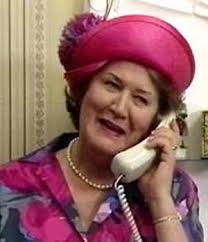
The hyacinth bean is new to me this year, but the bloom and the BritCom, starring Patricia Routledge as Hyacinth Bucket (pronounced BOO-kay) are old friends. (Please do check out these picture links! They present a great progression of colors.)
Mentioned in my seed stories, part 3, the hyacinth bean (HB) is not really a bean but a member of the pea family -- fabaceae. My packet contained only ten seeds, of which I gave five to John. On March 1, I planted my five in biodegradable jiffy pots.* The seeds looked just like this, essentially a black-eyed pea with the colors reversed. All the jiffy pots went outdoors only a couple of days after planting, possibly a mistake since the nights were really cold then.
Alas! Only one HB seed has germinated so far. Now I wish I'd planted only two or three -- or kept them inside while the others went out. After all, HB's natural habitat is mostly the tropical parts of Africa and Asia. We live and learn.
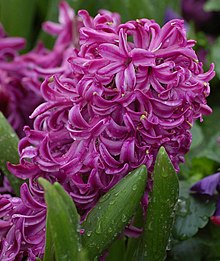
While HB lags, Hyacinthus orientalis (HO) is flourishing in the front yard. It's a well-naturalized garden variety hyacinth with loosely packed, bell-shaped blue flowers, generally not more than twelve to a stalk. Fancier varieties, used for forcing indoors and mass plantings in well manicured beds, produce tight clusters of flowers in a wide range of colors. If I divide the HO bulbs next fall as planned, I may get more bells per bulb.
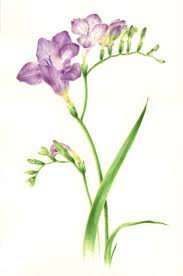
HO starts to open up as Freesia is almost past its prime, so there's a sort of changing of the guard in process. HO is taller and straighter, and the unopened buds look like grape hyacinths on stilts. They provide an interesting contract as they rise above floppy Freesias and the even floppier leaves of Star of Bethlehem (Ornithogalum umbellatum). Star of Bethlehem will end my parade of spring bulbs and leave the surrounding ground morning glory (convulvulus mauritanicus) to cover its subsiding leaves.
Hyacinth Bucket (pronounced BOO-kay) is a character in the BBC comedy Keeping Up Appearances (KUA), originally broadcast from 1990 to 1995 and re-run (I hope perennially) on PBS. What does this have to do with the aforementioned HB and HO? It's just a word association thing, and word association, it seems, is the governing principle of this blog. I can't think of hyacinth (the flower or bean) without thinking of Hyacinth (the character), who instructs her husband Richard to "Smile more when you're gardening, Richard!" The idea is for Richard to look like he enjoys gardening (which he doesn't), so that the neighbors will think the Buckets can afford a gardener but don't hire one because Richard prefers to do it himself.
Looking up links on KUA, I learned that star Patricia Routledge also played the 12th-century nun Hildegard von Bingen in 1994. That reminds me! I must get started on my posting for Ada Lovelace Day, coming up next Wednesday.
-----
*I planted 40 jiffy pots that night. The fastest seeds to germinate were hollyhocks, followed by corn and Swiss chard.
Mentioned in my seed stories, part 3, the hyacinth bean (HB) is not really a bean but a member of the pea family -- fabaceae. My packet contained only ten seeds, of which I gave five to John. On March 1, I planted my five in biodegradable jiffy pots.* The seeds looked just like this, essentially a black-eyed pea with the colors reversed. All the jiffy pots went outdoors only a couple of days after planting, possibly a mistake since the nights were really cold then.
Alas! Only one HB seed has germinated so far. Now I wish I'd planted only two or three -- or kept them inside while the others went out. After all, HB's natural habitat is mostly the tropical parts of Africa and Asia. We live and learn.
While HB lags, Hyacinthus orientalis (HO) is flourishing in the front yard. It's a well-naturalized garden variety hyacinth with loosely packed, bell-shaped blue flowers, generally not more than twelve to a stalk. Fancier varieties, used for forcing indoors and mass plantings in well manicured beds, produce tight clusters of flowers in a wide range of colors. If I divide the HO bulbs next fall as planned, I may get more bells per bulb.
HO starts to open up as Freesia is almost past its prime, so there's a sort of changing of the guard in process. HO is taller and straighter, and the unopened buds look like grape hyacinths on stilts. They provide an interesting contract as they rise above floppy Freesias and the even floppier leaves of Star of Bethlehem (Ornithogalum umbellatum). Star of Bethlehem will end my parade of spring bulbs and leave the surrounding ground morning glory (convulvulus mauritanicus) to cover its subsiding leaves.
Hyacinth Bucket (pronounced BOO-kay) is a character in the BBC comedy Keeping Up Appearances (KUA), originally broadcast from 1990 to 1995 and re-run (I hope perennially) on PBS. What does this have to do with the aforementioned HB and HO? It's just a word association thing, and word association, it seems, is the governing principle of this blog. I can't think of hyacinth (the flower or bean) without thinking of Hyacinth (the character), who instructs her husband Richard to "Smile more when you're gardening, Richard!" The idea is for Richard to look like he enjoys gardening (which he doesn't), so that the neighbors will think the Buckets can afford a gardener but don't hire one because Richard prefers to do it himself.
Looking up links on KUA, I learned that star Patricia Routledge also played the 12th-century nun Hildegard von Bingen in 1994. That reminds me! I must get started on my posting for Ada Lovelace Day, coming up next Wednesday.
-----
*I planted 40 jiffy pots that night. The fastest seeds to germinate were hollyhocks, followed by corn and Swiss chard.
Thursday, March 11, 2010
can you give me five minutes?
OMG! I was on the phone with Robyn at the LWV office just now, and she said, "Can you give me five minutes?" This, after I'd waited through a couple minutes of music on hold, which I hate unless it's baroque chamber music.
I told Robyn, in the nicest possible way, that I could not GIVE her five minutes because I did not HAVE five minutes. In my book, I explained, time is not HAD but USED. Well, it's HAD in the sense that everyone gets an equal amount (24 hours a day).
So I thought, why not USE the time Robyn wants GIVEN to her to write something and post it on my blog? I'll just keep writing until she calls me back (unless it takes her a really really long time), and then I'll post the blog. Fun, huh? Also an experiment that
[ here's where Robyn called me back ]
reminds me of Ada Lovelace Day (coming up on March 24) and my pledge to post a blog on that day about an important woman in technology or science.
Last year, my Lovelace Day post was about Grace Murray Hopper, USN (1906 - 1992). I didn't have my own blog spot at that time, so posted it on the generic page set aside for blogless bloggers.

So what does all this Lovelace/Hopper stuff have to do with the giving (or not) of five minutes? One of Hopper's signature questions was: "How do you value your data?" She illustrated her answer by pulling out a piece of wire and talking about how much time it took a certain amount of data to travel through that wire. At least that's my recollection, which of course may be flawed.
Somehow I'd like to try to establish the value of five minutes by calculating the amount of writing I can do in that amount of time. I used to assign students to write a '15 Minute Essay' (in class) on a surprise topic at least once a week. I would write along with them. Of course I had the advantage of knowing the topic in advance, but it's surprising how much a person can write in 15 minutes. By the end of the semester, most students (and I!) could write considerably more in 15 minutes than they wrote at the beginning.
A compulsive knitter of my mother's acquaintance (this was back in the 1950's) used to value her time in terms of how many yards or skeins of yarn she'd managed to use. I think this is very similar to the concept of Murray's piece of wire and my blog-length measure -- whatever it turns out to be.
I'll come back to this post and add a bunch of links later.* Right now I don't HAVE TIME!
-----
* DONE, at 3:23 pm!
I told Robyn, in the nicest possible way, that I could not GIVE her five minutes because I did not HAVE five minutes. In my book, I explained, time is not HAD but USED. Well, it's HAD in the sense that everyone gets an equal amount (24 hours a day).
So I thought, why not USE the time Robyn wants GIVEN to her to write something and post it on my blog? I'll just keep writing until she calls me back (unless it takes her a really really long time), and then I'll post the blog. Fun, huh? Also an experiment that
[ here's where Robyn called me back ]
reminds me of Ada Lovelace Day (coming up on March 24) and my pledge to post a blog on that day about an important woman in technology or science.
Last year, my Lovelace Day post was about Grace Murray Hopper, USN (1906 - 1992). I didn't have my own blog spot at that time, so posted it on the generic page set aside for blogless bloggers.
So what does all this Lovelace/Hopper stuff have to do with the giving (or not) of five minutes? One of Hopper's signature questions was: "How do you value your data?" She illustrated her answer by pulling out a piece of wire and talking about how much time it took a certain amount of data to travel through that wire. At least that's my recollection, which of course may be flawed.
Somehow I'd like to try to establish the value of five minutes by calculating the amount of writing I can do in that amount of time. I used to assign students to write a '15 Minute Essay' (in class) on a surprise topic at least once a week. I would write along with them. Of course I had the advantage of knowing the topic in advance, but it's surprising how much a person can write in 15 minutes. By the end of the semester, most students (and I!) could write considerably more in 15 minutes than they wrote at the beginning.
A compulsive knitter of my mother's acquaintance (this was back in the 1950's) used to value her time in terms of how many yards or skeins of yarn she'd managed to use. I think this is very similar to the concept of Murray's piece of wire and my blog-length measure -- whatever it turns out to be.
I'll come back to this post and add a bunch of links later.* Right now I don't HAVE TIME!
-----
* DONE, at 3:23 pm!
Subscribe to:
Posts (Atom)