Sunday, September 13, 2015

kinsey and me (too), part 2

Not much is said of the (too) in kinsey and me (too), part 1, unless you surmised that I too would stay awake to "read Nancy Drew mysteries on hot summer nights," as Sue, Kit, and Kinsey did. This post will go back and pick up on the 'me too' thread.

I have always felt a kinship with Kinsey Millhone, although I could never follow her regimen of running three miles a day (five days a week), and I have no training in martial arts or marksmanship. I appreciate to the fullest Kinsey's irreverence for most social mores and I endorse her minimalist lifestyle: small cars, a casual wardrobe (with one good black dress/tunic for emergencies), and readiness to travel at the drop of a hat. I love peanut-butter and pickle sandwiches, but am not addicted to the fast food Kinsey shamelessly devours in her car. Since high school, 3x5 index cards have been my preferred medium for important notes and lists, and Kinsey always carries a big bundle of cards in her shoulder bag.

Having spent memorable times in Santa Barbara, I enjoy the settings of Sue Grafton's novels. Her fictional Santa Teresa and neighboring cities including Colgate, Montebello, Perdido, and Cottonwood are thinly veiled versions of towns in the greater Santa Barbara/Ventura area. When Kinsey travels outside this area, 'real' place names are used: Reno, San Francisco, Bakersfield, Los Angeles, Beverly Hills, Culver City.

Getting to know landmarks and characters through a series of novels makes a reader feel at home. This is true in Anthony Trollope's Barsetshire and Caroline Keene's* River Heights, as well as in Sue Grafton's Santa Teresa. Kinsey's friends are my friends: lovable landlord Henry Pitts, restaurateur Rosie, confidante Vera, the enigmatic Dietz, and a cohort of officers from the Santa Teresa Police Department.

My kinship with Sue Grafton is simpler in a sense, but more complex in others. She was born in 1940, I in 1941; we came along at the tail end of the 'silent generation (1925-1942),'** born before Pearl Harbor yet shaped by our parents' experiences of the Great Depression and World War II.


I have watched Grafton age gracefully through book-jacket photos taken from 1983 to the present, and in each one she looks like someone I would meet at a community event or remember from my high school class of 1958. Just look at those dimples!

With this image in mind it was fun to spot Grafton's dimples on the face of evil Edna Shallenbarger, an embezzler who skips bail to appear in X. Kinsey tells us: "She smiled with her lips together, creating a dimple in each cheek. The effect was curious. Malice surfaced and then disappeared" (pp. 154-55). I sensed that Sue Grafton has used her dimples to great advantage throughout her life, and I now I will continue to look for dimples on the faces of characters in her fiction.

It's tempting, but I do not intend to count the ways that reading Kinsey and Me has informed -- and will continue to inform -- my reading and re-reading of the Kinsey Millhone mysteries, but I do want to comment on the 'me too' effect in Grafton's X. Don't worry. No 'spoiler alert' is needed.

X is set during a serious drought that lasted from 1986 to 1991, and all the households in Santa Teresa are being asked to cut back voluntarily on their water use. Henry Pitts is trying hard to comply by taking out his thirsty lawn, putting in a drip irrigation system, and learning about gray water. At times I felt like I was reading my own blog:

Weather pundits warn that California's drought is not over . . . . Water-saving measures abound: days and hours (minutes!) of watering time are severely limited, cities pay $2.00 per square foot and more for residential lawn removal, and courses in xeriscaping appear in college extension catalogs. People joke about the 'water police.'
But where Henry's compliance is still voluntary, we in Culver City have moved to the mandatory level. A fine of $250 will be levied any time we are caught running potable water outdoors, at times other than before 8:00 a.m. or after 6:00 p.m. on Tuesdays and Saturdays. One neighbor in particular likes to phone the water company whenever she spots a violation.

From time to time I have written about my preoccupation with organizing our household effects. Sandra Felton, one of my current gurus in this area, recommends a regimen of three C's to use when decluttering: consolidate, containerize, condense. Following this procedure, I am currently consolidating and containerizing a vast number of things -- mostly yarn and other craft supplies -- into an indexed series of Bankers Boxes (about 30 so far, with no end in sight).

When Kinsey talks about assembling Bankers Boxes I once again feel that I am astride that fine line between fiction and fact. Kinsey uses her knowledge of Bankers Box construction (and deconstruction) to find an important clue about X's worst villain, and I can see just exactly how she did it. Luckily, I don't think I'll need to follow her example. But who knows? Someday I might want to conceal the details of a secret yarnbombing project. Where better than between layers of cardboard in Box Y?

- - - - - -
* collective pen name of a large group of underpaid ghostwriters working through the Stratemeyer Syndicate to create the Nancy Drew mystery series. 

** "too young to see action in World War II and too old to participate in the fun of the Summer of Love." See NPR's How Generations Get Nicknames.


Sunday, September 6, 2015

kinsey and me (too), part 1

Years ago, on the advice of a friend, I read G is for Gumshoe, Book 7 in Sue Grafton's alphabetical series of Kinsey Millhone mysteries. Soon thereafter I doubled back to A is for Alibi and kept with it through W is for Wasted -- the last few titles via my Kindle e-reader. Naturally I pre-ordered Book 24 ([is for whatever]), but what was I to read while I waited?

I noticed that Amazon's Sue Grafton page offered a book of short stories, Kinsey and Me, and so I ordered it even though I prefer longer fiction. The first half of Kinsey and Me features Kinsey Millhone, solving cases lickety-split within the rigid confines of the short-story format. The second features a fictionalized Sue Grafton, coming of age in Kentucky as 'Kit Blue' (née Conway) and coming to terms with the transitions in her alcoholic parents' self-destructive lives. The 'Kit Blue' stories were written during the decade following her mother's death. 'Vanessa' "died of an overdose of sleeping pills after extensive surgery so that the cause of death was probably listed as Despair" (pp. 273-74).

Besides the two groups of stories, Grafton presents three excellent essays which, for me, establish her credentials as a writer of elegant nonfiction. There's a preface in two parts: first describing the important differences between the mystery novel and the mystery short story, and then laying down a rationale for the writing of the more personal second part of the book. Between the two parts, "An Eye for an I" traces Grafton's own development as a reader and writer of crime fiction, alongside a detailed analysis of the genre. Finally the introduction to the second group of stories delves into the relationship between Sue, Kit, and Kinsey, starting with their largely unsupervised childhoods, free to read Nancy Drew mysteries on hot summer nights.

No doubt I could go on forever comparing and contrasting the parts of Kinsey and Me, but I'll stop with a couple of observations about style. The second half is written at what your English teacher would have called 'a higher level of diction' than anything you'll ever see in a Kinsey Millhone novel or story. It's a treat to witness Grafton take flight onto this more abstract level, but it's also a treat to see her come back down to the straightforward level on which Kinsey moves. I think the difference in style and tone is based on the fact that Kinsey is always moving into the future whereas Kit is always moving into the past.

I loved all the stories and essays in Kinsey and Me, but they would not keep me occupied until Book 24 finally downloaded itself onto my Kindle. Again, what was I to read?

Anthony Trollope (1815-1882) rarely disappoints, and the Trollope group on Facebook was discussing his one-volume novel Miss Mackenzie in July and August. I read it quickly while waiting for the group to begin its discussion, and signed up to write summaries for the last three chapters (28, 29, and 30). BTW this was the first time I have been able to stay in sync with the group schedule, and I greatly enjoyed the leisurely second reading, enhanced by comments and background material from other readers. I shared some info on aspects of Victorian life -- mourning attire and dinner-party service à la russe, for example -- and am looking forward to the group's next project.

Just as I stepped away from the rarefied atmosphere of Miss Mackenzie, Sue Grafton's X appeared on the menu of my Kindle Paperwhite. There was no 'is for' clause in the title. Grafton takes up this issue in a USA Today interview:
I first thought of using 'X is for Xenophobe' or Xenophobia, which suggests a fear of foreigners, but alas, not one single foreigner materialized in the course of the writing," Grafton says. "There's a box of files with an X on the lid, a Father Xavier, a married couple whose last name is Xanakis, and a missing painting of a xebec which is a three-masted sailing vessel, but none of these seemed to encompass the whole. Finally, it occurred to me that since I was the one who invented this 'rule' about '…is for…' I was surely entitled to break it.
Let's wait for another day to talk about reading X with the new insights afforded by Kinsey and Me.

635652322095155007-mottled-X


Monday, August 31, 2015

dragon fruit? it's really cereus!

On Friday, I posted cereus fruits, and on Saturday morning I walked out our front door to find our next-door neighbor talking with another gentleman on the sidewalk beside our cereus. The other gentleman kept saying something about dragon fruit.

I was in a hurry to get to our local fiesta, where I would be volunteering at the garden club's booth, so I didn't hang around to participate in the discussion. But dragon fruit kept nudging my brain and at last brought up the memory of a TV cooking show I'd seen where professional chefs were challenged to prepare an appetizer using dragon fruit. Yes! The picture in my memory matched a picture in my previous day's blog post: the fruit just splitting open and showing a wedge of something black and white.


Throughout the fiesta, I was thinking of dragon fruit. I couldn't wait to get home and do some googling. Info, of course, abounded. If you are already a dragon fruit aficionado, you may want to stop reading right now. But what I'm writing about is not so much dragon fruit per se as my delight at being set straight on something new that applies to my gardening efforts. I find it endlessly fascinating to explore the gaps between what I think I'm growing and what may eventually grace our table.

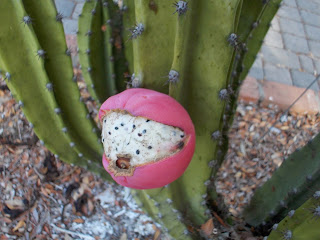
Here's the overview. Dragon fruit (aka pitaya) come in about four types, based on the variety of cereus that bears them. Our tree-like cactus produces bright red fruit shaped like hand grenades; inside they have black seeds distributed evenly through white pulp. Others, grown from plants with trailing stems, have pointed green scales (making them look more dragon-like) and may have either red or white pulp; the ones with red pulp are juicier and not as sweet as the ones with white pulp. Finally, most of the dragon fruit grown in Southeast Asia have yellow skin with green scales; again, pulp may be white or red. All are low in calories and high in antioxidants.


I found not only an account of the cooking show I'd seen last year, but also numerous videos on how to eat a dragon fruit. These ranged from a raucous piece by Chef Buck (must I warn you about the 'adult' language?) to a comprehensive farm-to-table presentation by a clean-cut young representative of  Tropical Fruit Growers of South Florida. The latter offers to have dragon fruit delivered right to your door. 


The idea of delivery raises the question: "How much does dragon fruit cost?" Again, there's a range. Chef Buck got his for $5.99 a pound, and this seems to be the low end. Amazon will send you a box of 3 -- the kind with green scales and white flesh -- for $28.95. Since most dragon fruit sold commercially weigh about a pound each, this is actually about the same price as the $10.00 per pound you're likely to pay in the upscale supermarkets (Whole Foods, Sprouts, Bristol Farms). Local farmers' markets offer them for as low as $7.00 per pound.


Today Steve and I counted four small dragon fruits on our tall cereus. With these and the possibility of an additional four or five from more recent blooms, I don't think we'll make a killing in the dragon fruit market. These are for home consumption, and while we wait for them to mature (probably not until November) we can start collecting recipes. On second thought, maybe just a small wedge will suffice for starters.


Friday, August 28, 2015

cereus fruits

Last Saturday, Steve's former colleagues Louise and Marsha came by to pick him up for an event. They were fascinated by our huge cereus,* which happened to be bearing a number of fat buds as well as some spent blossoms in various stages of dilapidation. We speculated about whether any would turn into fruit. Since Louise is a faithful reader of this blog, I started talking about a post I'd written last year about the fruit that had formed then. Louise said she hadn't seen it, so I thought I'd look it up and send her a link.

To make a long story somewhat shorter, my search was fruitless. I could visualize the photos I'd taken of the cereus fruit, but evidently I'd never even started a draft of the post or uploaded the photos into the draft. Some of the words I'd intended to use were still floating around in my head, but none had been written.

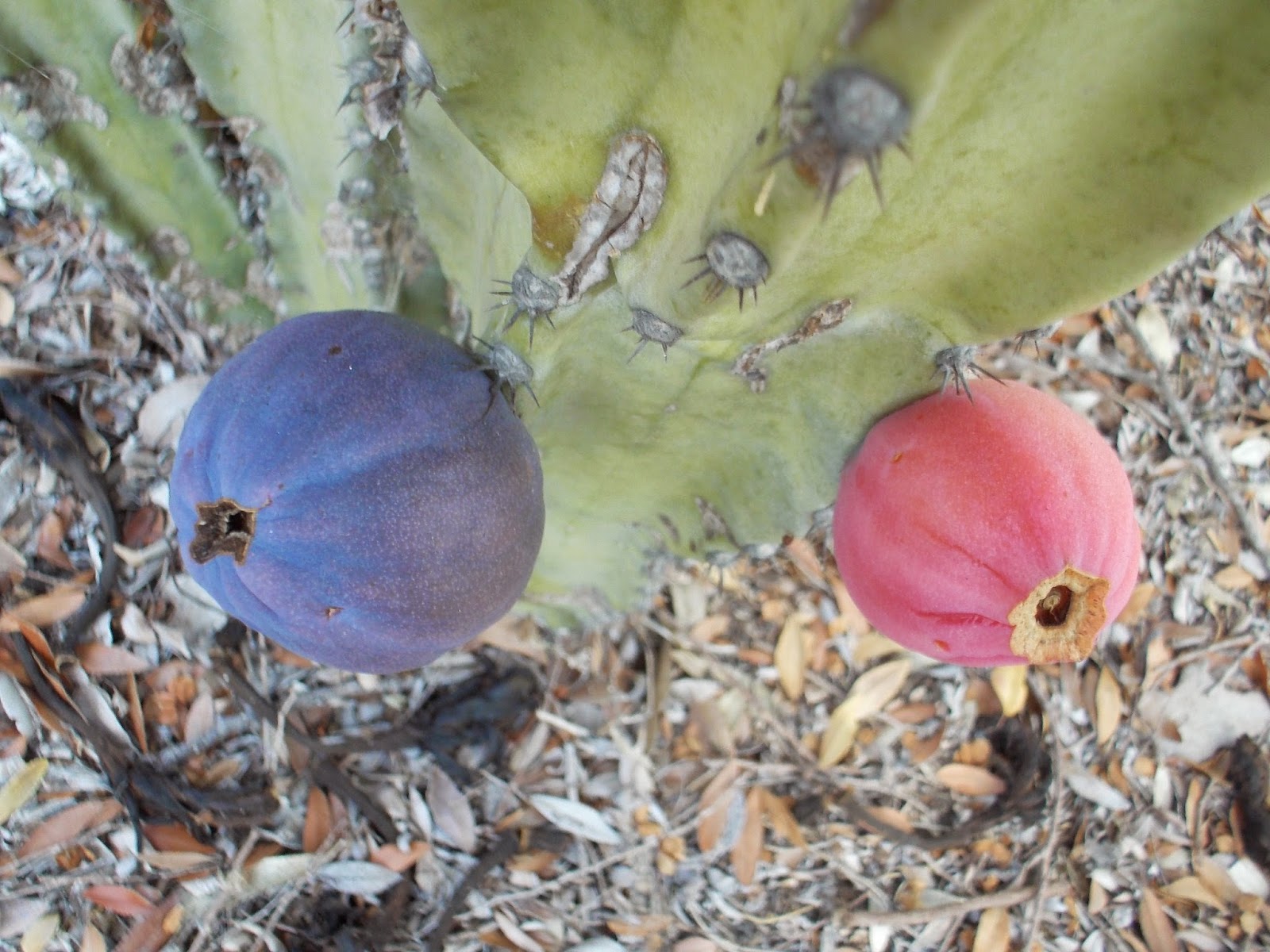
It was easy to find the photos, which I'd stored on the Internet on August 22, 2014. Let's look at them:


On the left is an unripe cereus fruit, and on the right a ripening fruit. The black things on the ground are dead blossoms, and the holes in the blossom ends of the fruits are where the pistil hung for several days after the other parts of the flower had dropped off. I know it's hard to believe that the darker fruit is the unripe one, but bear with me here.


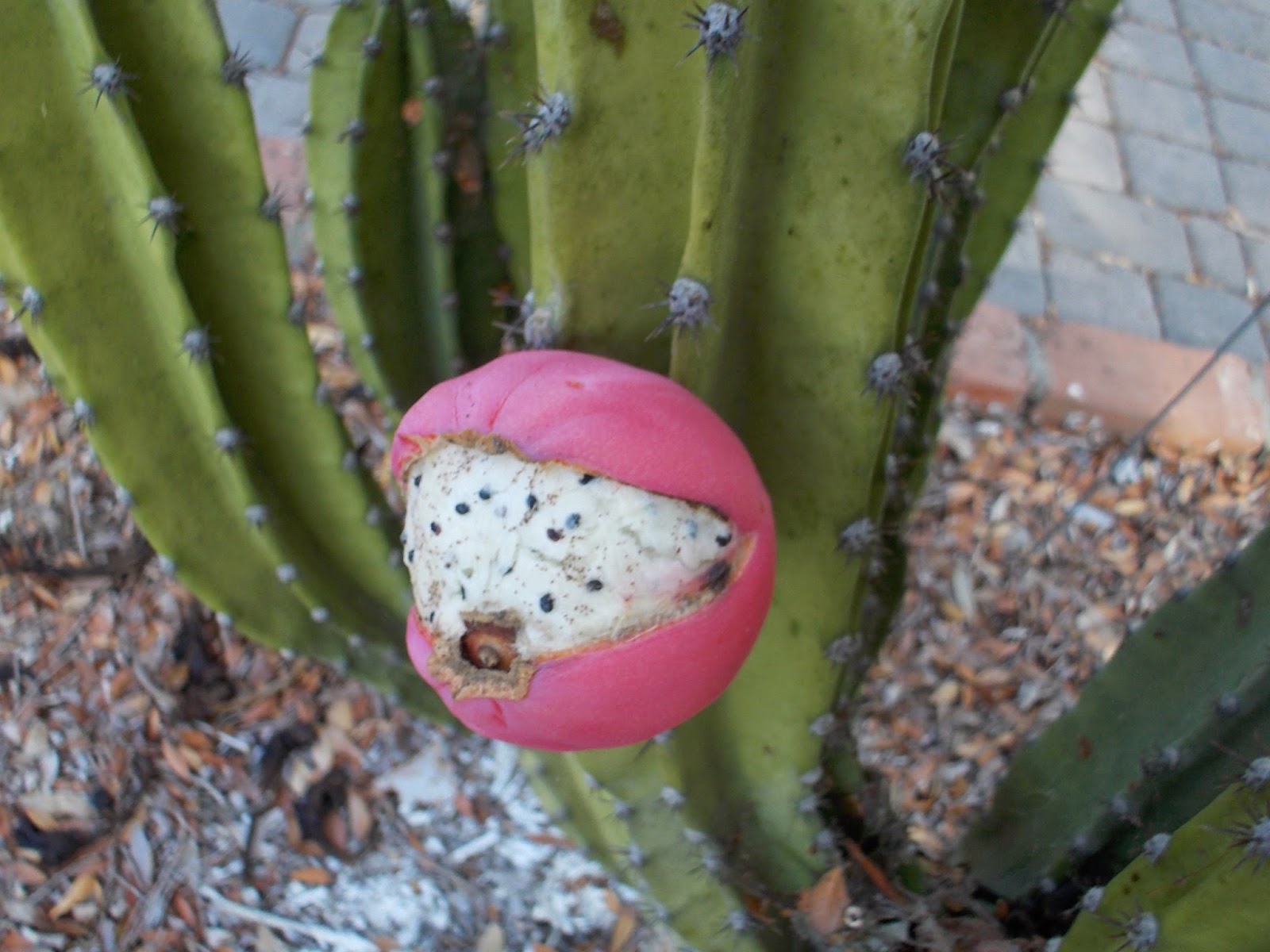
The stem end of the ripe fruit shown above has fattened up to strengthen its bond with the plant, and the fruit shown below has started to open up. I think it looks like some weird hors d'oeuvre (tomato stuffed with cream cheese and poppy seeds?), or maybe 'Pac-Man' rudely talking with his mouth full:


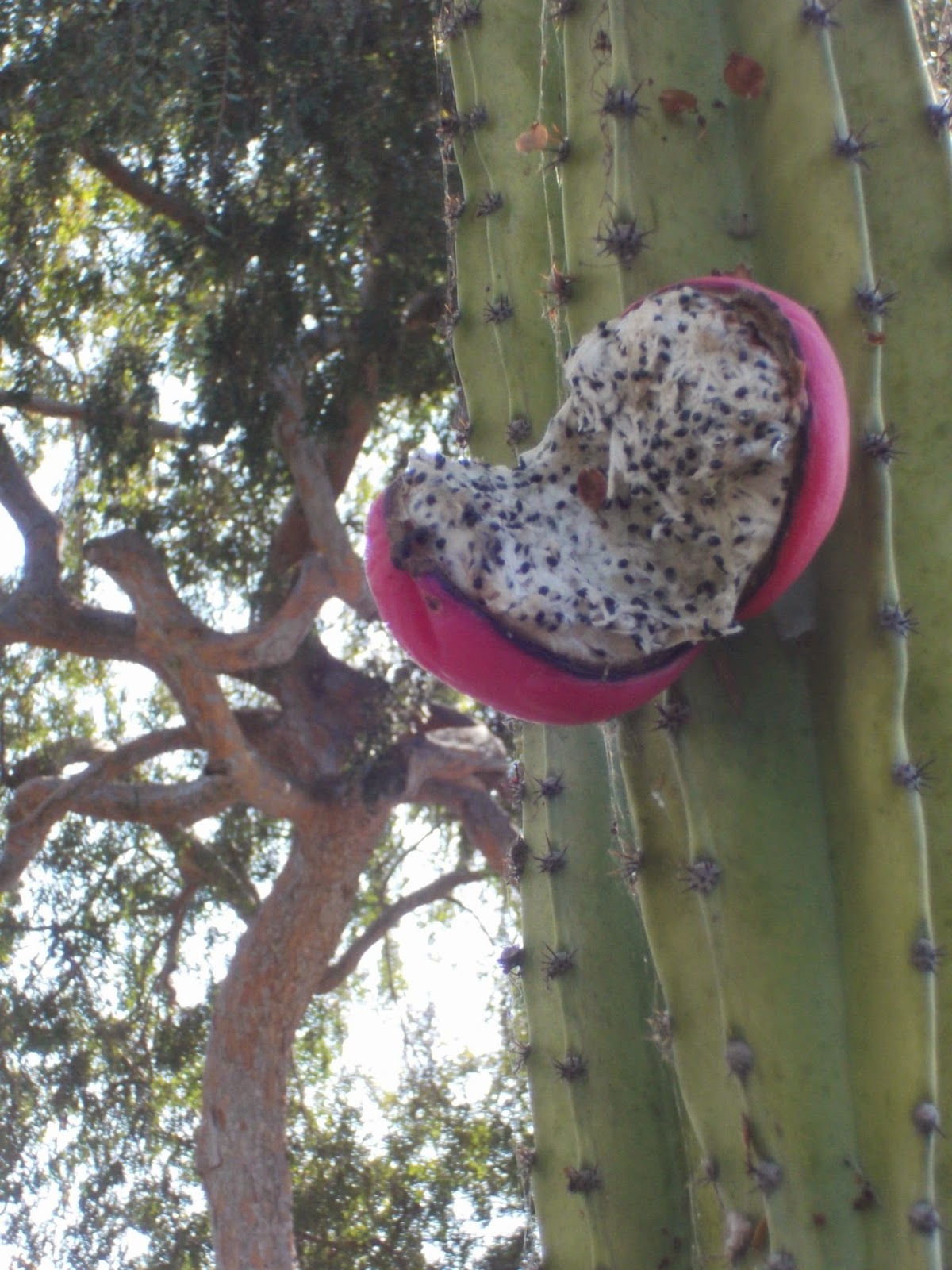
At last, the final shot, where our Pac-Man appears to be frothing at the mouth:


Steve bravely tasted the gooey substance and said it was quite sweet. I'm grateful that he lived to tell the tale and that Louise told me she hadn't read it.

Am I chagrined that I had not brought this story of plant procreation to light last year? Not especially. I think anyone who is serious about writing has a mental stash of texts, and sometimes there's a fine line between those that have actually been written and those that exist only as phantasms. 

For years I struggled to write a poem about the phenomenon of gardenias blooming in our garden in November and, after a lot of over-intellectualizing along with references to Platonism and Victorian literary theory, I came up with this haiku:

                  Spring bloom in fall month 
                  draws wonder and suspicion
                  yet smells sweet as June's.

- - - - - -
 * This venerable plant has appeared in two previous posts on this blog -- it's cereus (August 2012), and cereus business (November 2013)  -- but, as in so many of my botanical and horticultural ramblings, it merely provided a vehicle for other subjects: procrastination, the importance of theme in writing, the poetry of Thomas Gray, etc.

Wednesday, July 22, 2015

return of the sisters

Fantasy and failure marked my gardening efforts in 2010. I bought a plethora of seeds, set out innumerable tomatoes, and reaped almost nothing. Perhaps my most pathetic failure was the Native American three sisters tableau (corn, beans, squash) I started in the front garden, where only the pervasive, quasi-perennial scarlet runner beans (SRB) survived to haunt me this year.

Older and wiser, I sorted my seeds this spring and found many from 2010's shopping spree. All these, along with any purchased before 2014, have gone to the landfill to sprout or rot as conditions allow. I envision a tangle of SRB infesting someone's moldy sneaker.

Last fall, as you may be aware, I had an epiphany on the value of companion planting, and this, followed by my attempts to grow chayote squash and my success with Peruvian red lima beans (I try to remember to pronounce it LEE-mah, but cannot overcome my central Ohio heritagein the general area of LYE-muh). Thus when I transplanted three struggling chayote plants to where they could climb a south-facing wooden fence, I purposely created a pre-Columbian environment for them by giving each one a companion Peruvian lima bean. Additional pole beans and cukes have joined the party, which may also accommodate a few stalks of corn when all is said and done.

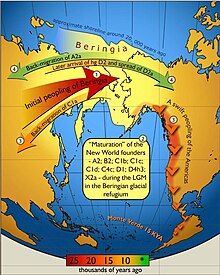
Where the chayotes had originally been planted along a north-facing fence, I have gone almost whole hog with the three sisters concept: corn, bush beans, miniature pumpkins, and yellow crookneck squash. I say "almost whole hog" because half of the bush beans are edamame, native to Japan. According to Wikipedia, "The earliest documented reference to the term edamame dates from the year 1275, when the Japanese monk Nichiren wrote a note thanking a parishioner for the gift of edamame he had left at the temple." Pre-Columbian, indeed! Could it be that beans, carried along by the south-bound immigrants who grew them and passed them along to the Conquistadors, were brought to the Western Hemisphere via the prehistoric land bridge from Asia? But, if so, why didn't they take the edamames?


"History ain't what it used to be.*" When most of us were in school, American history started with Columbus, east was east and west was west, and we knew where our beans came from. 
- - - - -

*I'd like to attribute these words to someone, but the best I can do is refer you to Another History Blog. If you think Yogi Berra said it, you're close. His words were similar in style but different in content: "The future ain't what it used to be."


Saturday, July 18, 2015

nasturtiums restrained

In April of 2012, I learned that the 'Weed Watch' campaign includes nasturtium (Tropaeolum majus) among the species NOT to plant if we are to "Stop the Invasion" of plants that "fuel wildfires, degrade grazing land, contribute to soil erosion, clog streams and rivers, and increase the risk of flooding." Therefore I have exercised considerable restraint in allowing nasturtiums to appear in my garden. In winter and spring I let them take over the strip devoted to herbs and veggies and climb to the top of our chain link fence. When peas, beans, and tomatoes need the space, I rip the nasturtiums out and let their bouncy seeds fall to the ground, where they will almost immediately germinate. This 'second coming' of nasturtium plants is thinned repeatedly but allowed to play their traditional role as companion plants to attract pests away from wanted plants.

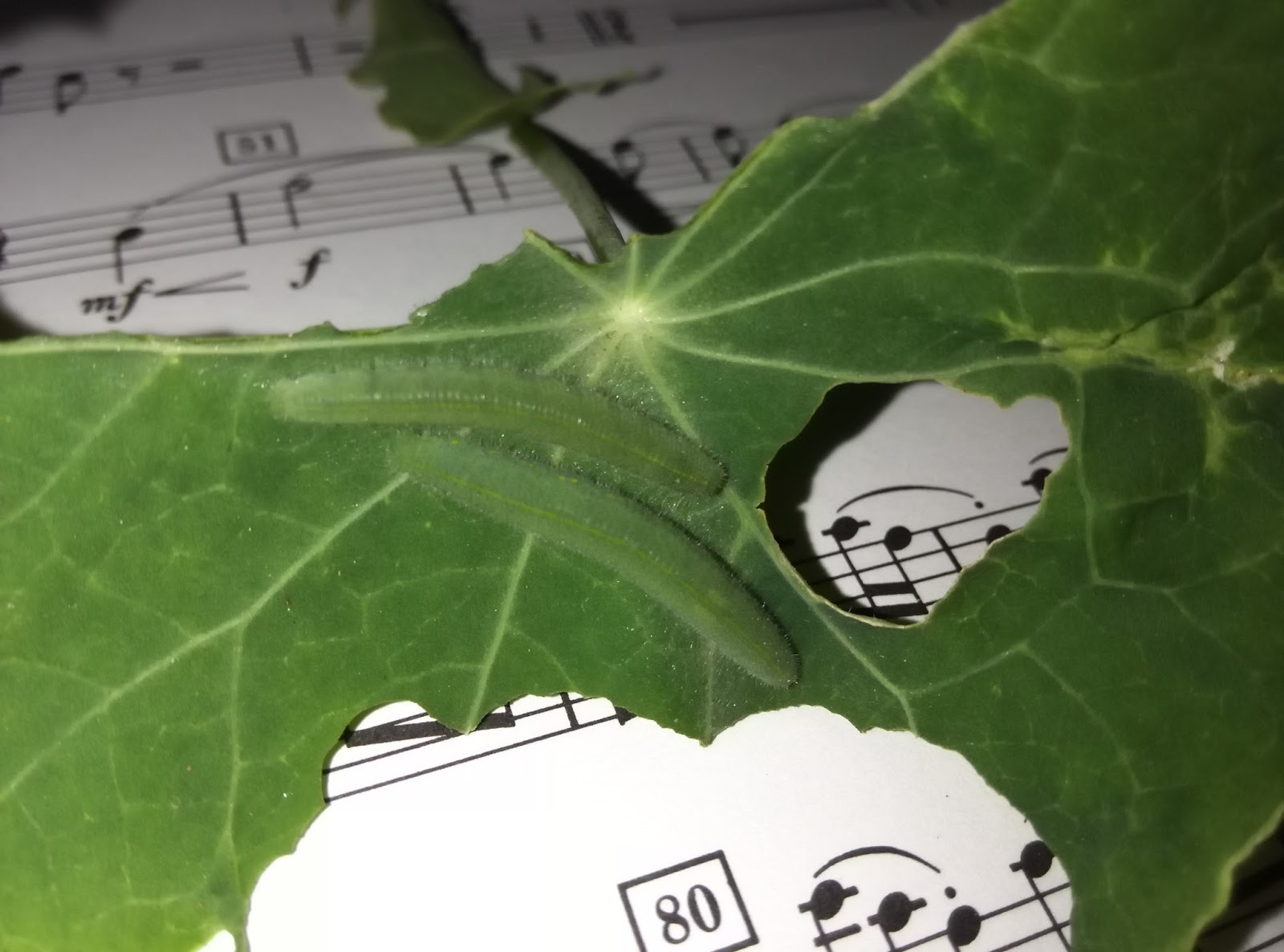
In the photo below, you can see how this works. Two well-camouflaged green worms appear to be relaxing on the nasturtium leaf at upper left, possibly dreaming of the day they will morph into white moths. Meanwhile the tomato leaf at upper right remains untouched.


Though it shows oregano, tarragon, and marjoram to good advantage, I do not like this photo. The sun was so bright that all I could see on the screen of my smart phone was my own reflection. I showed the worms and the photo to Steve, and he wisely offered a solution: "Why don't you take off the leaf?" Why, indeed? So I carried the leaf and its little sunbathers inside and placed them on a piece of band music. What a lovely setting:


After snapping this photo, I gently placed the nasturtium leaf, worm-side down, in a compost digester. A couple of hours later, the worms had vanished while the leaf was virtually unchanged.

Though I often choose a politically correct option when facing a moral dilemma, I feel no guilt about harboring nasturtiums. I have repented my old way of letting them run rampant, but I have have never believed that, in the context of my urban, self-contained garden, they would "fuel wildfires, degrade grazing land, contribute to soil erosion, clog streams and rivers, and increase the risk of flooding." Even so, I keep an eye on them. A good way to see a flower or two.


This photo, taken earlier this morning before the sun hit this part of the garden, shows at least two nasturtiums keeping watch over some small Swiss chard. Unfortunately in this case the pests seem to prefer the chard.

Saturday, July 11, 2015

year of the bean

I haven't blogged about growing beans since June of 2010, when I wrote look at them beans in the misguided state of euphoria I experienced after getting scarlet runner beans and hyacinth beans to grow on our chain link fence. By January of 2012, I had given up my fascination with hyacinth beans and their alleged magic, and today I view the scarlet runner bean (SRB) as a threat to civilization as we know it.

When I re-read look at them beans this morning, I was astounded to see that I had bought four SRB plants as soon as we finished putting up the fence in 2009, and had saved the seed to plant the next year and, indeed, just about every year since. In other words, all the SRBs I have grown here are descendants of four plants. I still love to see their blossoms appear on our side gate:


The huge pods, however, attract a thick powdery mildew that fills me with fear and loathing. The photo of the ungainly specimen below was taken after I had cut the vine at ground level so that the nearby leaves had totally shriveled:


The green leaves at the right belong to a much better variety of bean, the Worcester Indian Red Pole Lima (aka Peruvian Lima), grown from seed I had ordered on line from Amishland Seeds in 2012. According to Amishland's descriptive catalog, the Incas dried these beans and ground them into flour. I let them dry on the vine and then use them to make soup or stew along with other veggies, usually spiced with East Indian sambar masala. I enjoy the juxtaposition of a pre-Columbian New World bean with an Old World spice.

When I ordered bean seeds from Amishland Seeds, they were offering a promotion: one free variety with four. How could I resist? I don't remember which was the free one, but I was delighted when I received five packets of 10 seeds each in the mail: Peruvian Lima, Amish Gnuddel, Lazy Wife, Anellino, and Cascade Giant. Of course I should have planted them right away, but for some reason I waited till fall of 2014 and then chose the Peruvian Lima.

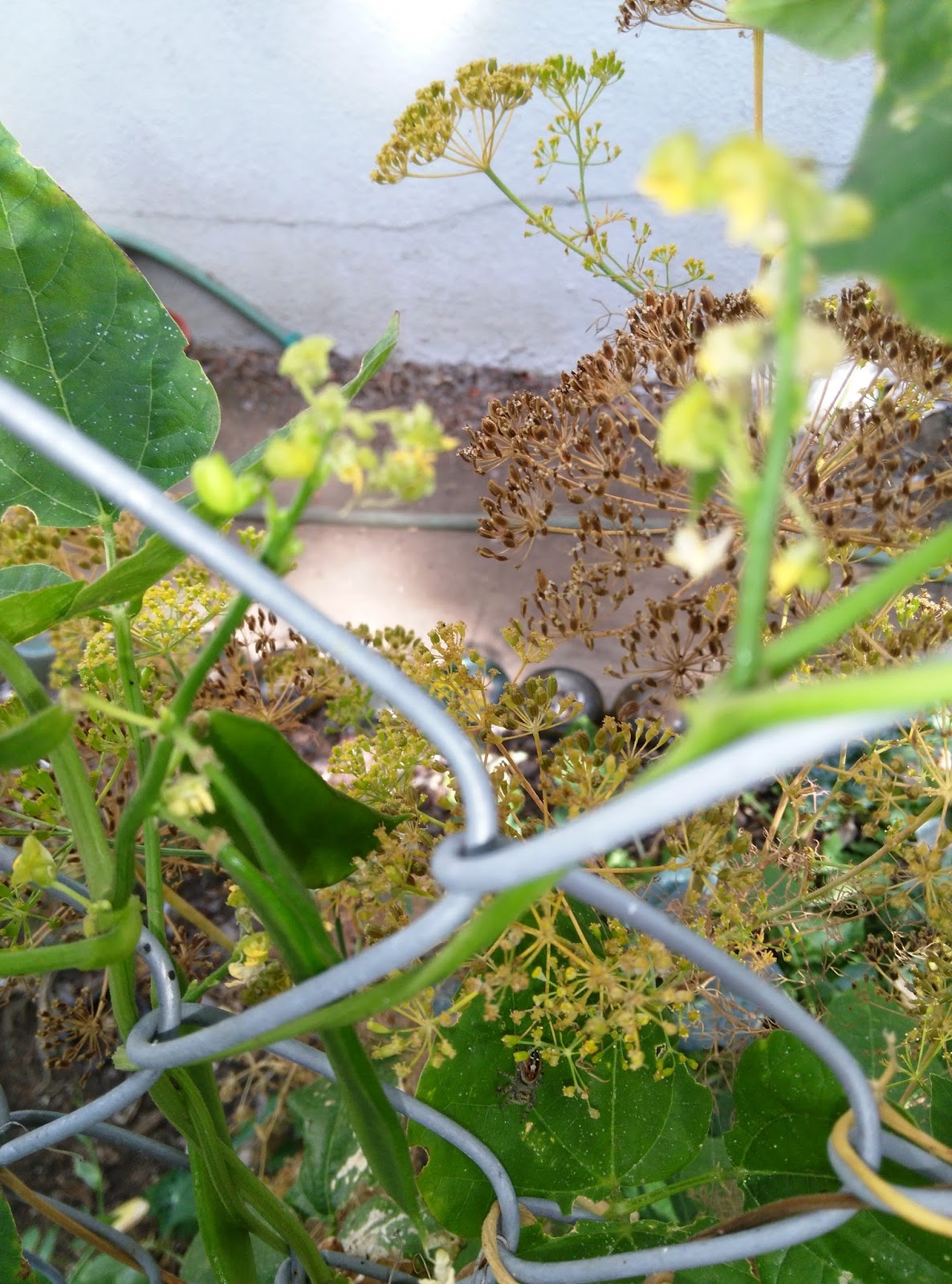
It was in fall 2014 that I first planted veggies following the principles of companion planting and crop rotation. Previously I had relied solely on aesthetic principles: if I had four boysenberry plants, I spaced them evenly along the fence. Same thing with tomato plants and bean or pea seeds. It didn't work very well, and so last fall I moved the boysenberry plants into the same section of of the bed. But beans are supposed to be good companions for any other veggie, and besides they 'fix' nitrogen. And so I started my saved SRB seeds and my new Peruvian Lima seeds indoors in toilet paper tubes and planted them evenly all along the fence in November or December. They soon started producing tiny white and yellow blossoms:

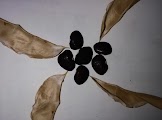
Fortunately 100% of the Peruvian Lima seeds germinated, and they turned out to be extremely prolific. I pick some dried pods practically every day, and when I get enough to cook I make sure to save at least 15 for seed. Here's today's harvest:


Of those saved for seed, some have become companions for chayotes, and some for gourds. Because the seed pods 'shatter' when mature, some have come up volunteer on both sides of the fence. I cannot imagine planting a garden without Peruvian Limas, though I've learned that boysenberries dislike pole beans. I took out all the pole beans from the berry patch and I think the problem was competition for space on the fence. Anyway the boysenberries are looking happier, even with tomatoes encroaching a bit.

What of the other four Amishland bean varieties? Due to my having aged them so long, the germination was spotty at best. I currently have ONE Amish Gnuddel plant, THREE Lazy Wife plants, and THREE that may be either Cascade Giants or Anellinos. A report on their progress, if any, must wait until another day.


Creative Commons License
POSToccupations by Frances Talbott-White is licensed under a Creative Commons Attribution-Noncommercial-No Derivative Works 3.0 United States License