Monday, October 4, 2010

toola, מִשׁיִי, and the ineffable viscous vivian

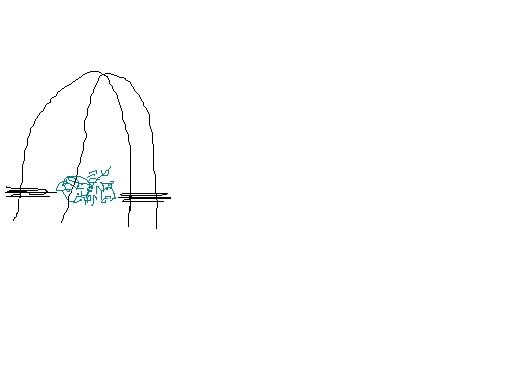
Toola has indeed prospered since I wrote about her in January, and the catnip I planted for her then is alive but not exactly thriving. The struggling plant still needs the protection provided by heavy wires* crossed over it. As our Marigold did years ago, Toola lies on the sun-warmed concrete walk, with her head as close to the catnip as it can be, and rolls until thoroughly stoned.

We  
now call Toola our 'surrogate' cat, and she performs this role enthusiastically. When we sit at our bistro table outside, she jumps onto Steve's lap -- kneading and purring with glee. Being allergic to cats, I try not to touch her, but we've had lots of good talks, at the table or when I'm gardening.

Toola is not the only cat who uses our catnip regularly. Her siste
מִשׁיִי (pronounced Meshy but probably not transliterated that way). Jacob told me that  מִשׁיִי is the Hebrew word for Silky, which describes her coat -- much the same colors as Toola's but evidently much softer.

I know how to spell Toola's name (based on the Hebrew word for Cat, but without an initial Cha syllable) because I am able to read her tag. Meshy does not permit this level of intimacy, but I have seen her enjoying the catnip. 

A couple of weeks ago, I spotted another cat on the garden path, and obviously it was neither Toola nor Meshy. This cat was pure black and had only three legs. Spotting a tag I called out to Steve, thinking we could corner the animal and read the tag. Alas! It sprinted clumsily across the street and up a tree in the alley.

Then one day last week I walked out the back door early in the morning and heard loud meows. The three-legged black cat, obviously needing attention and/or food, approached me and rolled submissively at my feet. I couldn't resist petting the silky black fur and was happy to see (and feel) that the coat was in wonderful condition. Viscous was the word on its tag, along with some numbers I wasn't able to read.

Questions abound. Had someone misspelled Vicious (certainly not an apt name for my new friend)? How was the leg lost (it's a very well healed surgical removal)? Was the new submissive attitude caused by hunger, a catnip' high,' or something else? Was this cat new to the neighborhood and now more 'at home' than when it climbed a tree to get away from me? Will I see it again?

A posting on Craigslist and an entry in a lost and found pet database have not produced any results so far.

Without going into a big T.S. Eliot explanation, I think Vivian would be a good name for this ineffably silky cat.
- - - - -
* Each of the two wires is about 18" long and each of the four ends sticks about 4" into the ground, so this drawing is not to scale. Like most of my drawings, it needs an explanation.of 1000 words or more but is only worth 25 or less. The green stuff is the catnip; the horizontal lines represent ground level; the wires are placed at right angles to each other. Hope it gives you the general idea. 
Saturday, October 2, 2010

drops in the bucket, part 3

Parts 1 and 2 of this title were written in January, when El Niño was filling and re-filling our rain barrels regularly. Now, ending a week that brought record high temperatures to the L.A. area, we seem to be starting a dry and dusty La Niña season. Dr. Jeff Masters' WunderBlog, which may tell you more than you want to know about such things, states that "historically, about 35 - 40% of El Niño events are followed by a La Niña within the same year."

I loved El Niño and so am hoping 2010 is one of the 60 - 65% of years when La Niña does NOT follow in her brother's footsteps. Even a year of NORMAL rainfall would be welcome.

Our five rain barrels have been empty for months (the last measurable rain having fallen in March), but within the last couple of weeks I've found a new source of water to 'harvest' -- the washing machine! Having switched from detergent to a magic green plastic laundry ball filled with ceramic beads, I have a dependable source of chemical-free water, laced with very dilute solutions of dirt, food, and human effluvia -- nothing a plant wouldn't love.

Harvesting wash water is more labor intensive than harvesting rain water, but I'm getting it down to a fairly simple routine -- learned the HARD WAY, of course, with much spillage.

First, siphoning into the nearest rain barrel with a regular garden hose was impractical. Starting and stopping the siphon were tricky operations, to say the least, and a large load of laundry produced more than the barrel's 50 gallon capacity. Running the hose out the back door brought in insects and heat, and would not be practical year-round.

A siphon pump improved the process greatly, but its tubing slipped out easily and the end in the washing machine got blocked by clothes. Steve perforated a small plastic hand-sanitizer bottle and attached it to the sucking end, but all the parts slipped apart too easily so he secured them with Gorilla Glue. Unfortunately the Gorilla Glue rendered the pump totally inoperable. Evidently it expanded to block all the joints where it had been applied.

Steve bought another siphon pump and perforated another hand-sanitizer bottle, and we were in business at last! I started siphoning water into various vessels including our old galvanized watering can (Haws' "Peter Rabbit" model, no longer available in the one-gallon size, but priced at $129.95 for the two-gallon size). Steve  bought ours for $1.00 at the Salvation Army Thrift Store years ago, and I suppose we need to treat is as an heirloom.

I started feeling like the Sorcerer's Apprentice, running back and forth between washing machine and garden with a motley assortment of containers. Fun, in a way, but frustrating to come back from emptying two half-gallon containers to find that the one-gallon watering can is overflowing. A pair of two-gallon plastic watering cans from Home Depot seemed to solve the problem, but they're pretty heavy when full.

Emptying the two-gallon watering cans into a rain barrel permits some relief, but I still need to take the water out of the rain barrel and USE it before the washing machine has to be emptied again.

It is shocking to realize that I regularly use A LOT MORE water to do laundry than I use to water the garden. See drops in the bucket, part 4, (assuming that I ever have time to write it!) for more on this issue.

Monday, September 27, 2010

a fellow non-marthette

Having gone to great lengths to dissociate myself from the marthettes*, I was happy to learn about bon appétempt, a blog that documents one woman's struggle with preparing dishes so that they look as good as their photographs on magazine covers and the pages of illustrated cookbooks.

The blogger's name is Amelia Morris. I heard Lynne Rossetto Kasper interview her on Saturday -- my favorite day for listening to public radio station KPCC-89.3 while running errands. Naturally I added bonappétempt to my Google Reader subscriptions as soon as I got home.

Amelia is 28 years old and has been blogging for two years, so she's squarely in the marthettes generation. Her blog's original motto was: "tackling semi-ridiculous to outright ridiculous gourmet and/or seemingly intense recipes, despite my novice skill set and average-at-best collection of kitchen appliances and cooking tools," but then she had what she calls "a big culinary change of heart" and started respecting the recipes and their creators. Declaring "I don't want things not to be hilarious," Amelia now focuses on her learning curve and freely admits her mistakes, which are sometimes hilarious and sometimes not.

Which brings me to another characteristic of the marthettes: their lack of a sense of humor.

postoccupations and bon appétempt have a lot in common, I think, but there are a couple things that set us apart. Amelia allows comments on her blog, and she posts a lot of wonderful photos.
- - - - -
* Wondering why marthette is always dinged by my spell-check but marthettes sometimes isn't, I googled marthette and learned that it's the name of nine persons in the U.S. (outnumbered by 320,693 Franceses and 47,797 Amelias). How little we knew in the pre-Internet days, even if we were highly educated! This may turn out to be the subject of another post.

Thursday, September 23, 2010

marthette? moi?

Almost every day, Google Reader brings me a couple of postings from Schott's Vocab: A Miscellany of Modern Words and Phrases, from the New York Times' vast selection of blogs. Sometimes it's a definition of, and commentary on, an arcane or highly technical word, sometimes it's a quick but challenging puzzle or game, and sometimes it's a neologism that Ben Schott has created or picked up in the blogosphere.

A few weeks ago, the new word was marthettes, coined and defined by Sadie Stein as "Intimidatingly 'perfect' female bloggers who are to this generation as Martha Stewart was to the last." BTW Sadie blogs on Jezebel (Celebrity, Sex, Fashion for Women), which, to me at least, seems rife with intimidating material.

My immediate response to the idea of marthettes was a sort of paranoia. Was somebody going to accuse ME of being a marthette? I'm obviously a 'female blogger,' and I confess that I can be intimidating (sometimes intentionally), but what about the other attributes?

While I have to admit that I see some aspects of my blogger identity in the marthettes' subjects, themes, and even attitudes, I am NOT part of the generation that was intimidated by Martha Stewart. If this means that I'm from the "generation before last," so be it.

I have certainly never claimed to be 'perfect' or do any particular thing 'perfectly.' My foibles have been laid bare in many blog posts -- most notably about struggles with weeds and pests. Martha and the marthettes (sounds like a Doo-Wop group, doesn't it?) may go through these struggles, but I don't think they ever tell you about them. It's like the perfect omelette or photo just rolled onto the set without the aid of a food stylist or graphic editor.

When I first became aware of Martha Stewart, she was a guest on CNN's Larry King Live, which Steve and I watched regularly during our first few years as empty nesters. Up to then, we had been unaware of Martha and her large media following, who were now -- through Larry's fawning interview technique -- being treated to instructions on how to dip dried magnolia leaves into liquid gold so's to feature them properly in a fall centerpiece. Shortly after this, we saw Martha on PBS doing something that involved a turkey and a two-quart Pyrex measuring cup of melted butter. I was shocked, not intimidated, by the sheer ridiculousness of these flagrant displays of conspicuous consumption.

Later my friend Janet received a copy of Martha Stewart Weddings from the mother of her son's fiancée. Janet was not intimidated -- just mildly irked at the implications of the gift. Following an extremely silly incident, Kay and I became known to each other as Martha [Stewart] and Betty [Crocker], and had a lot of fun dissociating ourselves from our famous alter egos.

Of course Martha Stewart herself is now a blogger. Check out The Martha Blog where, among many other things, Martha displays the handmade birthday cards she received from her summer interns, along with the special box they made for her to keep them in.

Yesterday Kathy and I talked about blogging to a new friend named Martha. Our Martha 'got it' immediately that marthettes are Martha Stewart knock-offs. So the neologism is apt and will probably stick -- but not, let's hope, on me.

Wednesday, July 21, 2010

sow's ear

Last week I crocheted a market bag using recycled t-shirts for yarn. As an unabashed fan of MyRecycledBags.com I had been destined to take on this project for months, but it didn't come together for me until late May, when Elana listed a bag of about 20 old t-shirts on craigslist.org* -- free to anyone who would come and pick them up -- and I realized it was time to start trying Cindy's techniques for making and using t-shirt yarn.

RecycleCindy instructs her followers to cut t-shirts into 1/4" strips to make what she calls
t-yarn or tarn, and that is exactly what I started doing as soon as I got home with Elana's old t-shirts. BTW, Elana was moving out of her apartment about six blocks away from our house. She felt that the shirts weren't in good enough shape to give to charity, but, though she'd never heard of t-yarn, hoped they'd be of use to someone. I loved that she was so conscientious about not dumping her discards, and we had a pleasant though short visit among her boxes and bags.

Cutting t-shirts into 1/4" strips is a pretty tedious operation, and I soon found that I had more compelling things to do with my time. Days later, I returned to it while watching TV, but somehow the 1/4" strips became 1/2" to 5/8" strips. As my ball of
t-yarn grew, I started trying various crochet hooks with it, and ended up with my beloved wooden 'Q'-sized monster, which quickly created a very heavy fabric with a nice floppy feel to it. Not bothering to check Cindy's patterns, I lost sight of the fact that my t-yarn was twice as heavy as hers.

Suddenly a couple of weeks ago, when I finished a crochet project for our five-year-old granddaughter, it was time to get serious about the t-yarn. I checked some patterns and settled on a market bag style because I liked the idea of a single handle strap integrated firmly into the design rather than being stuck on like an afterthought.

I decided to use only 100% cotton t-shirts -- all white or with white backgrounds. Of course some of the shirts were whiter than others, so as the work developed, it took on a subtly striped appearance when I changed from one shirt to the next, while the flecks of printed color produced a slight tweediness. The handle prescribed by my chosen pattern didn't seem right at all, so I reoriented it to the ends rather than the sides of the bag.

Last Wednesday night I was going to an art lecture**, so I decided this would be a good time to field-test the bag. Alas! The handle stretched to an unacceptable length while tiny white dandruff-like particles of cotton appeared all over my black pants. Reluctantly I cut Elana's last white cotton t-shirt and started a row of reinforcement around the handle and top opening, but it was too white for the quasi-natural look of the bag. So I pulled the new stitches out (crocheters call this
frogging because we "Rip It"!) and completed the process with an old t-shirt of Steve's. A careful laundering reduced the dandruff effect considerably, and I have faith that it will all go away soon.

Is my bag finished? Probably not, but I will field-test it again at this evening's Historical Society picnic. It's a bag with a history so should be very appropriate. I'm thinking in terms of lining it with a piece of another old t-shirt so that my crochet hooks and knitting needles won't work their way out.

When my bag IS finished, I'll post a picture of it, along with a draft of a pattern. Maybe someone else will want to make one.
- - - - -
* I wouldn't have found the t-shirt posting if I hadn't listed some plants in craigslist's 'free stuff' section. Elana's listing was adjacent to mine, so I spotted it serendipitously when I went to check that the info on my proffered dudleyas was correct.

** The artist, Salomon Huerta, repeatedly uses a power sander to obliterate the portraits he paints, until he gets them JUST RIGHT and sees that they are truly finished. One of Huerta's guiding principles -- simpler than his esoteric preoccupation with the look of the face -- is that his laboriously constructed canvas-covered boards should not be thrown away. 
My more mundane ripping out and re-crocheting was a delightful coincidence. Recycling is where you find it. 

Friday, July 9, 2010

courage under fire

Writing about Gram's garden tools last week has kept that venerable lady in my recent thoughts. As our children's generation procreates later in life than we did, fewer and fewer will grow up knowing their grandparents, great grandparents, and grandparents-in-law. This sad fact calls for more memoirs, and I will try to fill the gap.

Today's title and the tone of my opening paragraph notwithstanding, I want to relate a humorous anecdote about Gram. Steve and I have laughed about this story many times over the years, but kept respectfully straight faces when it happened.

The scene was a four-generation holiday dinner at Steve's parents' home. Gram was in her late eighties but in good health, mentally and physically, largely due to the strong discipline she imposed open herself in her daily life. Alice set a dish on the table and one of the men (Steve or his dad, Homer) started to pick it up, but drew back immediately when he felt how hot it was.

Gram observed: "Women can stand to hold hot things better than men can." Instantly sensing that the men at the table might have been offended, she added: "Of course, men are brave in time of war." I must have been in my late thirties or early forties, but was sorely tempted to giggle. Fortunately the kids, grade-school age, were too young to see any humor in the situation.

Gram's hasty equivocation was the rhetorical equivalent of "shoot first, ask questions later," and it was not the only time I heard her use this technique. Once she was praising a pianist she'd seen on the Lawrence Welk Show and added, "But Steve sits up straighter than any of them."

I sense that as a young woman Gram (Bess) must have tried hard to curb her impulsive tongue. As a girl, she had ridden horseback with her father and three sisters from Denver, Colorado, to Bend, Oregon, yet she was always looking for refinement and self-improvement -- reciting poetry to herself and repeatedly saying the alphabet backwards to keep her voice from growing weak in her years as a widow living alone.

Last night at dinner Steve picked up a hot ear of sweet corn and dropped it unceremoniously onto his plate. I made sure to hold mine for several seconds before setting it down gently, while quoting for the zillioneth time: "Men are brave in time of war."

Saturday, July 3, 2010

moebles

The same year Steve and I were married, his paternal grandmother, Bess (always known as 'Gram' to her three grandsons), moved from her home in Lynwood into a small apartment in a Sun City retirement community. This was a miracle of timing, as we were able to furnish our tiny house in married student housing from things she had left over in her move: a sofabed, a kitchen table with four chairs, an ornately carved upright piano with a set of piano-tuning tools which had belonged to Steve's grandfather, a classic footstool cum storage cube, several blankets, and an array of garden tools.

Gram's piano, which she had personally stripped of enamel and refinished with a thick varnish, only moved with us once. It was traded in on a new Yamaha 3/4 upright. Having the old piano picked up at Point A and the new one delivered to Point B was a clever ploy to expedite our moving. BTW, Steve still has his grandfather's set of piano tuning tools and uses them to this day, along with the Yamaha piano, which has graced six homes in four states.

Gram's garden tools were of little or no use to us in student housing where the grounds (basically an old avocado grove interspersed with struggling lawn) was maintained by the management. We moved twice before we were able to use the tools, but most of them have been in use ever since. Along the way we've collected a few more: a smaller shovel and pitchfork at Pennsylvania farm auctions; an aluminum trowel left in our Evanston, Illinois, basement along with a lot of other stuff abandoned by the previous owner; a brand-new spading fork, pruning shears, loppers, etc.

Last year I replaced Gram's ancient folding saw with a new one from Home Depot. What an improvement! The pushbutton lock keeps it from collapsing on me as Gram's always did, and the stainless steel blade goes through branches in no time.

We've had little use for Gram's half-moon lawn edger (whose name I have just learned after over 45 years of ownership) but this spring it struck me that it could be used to cut through the decaying cardboard that underlies our mulch. Thus my three sisters tableaux were planted with the aid of an heirloom tool with no moving parts. Somehow this makes it seem even more traditional.

Moebles? Here's a simple definition.

I treasure old things that are worth carrying along for continued use, be they words or more tangible tools, from pitchforks to tuning forks.
Creative Commons License
POSToccupations by Frances Talbott-White is licensed under a Creative Commons Attribution-Noncommercial-No Derivative Works 3.0 United States License