Tuesday, December 3, 2013

fring 2013

We returned from a four-day Thanksgiving trip on Friday November 29 to find that this year's rainy season had started the night before. Thus the official start of fring, the spring-like season brought on by Southern California's fall rains.

On Saturday I took inventory. Narcissus and freesia bulbs were sprouting. Calla lilies (sprouted during the dry months) were unfurling their broad leaves on noticeably taller stems. Fattening jade plant and ice plant were starting to bloom, sweet violets were standing tall, and a single volunteer sweet pea seedling stood next to the kalanchoes. It's too early to expect any Idaho daffodils.


Jade Plant

Freesia
Calla Lily

Perhaps my greatest fring surprise is the false dragonhead (Physostegia virginiana) I had been trying to keep alive in a container. This plant was totally new to me when I admired its striking pink blossoms in my friend Nancy's* late August garden As soon as I asked about it, Nancy started pulling up great handfuls. She told me to come back for more if these didn't grow for me. At the time, I had no good place for them in the garden and felt that it was too hot and dry for a new plant. I stuck them in water till they made some new roots, and then potted them.

As the dragonheads shed their blossoms and then their leaves, I started using the same pot to root kalanchoe cuttings. Sure enough, fring brought the dragon heads to life, and inch-high shoots were coming up at the base of each dry stem. The roots had managed to stay alive, and I'm thinking of planting them next to the African white irises which bloom off and on all year.

False Dragonhead Sprouts
So why are they called false dragonheads? According to Wikipedia, they were once thought to be part of the genus Dracocephalum, but both true and false dragonheads are part of the huge mint family (Lamiaceae). Wikipedia also says they are rhizomatous. I don't remember any rhizomes when I planted them, but we'll see when they come out of the pot. This will be soon, I hope.

Fring will be replaced by wring on December 21. A short but intense season, barely long enough to get the false dragonheads established, but promising many pleasures along the way.

- - - - - -
* Nancy loves to share her garden's bounty and is best known for the lavish bouquets of sweet peas she gives to local friends and neighbors. On her many travels, Nancy carries sweet pea seeds she has saved for this purpose, and has left a trail of lovely blossoms in the gardens of new and old friends on all the temperate continents.

Tuesday, November 12, 2013

cereus business

Our huge Cereus lamprospermus is a night bloomer, and so I was astounded when I stepped outside on Saturday morning and saw this magnificent blossom facing our front door. It had bloomed during the night, but stayed open in daylight due to a rare set of conditions: shaded by our street tree, facing due west and thus not struck by November sun coming from the southern sky. I was glad my little camera was charged up and ready to go, to catch not only the full-blown cactus blossom but also the sun highlighting a Eugenia hedge across the street.


Our Cereus usually blooms in late spring or summer, but this fall it has produced four buds. We totally missed the first opening a couple of weeks ago, but kept a vigil for the second, which never opened fully because it was blocked by one of the plant's five tall trunks. This, the third blossom, is a rarity. The fourth and last bud faces south; it will close early, and, since it's only a foot off the ground, we will have to kneel on the sidewalk to see it.


Tonight Steve and I will both be going to rehearsals, and I hope we'll remember to check on the progress of this bud when we get home.

In Elegy Written in a Country Churchyard, Thomas Gray (1716–1771) observed: "Full many a flow'r is born to blush unseen, /   And waste its sweetness on the desert air." This is an apt though unintentional description of our experiences with night-blooming Cereus, but I'm willing to bet Gray wasn't talking about any kind of cactus. The word desert, in this context, simply means deserted, and blush is an obsolete synonym for bloom. It was not until the following century that explorers and botanists began bringing African and South American cacti home to Kew Gardens and private plant collections where English poets could see them. A Cereus would have frozen to death in Gray's celebrated country churchyard.

Thomas Gray is best known for his widely misinterpreted words "ignorance is bliss," from Ode on a Distant Prospect of Eton College. This would be a good poem to read while waiting for a night-blooming Cereus to bloom. Or, you can watch lovely time-lapse photos of Cereus openings at YouTube.

It is not blissful to be ignorant of cactus blossoms in one's own garden.

Thursday, October 31, 2013

a mushroom chronicle, part 3

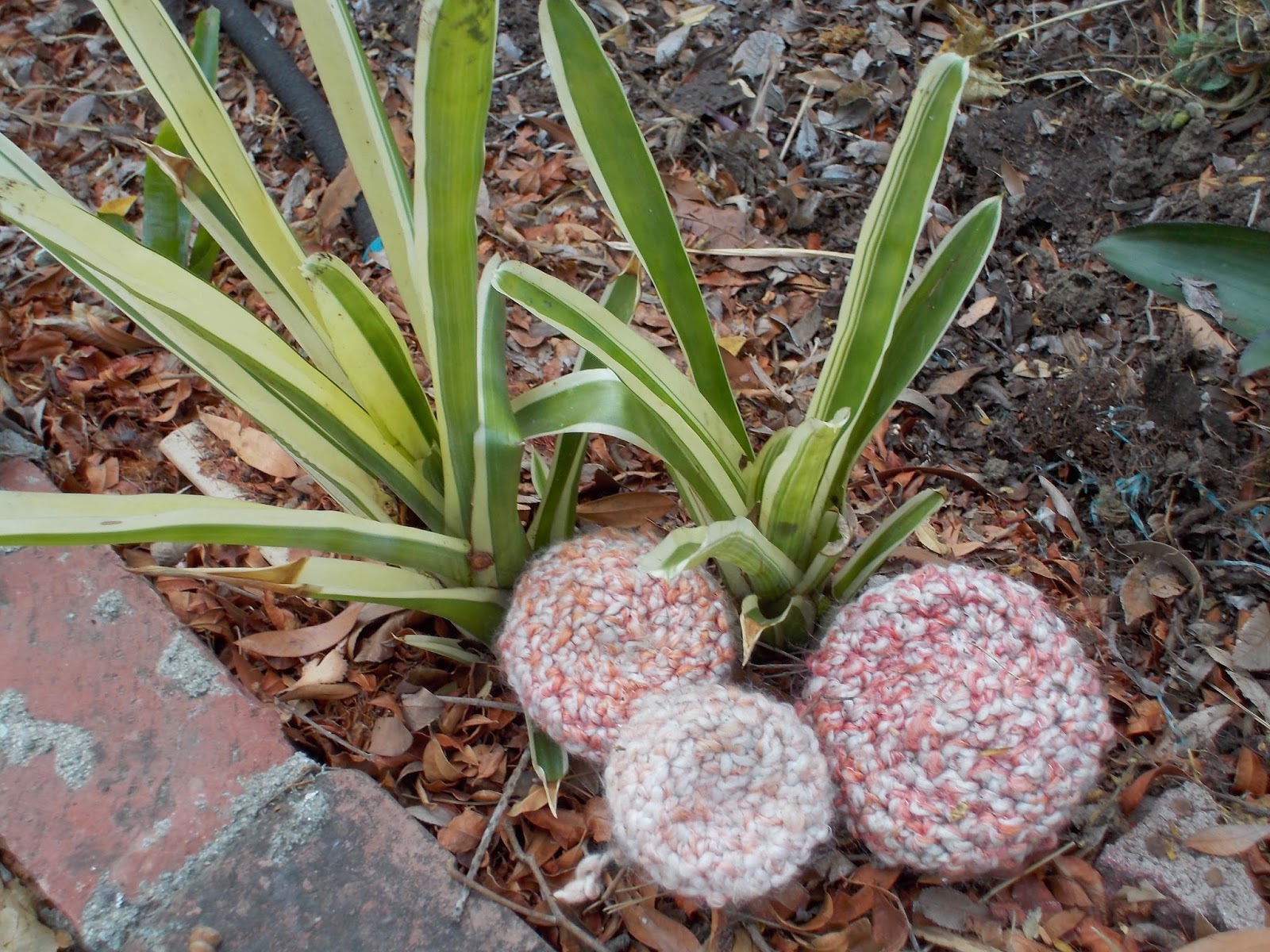
All has been quiet on the local yarnbombing front since I posted a mushroom chronicle, part 2 in April. Oh, there was one small episode when Mr. B spotted a REAL mushroom in his front yard and, at first glance, attributed it to me. We had a good laugh over that one.

Earlier this week, I was walking up our street to make a trade at the Little Free Library that's sprung up in the block north of us (talk about mushrooming!). Perhaps half way between home and the corner, I was surprised to see one of my crocheted mushrooms lying on the sidewalk. I quickly picked it up and put it in my pocket.

This mushroom was VERY DIRTY. The three crocheted mushrooms in Mr. B's front yard are nice and clean, because he waters that part of his yard frequently. The three I've placed in our parking strip, however, are in a clump of dogbane which I never water. It will 'green up' with the rest of the succulents as soon as the fall rains start, but meanwhile the soft, spongy yarn I used to make these mushrooms has absorbed a great deal of the street dirt thrown up by passing cars. In fact, I had been thinking of washing these mushrooms and 'replanting' them if the rains don't come soon.

So the errant mushroom was soaked upside down for a day in a dilute solution of dishwashing liquid, kneaded repeatedly against its wire frame to loosen the dirt, and then thoroughly rinsed. It took another day to dry, stuck in a glass and placed on our bistro table to get some sun.

I'm thinking about washing the other two mushrooms and then placing all three in a more sheltered location among the bromeliads or kalanchoes.

Of course I'm curious about how my mushroom migrated up the street. Not prone to suspecting foul play, I have hypothesized that it was picked up by the wheel of a stroller, tricycle, or skateboard and then fell off after being transported about 50 yards. Steve is convinced that "a little girl" picked it and threw it away after getting tired of carrying it. More likely her mother noticed it and told her to drop it because it was so dirty.

This is one of the many things we'll never know. I'm just glad I was able to bring the mushroom back home. "All's well that ends well," they say.


Tuesday, October 29, 2013

bloglovin'

With the demise of Google Reader, you may be shopping for a new way to keep track of the blogs you like to read. Like, this one!

If you go to http://www.bloglovin.com/ and copy http://postocc.blogspot.com/ into the 'search blogs' box, you can ask to be notified whenever I churn out a new posting. This assumes that you open a free account (with no privacy risk that I can see),

I keep track of a whole raft of blogs through bloglovin' and, though I organize them into categories, I like to whip through the combined list each day and read the individual posts selectively or 'like' them for later reference.

My list includes most of my local newspapers -- exciting reading now that we're in the throes of a divisive school board election campaign -- as well as numerous sources of free needlework patterns and recipes.

Check it OUT!


Monday, October 28, 2013

rain readiness

Today we are supposed to have new rain gutters installed. They will be red aluminum to go with our new roof, and will drain into our four rain barrels. I am not totally convinced that the job will be done on schedule. Steve and I were out of town last week, thus missing the contractor's confirming phone call on Friday.

Another reason for my skepticism is that a 50% chance of rain is predicted for today. Of course this means there's an equal chance it won't rain, but yesterday it really felt like rain, and so I took time to plant the Idaho daffodil bulbs I had dug up during the summer and stored on the front porch in a small paper shopping bag.

There were nine bulbs -- eleven after I separated two doubles -- and I planted them in a circular space as planned. The soil there, at the foot of our largest lavender 'tree,' was not very good. We're talking about the part of our front garden that had originally been a driveway and later a thick bed of ivy. I scraped away three inches of what passes for topsoil plus mulch, and then used a bulb planter to make the eleven holes: eight around the edge and three in the center. About an inch of a bulb-friendly potting soil went in each hole, then the bulb, and then a generous trowel full of the potting soil, followed by an inch of topsoil, a generous sprinkling of blood meal, and finally the rest of the topsoil.

If it rains today, I'll wait until afterwards to apply more mulch. If it doesn't rain today, I'll water the new bulbs and then try to spread as much mulch as I can. In either case, I don't suppose I'll want to be gardening while the rain gutters are being installed -- if, indeed, that happens. I have until noon before the workers are supposed to show up anyway, and may be able to "make hay while the sun shines" and/or the clouds gather.

Two surprises graced my bulb-planting project. Both involved freesias, the principal inhabitants of our bulb bed. I was astounded not to find any freesia bulbs in the space I had chosen for the daffodils. Granted, I'd identified it as a bare spot last spring, but the freesias are prolific in casting off tiny bulbs at the end of each flowering season.

The other freesia surprise was my sighting of the first freesia sprout of 2014's blossoming. If it rains today or tomorrow, more grassy-looking freesia foliage will soon follow this harbinger. I'll happily declare the start of fring and start watching for the first paper-white narcissus to appear.

Tuesday, October 8, 2013

you, alfred hitchcock!

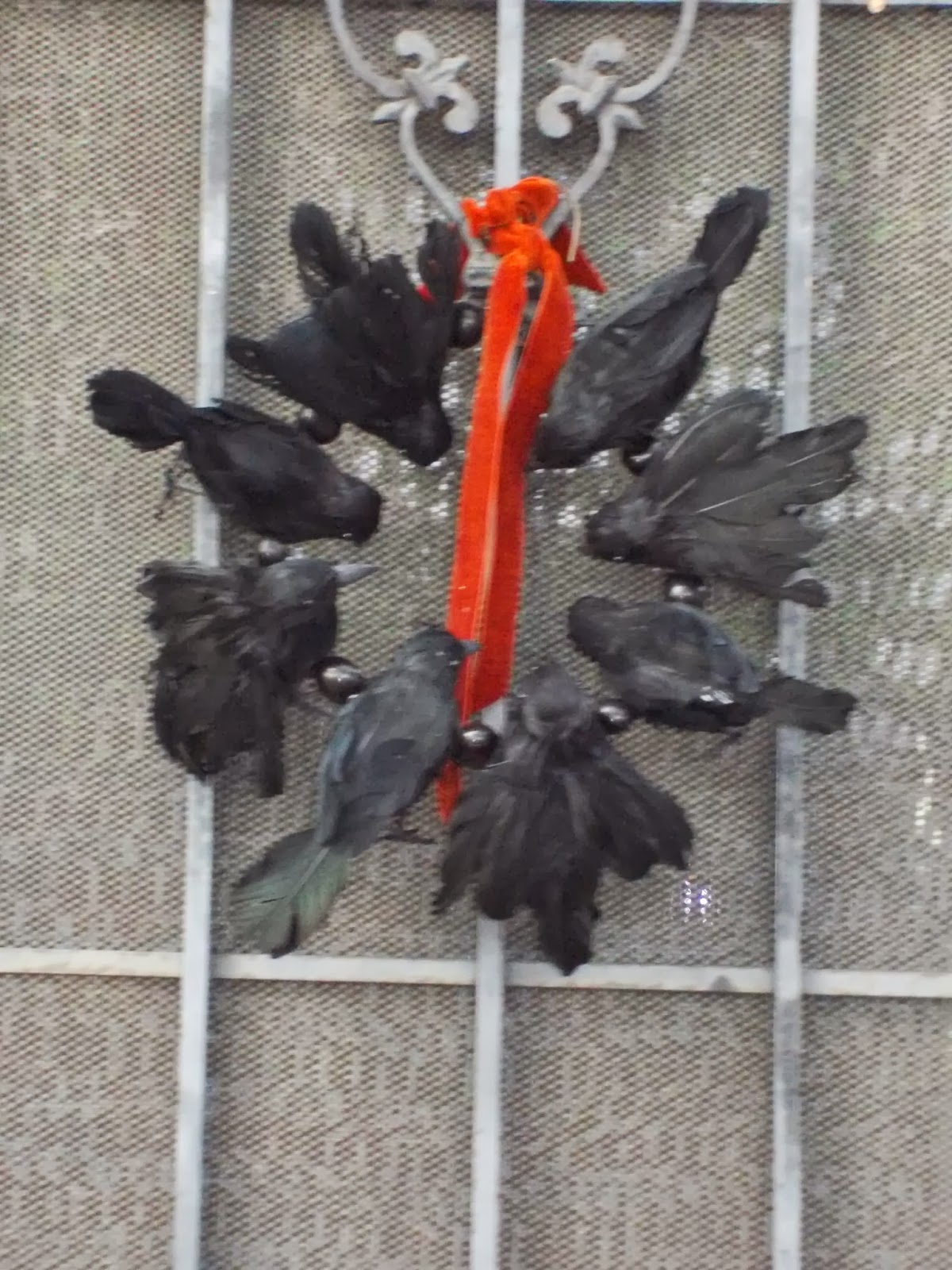
Yesterday on Facebook, Dollar Store Crafts shared a link to a picture of an elegant Halloween wreath made of black birds (they called them ravens). There was a detailed tutorial explaining how to hot-glue ten (10) dollar-store birds to a styrofoam wreath form. I don't usually do much decorating for Halloween, but this piece caught my eye.

Steve hates the noisy black crows that fly through our neighborhood most late afternoons and early evenings, often terrorizing smaller birds. He will sit at the bistro table in our front garden and fantasize about ways to kill them. Like, a water cannon. And so I knew that hanging some black bird effigies on our front door would appeal to him.

A digression about wreaths. My mother grew up believing that wreaths should be hung only to signify that there has been a death in the family, and that the body is still laid out in the house. Presumably when the hearse comes to take the body away, the wreath will be taken to decorate the church and, finally, the grave. Thus for me, hanging a wreath has that added frisson of childish rebellion.

So I went to our local Dollar Tree store and looked at all the items of Halloween decor. The black birds were tossed together in a big box on a bottom shelf along with other black things: unreal fluffy black owls, black plastic rats, and spiders of all sizes. I sorted through everything in the box and placed all the realistic crow-like black birds in my shopping cart -- then sorted those by shape and condition. Some had outstretched wings, while some held their wings close to their bodies. I selected four of each.

Dollar Tree was not stocking any styrofoam wreath forms, but Steve was quick to adapt a wire coat hanger, and seemed to enjoy stabbing it through the birds. We alternated the two bird shapes and added large black beads in between. An orange velvet ribbon set the whole thing off nicely, but I decided to forgo the dusting of black glitter.


If this wreath lasts until Halloween I'll be surprised, but I think its therapeutic value has been fully realized already.


Wednesday, September 18, 2013

the great green tomato worm race

Steve is not a sadistic person, but yesterday he showed some frightening tendencies in that direction.

I was at the computer, and he walked up to my desk with two long but not leafy stems from a tomato plant. One had a nice-looking ripe tomato at the end and the other one didn't, but what they had in common was that each bore a full-grown tomato worm: white stripes, red horn. and all.

This year, after two or three years of failure to grow a decent tomato crop, we took the plunge and bought some 'Topsy Turvy' tomato planters -- not only "seen on TV" but also featured at our local 99¢ Only Store. We're not inundated with tomatoes, as the ads seem to promise, but the ones we've harvested have been very good. And a Topsy Turvy  pepper planter has given us an adequate supply of jalapeno and serrano chili peppers.

We had not seen a single tomato worm until yesterday, when Steve brought these two bad boys into the house, and were thinking that maybe Topsy Turvy planters were immune from this scourge. Evidently not!

A few minutes after Steve walked off with the miscreants, I started wondering what he'd done with them, so I tracked him into our dining room, where he was calmly folding origami boxes. I asked if he had killed the tomato worms, and he said, somewhat diabolically, "No, I put them somewhere." I followed him to the front garden and there, in our cacti and succulent bed, the green tomato worms showed up in stark contrast against the tan background of our permanent mulch, made up mostly of dead leaves from our street trees: Chinese evergreen elms. These leaves are crunchy, small, and pointed -- with serrated sides -- not the smooth and shady green surface on which tomato worms generally spend their time.

It was fascinating to watch the tomato worms scurry around. They would seem to be making assaults on our giant cereus, but then would change their minds and rush off in another direction. The larger one walked between two stalks of a very spiny little cactus that I think may be a miniature cholla, but drew back after an inch of his body had tunneled through. The smaller one headed for the brick border of the bed. He thrust the front half of his body bravely over the edge, but then retreated back onto the carpet of crispy leaves.

How I wish I'd taken some pictures! I went back in a couple of hours and there was no trace of the green guys. Were they eaten by our resident crows or other birds? Were they on a long, dry trek back to the Topsy Turvy planters? Had they merely evaporated in the hot sun? We will never know. Unless we find more tomato worms and repeat the experiment under more controlled conditions.

The whole experience reminded me of a time years ago when we encountered an infestation of slugs. Steve was removing them with his fingers and setting them gently on the pavement. I was flicking them off the plants with a stick, and trampling them, along with the ones Steve had placed so gently. He said: "Isn't it interesting that you can't touch them and I can't kill them?"

I've killed many tomato worms over the years, and watched their liquid centers spill out. Steve didn't kill these two, but he certainly put them in harm's way.

I guess everyone has a sadistic side, whether we believe in treating our victims to a speedy death or a slow demise. Right now, I'm off to look for more tomato worms, and for sure I'm taking my camera.
Creative Commons License
POSToccupations by Frances Talbott-White is licensed under a Creative Commons Attribution-Noncommercial-No Derivative Works 3.0 United States License