Sunday, December 19, 2010

fring weeds

In second spring I wrote about the spring-like season that follows the onset of fall rains in Southern California. Having decided that the terms first spring and second spring are too judgmental, I'm going to call it fring -- a lovely season in its own right, and not an imitation of the flowering that begins in March.*

In spring I like to spend a lot of time pulling rain-nourished weeds out of the parking strip. With fring's infusions of laundry water and rainwater, the  common chickweed, dandelions, petty spurge, and oxalis, along with an occasional wild carrot have returned in force. But that's not all, as they say in the TV ads! There are innumerable dichondra and allysum seedlings, as well as some healthy runners -- and occasional blossoms -- on the violets.

I firmly believe my diligence in pulling spring weeds has made room for more of the wanted plants that are now getting an early start on spring 2011. Haven't I read over and over that the best way to fight weeds over the long haul is to deny them room? Another bit of conventional wisdom is that weed seeds are always lurking underground, just waiting to sprout when a vacant lot or new garden bed is forcibly dug up. Thus I try to pull weeds with minimal disturbance to the surrounding soil.

Neighbors and passersby see me pulling weeds by hand in the parking strip and sometimes remark on my patience and diligence. I generally tell them it's occupational therapy for me, but in truth it's pure recreation -- a time for quiet reflection punctuated by amusing visits. When other activities call, I add handfuls of mineral-rich weeds to the thick mulch in our raised beds.

Recently a woman asked me why I'm always working in the yard. "Isn't this supposed to be low maintenance?" she asked critically, indicating the sign that identifies us as proud harvesters of rainwater. I tried to explain that one's source of water and one's choice of plants are two different concepts, but she rushed on with her silent husband and their two slathering German shepherds. My bleat of "I do it for FUN!" dissipated in their wake.

With laundry water at my disposal, I hope to keep the parking strip 'greened up' year round. Where the greenness of spring 2010 was mostly weeds, the greenness of 2011 should include a thick mat of dichondra punctuated by white, purple, and pink blossoms. These last will be the primroses planted from seed last year.

How will I explain the lushness to folks who don't know that water isn't really redeemed until it's used?

- - - - - -
*Kurt Vonnegut defined six two-month seasons for areas of cold climate. He added locking between fall and winter and unlocking between winter and spring.
- - - - - -
On February 18, 2013, I found the source of Vonnegut's definition. I had thought it was an essay or speech, but it was in fact the novel Cat's Cradle (Chapter 119):
I had heard it suggested one time that the seasons in the temperate zone should be six rather than four in number: summer, autumn, locking, winter, unlocking, and spring. And I remembered that as I straightened up beside our manhole, and stared and listened and sniffed. There were no smells. There was no movement. Every step I took made a gravelly squeak in blue-white frost. And every squeak was echoed loudly. The season of locking was over. The earth was locked up tight.
It was winter, now and forever. (Reference, Wikiquote).

Friday, December 17, 2010

drops in the bucket, part 4

With rain predicted for the next four days, I'm taking a break from harvesting laundry water, a major preoccupation since early October, when I wrote drops in the bucket, part 3.

During these spring-like weeks, I've been seriously questioning my values with regard to the uses of time and water, and finding that these two valuable commodities have much in common. Both water and time exist in finite quantities, yet humans tend to treat them as if they were infinite.

My first response to a new water source was that I could add a whole new range of plants to the garden, and, coincidentally, early October was the time when our 99¢ Only store received a huge shipment of what they labelled as 'mini fern' -- nephrolepis exaltata. As soon as I looked up the Latin name, I knew that 'mini' referred mainly to size of pot (2"), though I suspect that the plants I bought were a 'mini ruffle' cultivar of the Boston fern or Victorian parlor fern grown extensively as a houseplant in the east and midwest.*

Now I have a dozen ruffly Boston ferns thriving in the front garden, thanks to generous applications of laundry water. These are planted in groups of three, with each group centered on an empty 3-4" plastic pot and surrounded by a deep mulch. I water the ferns by filling and refilling the empty pots and thus avoid wetting the mulch while encouraging the ferns to make deep roots.

I used to claim that I had six varieties of fern in the bed where these new ferns are prospering: three asparagus ferns (sprenger, meyer, and the vining emerald) and three varieties Kay had given to me (leather, sword, and rabbit foot). Of these, only the meyer and leather ferns remain, and I am quick to admit that the meyer is not a fern. My saga of removing unwanted asparagus ferns is related in asparagus ferns, parts 1, 2, & 3. Kay's ferns wasted away from neglect, but the leather fern has come back and makes a fitting memorial to her, along with a row of her California native irises.

Besides indulging in new plants, I've dedicated laundry water to maintaining and restoring plants that have suffered from my low-water regimen -- most notably violets, dichondra, sweet alyssum, and jade plants in the parking strip, as well as the convolvulus mauritanicus I've been treating as a bulb cover. Of course the food crops (strawberries, boysenberries, veggies) have always received high priority, while the herbs, cacti, and succulents mostly get by on little or no water.

Paradoxically, I am both saving and spending more water today than I was last spring. It's taking more control that makes this possible -- catching water as it goes by (whether from rainclouds or city pipes) and diverting it from the sewer/storm-drain system that would dump it into the ocean.

There's more to come about the process and the results.

- - - - -
*One of my favorite professors in graduate school had a huge Boston fern hanging in his office, and I remember watching it shed on his desk while we discussed the history of the English novel -- from Richardson and Fielding through Henry James -- and thinking that in California these plants could grow in the ground.

Saturday, December 4, 2010

larrupin' pie

Holiday meals always make me think of Steve's mother, Alice, with whom we shared many Thanksgivings, Christmases, and Easters (her personal favorite, I thnk).

Alice was not fond of cooking, though she did like to make sure people were well fed. Preparing the ritual feasts was a chore for her. She would put a turkey in the oven by 5:30 in the morning, and do a lot of tenting, basting, and fussing until the meal was finally served around 2:00 p.m. One year she added oysters to the stuffing, under the impression that this was a tradition my mother and I had followed.

Garrison Keillor has spoken of daughters-in-law not being trusted to cook Thanksgiving dinner -- especially the iconic turkey -- until they reach their late forties, and it's very true that a mother-in-law is reluctant to pass this particular torch. So it was with Alice. But when I finally proved myself as a holiday hostess, she was full of praise and would often describe a dinner or one of its components as "larrupin'."

Like swan (the verb), another of Alice's words, larrupin' is a multi-regional American colloquialism, but has gone upscale as the name of a pricey ($$$) cafe in Trinidad (Humboldt County), California, and its line of signature sauces.

Steve and I have kept swan alive in our dialog, but danged if larrupin' isn't in danger of slipping away. How I wish I'd told our daughter-in-law her Thanksgiving pies were larrupin'. There will be another time.

Monday, November 29, 2010

thanksgiving 2010

Six days in Northern California afforded an idyllic visit with all our progeny -- two sons, three grandchildren -- as well as a taste of seasonal weather and the fall foliage we miss from years in the northwest and mid west.

An extended family of 13 sat down for the ritual feast with a delightful mix of traditional and innovative trimmings prepared by many hands: veggies (fennel and Brussels sprouts), starches (sweet-potato gnocchi with a sauce of brown butter, maple syrup and sage; cornbread; sausage-laced stuffing; scalloped potatoes), condiments (jellied cranberry sauce; cranberry-garlic chutney; turkey gravy), crudités (carrot, celery, jicama), green salad; and dessert (pumpkin pudding or apple pie -- choice of lattice crust or crumb top -- topped with vanilla ice cream or whipped cream).

Our younger son, the host, prepared an 18-pound free-range turkey (fresh, not frozen) -- brined overnight and slathered with mayonnaise to produce tender, juicy meat. Steve (having previously sharpened all the knives) carved and arranged turkey slices on separate platters of white and dark meat. Leftovers made wonderful sandwiches the next day, plus a Friday-night dinner of turkey with mashed potatoes and gravy, and a crock-pot of rich broth for soups to come.

We proudly watched a video of one granddaughter acting two Pilgrims' parts in her kindergarten Thanksgiving pageant -- very traditional except that the entire text was presented in Spanish. BTW, the other Pilgrim had been disabled by stage fright, but our brave girl made the show go on.

Spirited sessions of Euchre went on into Thursday and Friday nights. Steve and I tried to be graceful losers in this fast-paced, counterintuitive card game handed down from my paternal grandfather to become a staple of family gatherings.

Every holiday evokes remembrance of its past observances in good times and not-so-good times: a Mt. Wilson picnic and other outdoor meals in southern California, a retreat from Pennsylvania to Ohio, an Illinois gathering of relatives from three states, family transitions in Idaho. Years marked by loneliness or bereavement balance the lavish celebrations. Everyone switches roles from host to guest and back again. Meals are well planned or unplanned, eaten in amity or enmity

Who knows what November 2011 will bring? I'm looking forward to it already.

Sunday, November 28, 2010

second spring?

I wrote drops in the bucket, part 3, on October 2, and our first measurable rainfall of the year started the very next day. A gentle Pacific storm brought three days of drizzles, then peaked with a full inch on October 6. Once again, Weather Underground provides the stats. We eked out a total of 2.2" for the month, enough to launch what many call Southern California's "Second Spring."

It seems ironic that the October rainfall coincided with my new project of harvesting laundry water and my plans for a new narcissus bed. I alluded to the naturalized narcissi in late May when I was digging out invasive Star of Bethlehem bulbs. Winter 2009-2010 had brought only about six or eight stems of the fragrant paperwhites, and so I dug and divided them after the leaves had thoroughly dried. I selected an area separated from our cacti and succulents by a row of three small gardenia bushes, added a lot of compost, planted about 45  of the naturalized bulbs, and mulched deeply. One watering was all I gave at the time. The rain barrels were empty, and I expected the fall rains to be sufficient, as they have been for every year's winter/spring-flowering bulbs.

As summer wore on, though, I worried about the paperwhites in their new bed, and pledged to start watering them in early October. Thus they received hand waterings from the first laundry-water harvests, and were already starting to sprout when the October rains came along. November has brought an array of lovely blossoms including a couple of stragglers on the other side of the garden, where I thought I'd removed all the narcissi.

I've decided to call the period after our first fall rains the first (NOT second) spring of my gardening year. With no frosts to speak of, we can expect continued blossoming.

The paperwhites are our most obvious evidence of first spring, but others abound:
  • volunteer sweet pea seedlings, which I have spaced evenly along the chain link fence, interspersed with some planted from seed (the first volunteer, a dark purple, is already blooming);
  • marigolds and California poppies sprouting from seed scattered among the narcissi;
  • at least three new 'pups' for the boysenberry bushes;
  • strawberries blooming and ripening;
  • hyacinth beans blooming on one of last year's two vines;
  • new growth (and fruit) on last season's unproductive tomato plants;
  • sprouting of spring- and summer-blooming bulbs;
  • buds on the calla lilies;
  • snails; and
  • WEEDS.
More about the above-bulleted topics in future blogs, I hope.

A final evidence of first spring is the purchase of seeds. Our Thanksgiving visit to Northern California included a trip to the hardware store, where I found pumpkin on a stick. I'd just seen these little cuties for the first time in our daughter-in-law's holiday centerpiece. Internet research on the tiny "pumpkin's"  edible identity -- scarlet Chinese eggplant -- tempted me to an on-line order for four kinds of heirloom pole beans that will be planted before Christmas.

So many cycles, and cycles within cycles, make a maze of days. Amazing!

Monday, October 4, 2010

toola, מִשׁיִי, and the ineffable viscous vivian

Toola has indeed prospered since I wrote about her in January, and the catnip I planted for her then is alive but not exactly thriving. The struggling plant still needs the protection provided by heavy wires* crossed over it. As our Marigold did years ago, Toola lies on the sun-warmed concrete walk, with her head as close to the catnip as it can be, and rolls until thoroughly stoned.

We  
now call Toola our 'surrogate' cat, and she performs this role enthusiastically. When we sit at our bistro table outside, she jumps onto Steve's lap -- kneading and purring with glee. Being allergic to cats, I try not to touch her, but we've had lots of good talks, at the table or when I'm gardening.

Toola is not the only cat who uses our catnip regularly. Her siste
מִשׁיִי (pronounced Meshy but probably not transliterated that way). Jacob told me that  מִשׁיִי is the Hebrew word for Silky, which describes her coat -- much the same colors as Toola's but evidently much softer.

I know how to spell Toola's name (based on the Hebrew word for Cat, but without an initial Cha syllable) because I am able to read her tag. Meshy does not permit this level of intimacy, but I have seen her enjoying the catnip. 

A couple of weeks ago, I spotted another cat on the garden path, and obviously it was neither Toola nor Meshy. This cat was pure black and had only three legs. Spotting a tag I called out to Steve, thinking we could corner the animal and read the tag. Alas! It sprinted clumsily across the street and up a tree in the alley.

Then one day last week I walked out the back door early in the morning and heard loud meows. The three-legged black cat, obviously needing attention and/or food, approached me and rolled submissively at my feet. I couldn't resist petting the silky black fur and was happy to see (and feel) that the coat was in wonderful condition. Viscous was the word on its tag, along with some numbers I wasn't able to read.

Questions abound. Had someone misspelled Vicious (certainly not an apt name for my new friend)? How was the leg lost (it's a very well healed surgical removal)? Was the new submissive attitude caused by hunger, a catnip' high,' or something else? Was this cat new to the neighborhood and now more 'at home' than when it climbed a tree to get away from me? Will I see it again?

A posting on Craigslist and an entry in a lost and found pet database have not produced any results so far.

Without going into a big T.S. Eliot explanation, I think Vivian would be a good name for this ineffably silky cat.
- - - - -
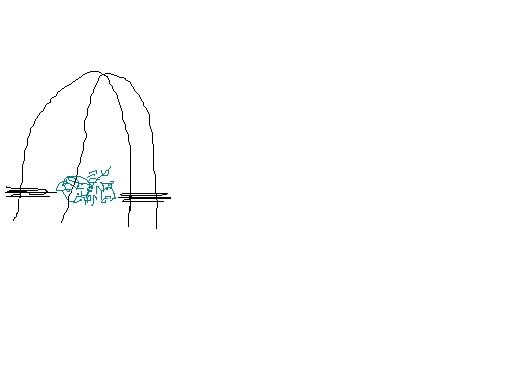
* Each of the two wires is about 18" long and each of the four ends sticks about 4" into the ground, so this drawing is not to scale. Like most of my drawings, it needs an explanation.of 1000 words or more but is only worth 25 or less. The green stuff is the catnip; the horizontal lines represent ground level; the wires are placed at right angles to each other. Hope it gives you the general idea. 

Saturday, October 2, 2010

drops in the bucket, part 3

Parts 1 and 2 of this title were written in January, when El Niño was filling and re-filling our rain barrels regularly. Now, ending a week that brought record high temperatures to the L.A. area, we seem to be starting a dry and dusty La Niña season. Dr. Jeff Masters' WunderBlog, which may tell you more than you want to know about such things, states that "historically, about 35 - 40% of El Niño events are followed by a La Niña within the same year."

I loved El Niño and so am hoping 2010 is one of the 60 - 65% of years when La Niña does NOT follow in her brother's footsteps. Even a year of NORMAL rainfall would be welcome.

Our five rain barrels have been empty for months (the last measurable rain having fallen in March), but within the last couple of weeks I've found a new source of water to 'harvest' -- the washing machine! Having switched from detergent to a magic green plastic laundry ball filled with ceramic beads, I have a dependable source of chemical-free water, laced with very dilute solutions of dirt, food, and human effluvia -- nothing a plant wouldn't love.

Harvesting wash water is more labor intensive than harvesting rain water, but I'm getting it down to a fairly simple routine -- learned the HARD WAY, of course, with much spillage.

First, siphoning into the nearest rain barrel with a regular garden hose was impractical. Starting and stopping the siphon were tricky operations, to say the least, and a large load of laundry produced more than the barrel's 50 gallon capacity. Running the hose out the back door brought in insects and heat, and would not be practical year-round.

A siphon pump improved the process greatly, but its tubing slipped out easily and the end in the washing machine got blocked by clothes. Steve perforated a small plastic hand-sanitizer bottle and attached it to the sucking end, but all the parts slipped apart too easily so he secured them with Gorilla Glue. Unfortunately the Gorilla Glue rendered the pump totally inoperable. Evidently it expanded to block all the joints where it had been applied.

Steve bought another siphon pump and perforated another hand-sanitizer bottle, and we were in business at last! I started siphoning water into various vessels including our old galvanized watering can (Haws' "Peter Rabbit" model, no longer available in the one-gallon size, but priced at $129.95 for the two-gallon size). Steve  bought ours for $1.00 at the Salvation Army Thrift Store years ago, and I suppose we need to treat is as an heirloom.

I started feeling like the Sorcerer's Apprentice, running back and forth between washing machine and garden with a motley assortment of containers. Fun, in a way, but frustrating to come back from emptying two half-gallon containers to find that the one-gallon watering can is overflowing. A pair of two-gallon plastic watering cans from Home Depot seemed to solve the problem, but they're pretty heavy when full.

Emptying the two-gallon watering cans into a rain barrel permits some relief, but I still need to take the water out of the rain barrel and USE it before the washing machine has to be emptied again.

It is shocking to realize that I regularly use A LOT MORE water to do laundry than I use to water the garden. See drops in the bucket, part 4, (assuming that I ever have time to write it!) for more on this issue.
Creative Commons License
POSToccupations by Frances Talbott-White is licensed under a Creative Commons Attribution-Noncommercial-No Derivative Works 3.0 United States License