Wednesday, November 23, 2016

deserting the village

The title of this post is an allusion to The Deserted Village, a poem by  Oliver Goldsmith (1728-74).  I would never have read this poem if it had not been assigned to me in college. The poem is 430 lines long -- all written in rhymed 'heroic' couplets of iambic pentameter. I do not expect you to read it,* but if you dip into Wikipedia's article on Goldsmith you will get an inkling of how it bemoaned the social and economic consequences of enclosure, a procedure which destroyed the concept of common lands and enabled the amassing of huge estates by wealthy landowners.

Goldsmith was an Irish-born novelist, playwright and poet who, in his day, was part of London's influential inner circle. These included Dr. Samuel Johnson and his biographer James Boswell, the painter Sir Joshua Reynolds, actor David Garrick, musician Charles Burney, and poet laureate Thomas Warton. In other words, Goldsmith became what we would now call a cultural icon, much as Marshall McLuhan became in the 1960s and 1970s in the U.S. and Canada. McLuhan famously appeared playing himself in Annie Halla film by Woody Allen (another cultural icon). McLuhan coined the term Global Villageto which my title alludes.

You may not be old enough to remember when everyone was talking about the global village concept. I am certainly no authority on it, but what I remember is that it had to do with a cultural bond based on people's being drawn to their television screens like campers around a campfire. In those days, television was dominated by three commercial networks, so everyone shared the same knowledge base, such as it was. ABC, NBC, and CBS gave us I Love Lucy, The Lone Ranger, Ed Sullivan, Walter Cronkite, etc.

McLuhan himself predicted that the Internet would greatly change our culture and that video would increasingly become an art form. I think he was right on both counts. The cultural change involves people deserting the village -- walking away from the campfire in droves, each with an individual video screen embedded in a smartphone. It's like carrying a candle (possibly lighted from the village fire) which, magically, brings each of us all the info we used to receive from television, plus much more.

Am I alarmed that the village is being deserted? Yes and no. 
While I rely on many of the features of my Android phone, I find it to be a hindrance to personal interaction. 

One example will suffice: a post-concert reception in the spring of 2014 where I sat at a table for eight or ten people who had either sung in or attended a concert at New York's Carnegie Hall. Only three people at the table were not talking on smartphones throughout the reception: a gentleman in his early eighties (member of the chorale), his young grandson (who had attended the concert with his grandmother and parents), and myself (member of the chorale). The three of us attempted 'live' conversation but, unfortunately, had little in common. Indeed, we came from different villages. The memory of this dysfunctional event was brought back to me recently when one of the persons who had been at that table told me how happy she was to have been able to talk on the phone to a former co-worker while she was in New York for the concert. 

Well, hey! I had friends in New York (and Los Angeles, and the U.K., and Pasadena, and Boise!) and could have called any or all of them, but I had chosen to be socially present at the occasion where my body and smartphone happened to be physically located. Disgruntled, I stomped back to our group's hotel and tried to talk to my roommate, who has never owned a smartphone but who was feeling too ill to communicate in any meaningful way.

I had TOO MUCH privacy at that reception, but lately I've been noticing how LITTLE privacy I have when I'm on my smartphone, which knows my age and location, what I've shopped for recently, and what pictures I have taken. Being 75 years old, I get what on-line marketers deem to be 'age-appropriate' ads (incontinent aids, beepers for when I've "fallen and can't get up," etc.). Oh, yes! The village is coming back to me in the form of a shopping mall.

- - - - 
 * In fact, I am not fond of The Deserted Village or any work of Oliver Goldsmith except his novel The Vicar of Wakefield, but I do not regret having studied 18th century literature in college and graduate school. I am grateful that I learned to appreciate the poets Alexander Pope, Thomas Gray, and Christopher Smart, along with seminal novelists including Samuel Richardson, Henry Fielding, Daniel Defoe, and even Aphra Behn.


Tuesday, May 24, 2016

is that what you're wearing?

Back in March 2010, I first wrote a blog post about family language rituals. Since then, I have often thought about writing more on that topic. Less often (like: twice or three times), I have even done so. Today, more than six years later, I want to write about something that Steve and I ask each other almost every day:
 "Is THAT what you're wearing?" 
Depending on our schedules, we sometimes ask it several times a day. Most people would be insulted by that question, but we are always amused by it. Yes, we're easily amused, and that may be one of the reasons we're still married after 53 years.

In a sense, "Is THAT what you're wearing?" can only be answered in the affirmative: "Yes, this clothing is what I HAVE ON at this moment!" By contrast, it's said that "Are you asleep?" can only be answered in the negative. Generally, though, our answers are not a simple negative or positive.

Steve will ask me, "Is THAT what you're wearing?" to call attention to the fact that I'm not ready to go somewhere. He's likely to BE ready, and I'm likely to be wearing my nightgown or gardening attire caked with mud. In this case, my answer would be "No!" or "Just hang on a few minutes."

I tend to ask Steve, "Is THAT what you're wearing?" to call attention to a color-coordination* problem or other wardrobe malfunction,** usually when he's getting ready for a rehearsal or performance. In this case, I make sure he's presentable before he leaves.

When my father, Erven, would leave to go grocery shopping, my mother, Charlotte, would often say, "Don't pinch the tomatoes!" Married couples need ways of gently checking up on each other. It helps make our worlds go 'round.
- - - - -
* Color coordination seems to be more difficult for men than for women. Geneticists see this as a chromosome issue, but Steve's brother Phil attributes it to the fact that little boys are typically given the eight-color box of crayons, while little girls tend to be given a higher multiple of the basic eight. Today's mega-box holds ninety-six colors.

** This famous euphemism was coined by Justin Timberlake to describe a semi-decent exposure he inflicted on Janet Jackson during a half-time show at Super Bowl XXXVIII in 2004. Steve's wardrobe malfunctions tend to involve misalignment of buttons with buttonholes or uneven tucking in of shirt tails.

Thursday, April 28, 2016

easter? cactus?


Easter Sunday this year fell on March 27, three days after Steve and I returned from our spring visit to Idaho. At that time our Easter Cactus was covered with buds, but they showed no sign of opening until Monday April 18, in time to develop full bloom by the first day of Passover on April 22. Hence the question mark after easter in the title of this post.

I must admit that I'm not especially fond of container gardening. I much prefer to grow plants in the ground, but two or three years ago we put up a broad shelf that's an obvious place to display potted plants along the front of the house. 

When we moved here in 1975, the space under what is now the potted-plant shelf was a sturdy brick planter with an old split-leaf philodendron entrenched in it. The split-leaf philodendron, in my not-so-humble opinion, is a cliché of the plant world. It was wildly popular as a gift plant during the 1950s, when this house was built. Its rather oxymoronic scientific name, Monstera deliciosa, refers to the fruit which, according to wikipedia, tastes like fruit salad. I never noticed any fruit on ours, and probably wouldn't have tasted it if I did.

It took me a long time to get rid of that monstrous old philodendron. Its thick, fleshy roots were trying to penetrate the foundation of the house and needed to be pried loose. I resolved not to plant anything in the old brick planter, and for several years tried using it for a bench. The problem there was that it was simply too uncomfortable for anything but emergency seating.

I've kept this particular Easter Cactus alive for several years. In some years it's squeezed out a few spring blossoms. What is different this year? Two years ago I replanted it in a glazed ceramic pot along with a scoop of balanced plant food, and set it in a place where it doesn't need to be moved. Upon reflection, I realize that must have been when I was populating the new shelf with (mostly) newly repotted plants. I've also been more consistent with watering. Reclaiming laundry water on a regular basis means USING the water on a regular basis, though sometimes I don't think about the potted plants until everything else has had its generous allotment,

It was because I thought I knew how to take care of cacti that I failed to give the Easter Cactus enough water. Rather than question my methods, however, I began to question whether it was really a cactus (hence the question mark after cactus in my title). A quick foray into wikipedia and some rare-plant nursery websites assured me that it is indeed a cactus, its spines having evolved into little hairy tufts appearing at regular intervals along the edges of its flat leaves. A native of the rainforests of southern Brazil, it belongs to the huge rhipsalideae tribe which also includes Christmas Cactus, Thanksgiving Cactus (new to me), and the broader leaved epiphyllums which have been having a hard time under my care in recent years.

I foresee happier days ahead for my rhipsalideae.

Thursday, April 14, 2016

new kid on the block

This past Sunday I wrote about two new colors of sweet pea blooming among the volunteer plants growing in our parking strip. I thought I had covered the subject pretty well when I described a blossom that was bright pink streaked with white as well as one showing a very subtle shading of light pink and white. 

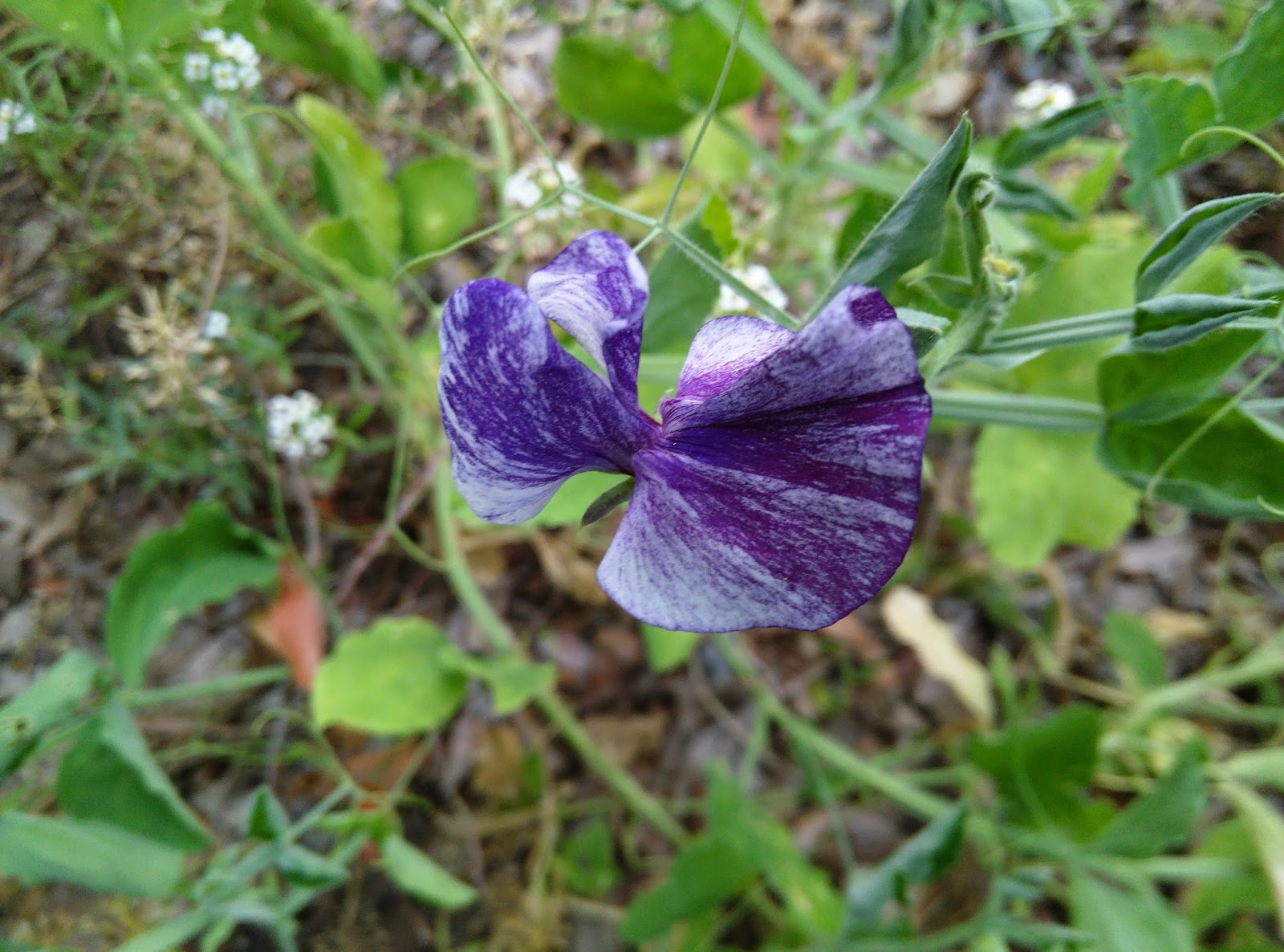
Preoccupied with other activities including a major offensive against weeds in our neglected back patio, I did not look at the parking strip for three or four days. Thus I was totally surprised yesterday afternoon to find that streaky purple and white blossoms had started to appear on two of the vines sprawling around there. I tried to take a picture then, but the sea breeze made focus too difficult. Here is this morning's effort, shown larger than life so that you can see the stripes quite clearly:


I tried a little research on sweet pea viruses before starting to write this morning's posting, but found nothing like this. Moreover, the fancy seeds being advertised as producing variegated blossoms do not show this kind of bold pattern. 

My first thought was to make this picture a post-script to the previous posting, but found it so striking that it deserves its own coverage.

What will the rest of this unusual spring bring to our increasingly wild parking strip? I'll try to watch more carefully so's not to miss anything.

Sunday, April 10, 2016

variegated volunteers

I haven't planted a sweet pea since 2011, and yet I've had some lovely specimens in the front garden and parking strip. You can see a history of my sweet-pea struggles (and triumphs!) in a post from 2013, where I focus on the genetics of pea blossoms and speculate about whether there will be changes (mutations?) in color among my volunteer sweet peas from year to year. I would especially like to see some all white blossoms;** these were fairly common when I planted from seed packets labeled as  'mixed' colors, but they have been totally absent from their naturalized progeny.

Due to stranger-than-usual weather in the fall-winter of 2015-16, volunteer sweet peas sprouted in early October but did not bloom until March. Steve and I returned from a spring visit to Idaho on March 24 to find that spring had actually come on schedule to our SoCal location. (It usually comes in October or November, when I delight in calling it 'Fring.') California poppies, freesias, hyacinths, azaleas, and nasturtiums were in vibrant bloom, and buds were fattening on the Texas sundrops. But the sweet peas were what caught my eye.

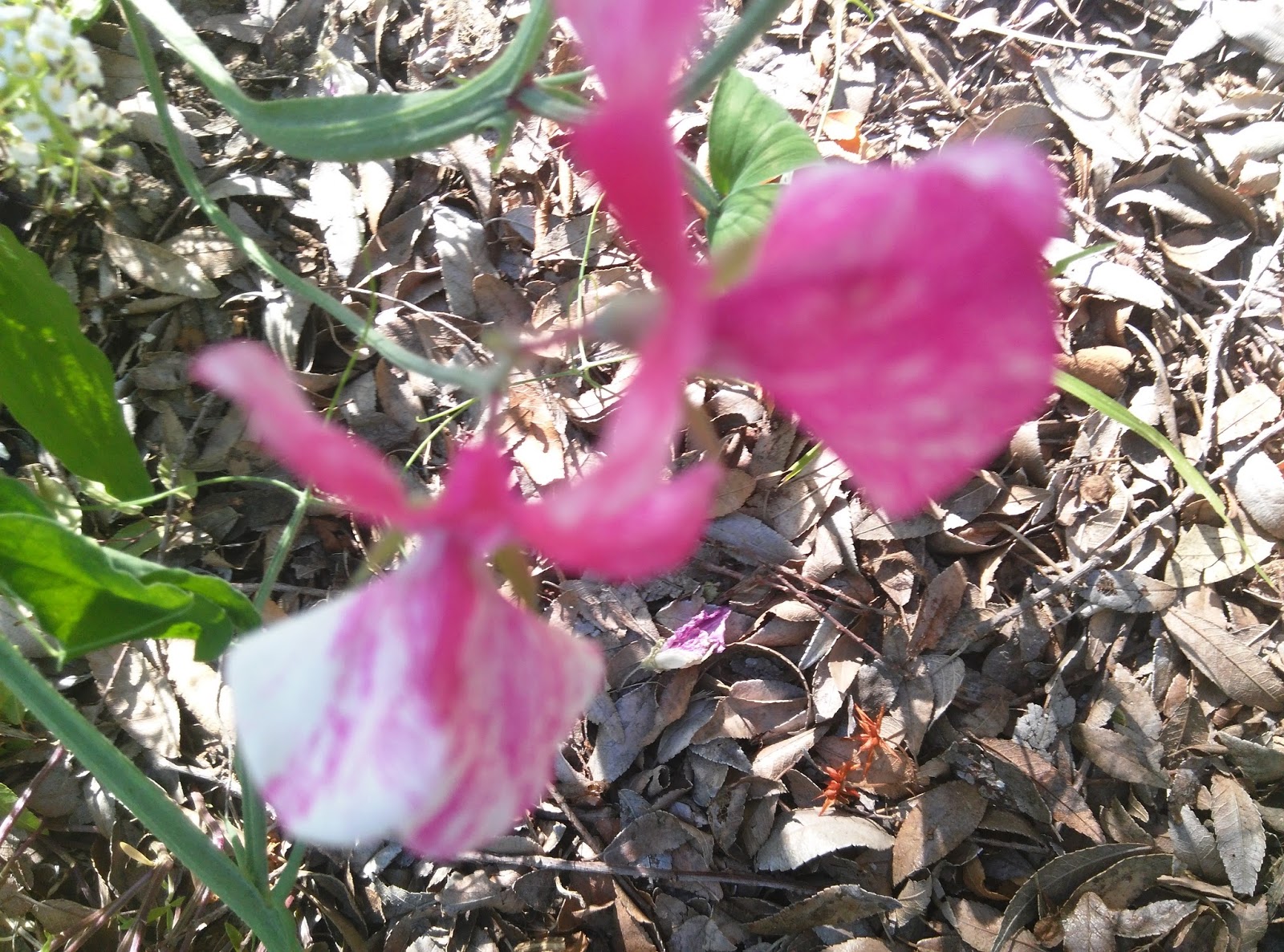
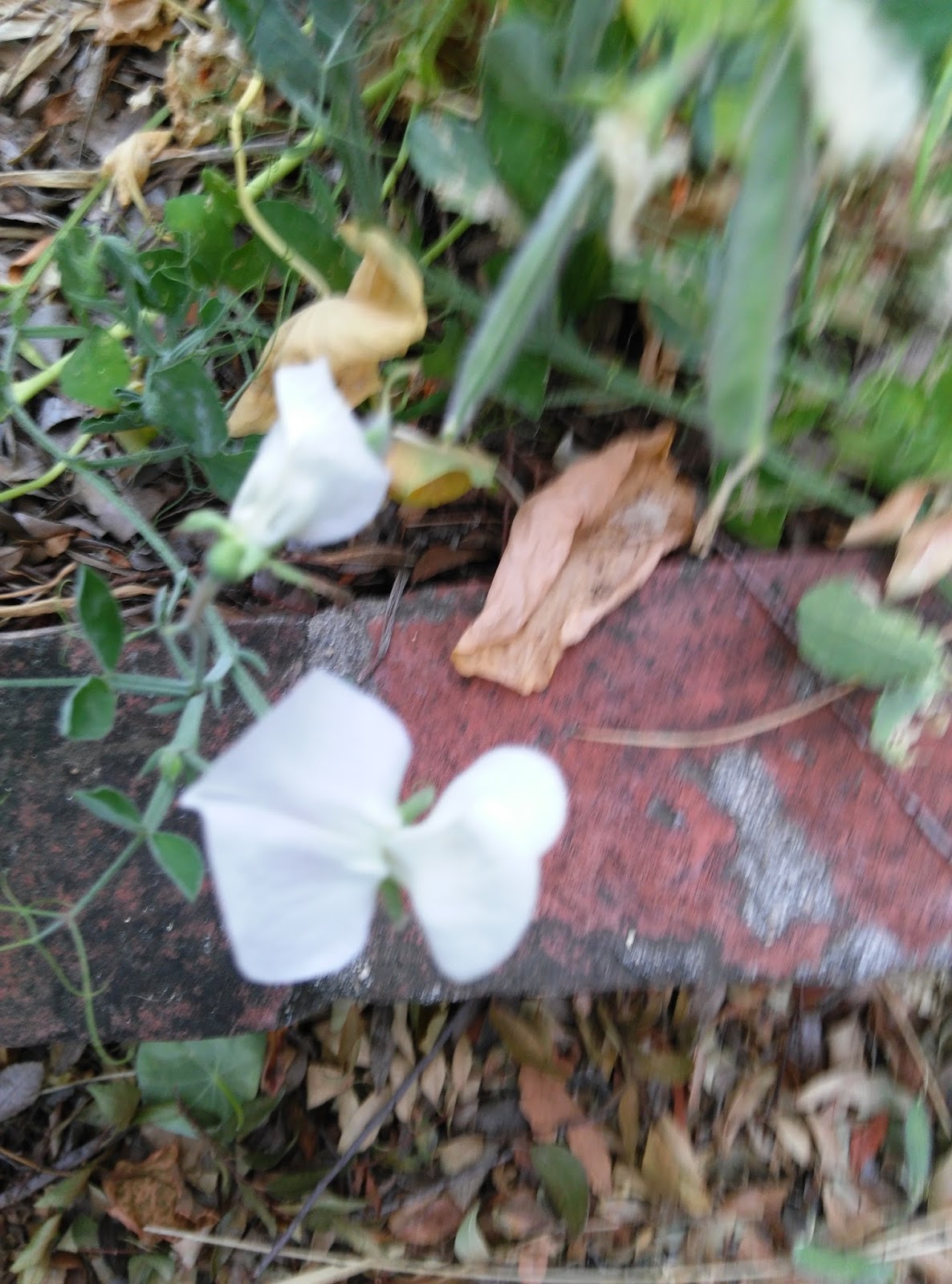
Examining the sweet peas closely, I observed two specimens that were like nothing I'd ever seen before among my volunteers:


The upper image shows STREAKING of bright pink on white (or vice versa), and the lower one shows the WHITEST petals I've seen on volunteer sweet peas. Plain bright pink blossoms have appeared every year, and there have been plenty of light pink with white, but none where the white part of the petal has predominated. If I were a more dedicated follower of Gregor Mendel, I would save seed from these two to see what they would do next year, but it's more fun to wait and be surprised.

To paraphrase the old saw about art: I don't know anything about plant genetics, but I know what I like!*
- - - - - -

* I do know enough about horticultural history to recall that streaking (most notably in tulips) can be the result of a virus. Going wild does have its risks.

** P.S. All-white blossoms have finally appeared on one of my volunteers. They're not in the parking strip, but in a bed devoted mostly to bulbs. This little vine is reaching out onto the sidewalk. Trying to get to the parking strip? When it dries out, I'll scatter its seed there. It could stay where it is, but I have ambitious plans to dig up and separate all my bulbs in August or September.


Friday, February 19, 2016

music hall

Here's another reminiscence of performing as a flutist accompanied on piano by my mother, Charlotte. This one happened while I was in junior high or high school.

In addition to her regular jobs as a church organist and choir director during my formative years, Charlotte was often called upon to accompany singers and instrumentalists at community meetings and special events. 'Mrs. M',* a violinist, was one of these performers. On the occasion I want to describe, it was evidently Mrs. M's turn to play a solo for her music sorority's alumnae group. She wanted Charlotte to accompany her. Various issues were at stake, and as I try to reconstruct the scene I think they stemmed mostly from the fact that Mrs. M wouldn't have wanted to pay Charlotte's fee.

There were and still are two major fraternal organizations for women studying music in U.S. colleges and universities -- Delta Omicron (DO) and Mu Phi Epsilon (Mu Phi) -- and the competition between these can become fairly intense from time to time. Charlotte had been a DO and Mrs. M had been a Mu Phi.** Mrs. M would have tried to convince Charlotte that playing gratis for Mu Phi was actually a contribution to DO. I wouldn't wonder that Mrs. M offered to play gratis for Charlotte's DO group in return. However, Charlotte -- a deeply anti-social person -- didn't have a DO group and wouldn't have wanted Mrs. M to be seen or heard there anyway.

In retrospect, I think Charlotte insisted that I must play with her and Mrs. M because I would benefit from the experience and thus bring some kind of recompense to our family. This argument, of course, was totally bogus. Charlotte and I had recently played with Mrs. M for a mother-daughter fashion show at our church. Mrs. M had complained to Charlotte that it was difficult to play with me because I kept a too-rigid beat. She felt that she was "playing in a marching band," an indignity to which she had never before been subjected. Besides her penchant for rubato, Mrs. M had the habit of sniffing noisily on the upbeat when she raised her violin to her chin. This was anathema to me. I had spent years learning to breathe deeply but silently on upbeats and, to this day, am proud of that skill.

Thus a troika of mismatched and unwilling players appeared on the appointed evening at the gracious home of a Mu Phi alumna in our upscale suburb. Upon entering the living room, we noticed right away that there was no piano, though Mrs. M had been assured that the hostess had a wonderful grand piano. Alas! The piano was in the den, separated from the living room by a hallway of about 12 to 15 feet in length.

Charlotte played piano in the den, Mrs. M played violin in the living room, and I played flute in the hallway. Mrs. M and Charlotte could both see me, but they could not see each other, and so I acted as conductor. I have no memory of what we played, though I know that I must have played the second part. Charlotte had instructed me that "No violinist wants to play 'second fiddle' to a flutist." It was probably something like Dvořák's Humoresque or a Haydn Serenade (or both). Charlotte would have written out a 'second fiddle' part for flute, and none of us would have needed to spend much time rehearsing with each other.

The Mu Phi's loved us, of course, and plied us with punch and cookies. Charlotte's compliment to me was that my tone sounded great because I was standing in front of the open bathroom door and getting resonance from all the tile work. We laughed for years about the 'music hall' performance

- - - - -

* In those days (the mid- to late-1950s, adults were always called 'Mr.', 'Mrs.,' or 'Miss' even if they were close friends. I once got in a lot of trouble for calling Judy's mother 'Doris' instead of 'Mrs. C.' It seemed so natural after hearing Charlotte refer to her regularly as 'Doris' for so many years.

** Years later, I became an honorary Mu Phi alumna, but that's another story.

Wednesday, February 3, 2016

a holiday visit

It was in early December of the year 2001 that my mother, Charlotte, suffered her first hip fracture and had surgery to rebuild the affected joint. She was 86 years old at the time, having been born in March of 1915. Charlotte eventually endured another hip fracture and another surgery in 2008, and would live on until October 2013, but that's another story (or two, or three).

On that early December day in 2001, I was reached at our older son and daughter-in-law's home in northern California, where I enjoyed their company while making myself available for some League of Women Voters' meetings. I was told that my parents would be needing my help. This was an understatement.

My father, Erven, had been entrusting all the cooking, cleaning, child-rearing, and other household duties to Charlotte since July of 1937, when they were married in Southern Ohio, and so he was seriously challenged by her inability to sustain him during this difficult time. Neighbors would tide him over until I got there, he said when we talked on the phone. He had arranged for Charlotte to stay in a rehab facility until he was ready to bring her home. When he did bring her home, he said, she would find a newly-installed dishwasher as a Christmas present. Meanwhile, he suggested that I should bring my flute and be ready to play some Christmas music with her.

And so I went home to Southern California and soon took off for Phoenix, where Erven picked me up at the airport and took me to Charlotte's rehab facility near Wickenberg, Arizona. Charlotte was not in good spirits. She had been asked and asked to play the piano there, but she repeatedly declined because "something had been done to it." I opened the top of the upright piano and saw that it had been stuffed with tightly folded blankets by someone who wanted to muffle the sound. When the blankets were removed, it worked like a normal piano, and so Charlotte was willing to play at last.

I pulled out my flute, and the Christmas music I had brought along. Sotto voce, I said: "Good King Wenceslas, key of G." Charlotte gave me a two-bar intro ("GATH-ring win-ter fue-OOO-el"), and we were OFF!. The other patients loved it, and so did I. We gave a full program of Christmas carols, with Charlotte playing everything by ear. This was the kind of thing I had grown up doing since the age of eight, always expecting and receiving an accurate but flexible accompaniment on piano or organ, and never knowing the meaning of stage fright until my classmates began to suffer from it.

Afterwards, Erven drove me back to their small but comfortable home. There was about half a leftover turkey in the fridge, so I showed him how to make turkey hash. He was good at chopping meat and onions and potatoes, but nevertheless waited for Charlotte to take the initiative for future meals. At least she got a head start from the quantity of turkey soup I left in their freezer. I don't think she cared much for the hash.

Next day, the dishwasher was installed, and a neighbor brought in some chunks of two-by-four to help Erven raise their bed to the level prescribed for convalescence from hip surgery.

It's always good to have some easy music on hand. In recent years I've also learned to keep some favorite recipes on line in case of emergency.

Thursday, October 22, 2015

silk purse

Facebook friend Josh has challenged us: "If you please, let's hear your personal definition of Creativity." So far, twenty people have responded with answers from one word (sanity; happiness) to a short paragraph. I would respond but cannot limit myself to a single paragraph.* Josh has over a thousand Facebook friends, so this challenge may take a long time to run its course.

Josh's friend April comes very close to my definition with: "Putting pieces together in a previously unexplored manner, whether art, literature, music, et al." Profound, but I must say more.

For me, creativity is a compulsion to raise things (words included) and/or concepts to a higher level and, in so doing, change and enhance their meaning: looking for the sow's ears that can be worked into silk purses. My late friend Kay was trained as a clinical psychologist, so she knew a compulsion when she saw it. She also had the empathy to say to me one time that she understood how creativity complicated my life. 

On the other hand, Letty once said of herself (rather proudly I think): "I'm NOT creative!" This, on the way home from a Cub Scout event where we'd been doing crafts with the boys.

A while back I found myself pondering a cliché: "with all deliberate speed." It occurred to me that this legalistic phrase, made notorious as a sow's ear in the history of school desegregation, was a sort of paradox. By and by, my silk purse emerged as a short poem:

     Physics
Speed
turns matter to energy
somewhere far away.
Deliberation
turns matter from noun to verb
producing energy I use today.
If you follow Joshua Frank Talbott's work, my speed and deliberation are sort of like his blue jay and dinosaur.

- - - - 
*Facebook grabs your words away as soon as you hit enter, and this seriously cramps my style.

Friday, October 16, 2015

how sweet it is!

At the end of February, I planted stevia* in our little boysenberry patch. Somehow I had learned that boysenberries like to grow near tall herbs that will bloom and attract insects to pollinate the berries. Thus our berries' companion plants currently include not only stevia but also Italian oregano, mint, purple-flowered sweet marjoram, and garlic (chives and bulbs). In spite of this carefully controlled environment, 2015 has been a terrible year for boysenberries. In fact, I think I have harvested about three (3) berries and simply popped them into my mouth in situ.

I expected stevia and boysenberries to be great companions on our table as well as in the garden. I envisioned big bowls of berries sweetened with chopped fresh stevia leaves. We often eat strawberries that way, and I've been looking forward to drying and grinding some stevia leaves for sweetening hot drinks. Just imagine a sugar bowl full of dark grey powder!

Sadly, it's been harder and harder to find the stevia plant in our berry bed, because tomatoes** have pretty well taken over the space. Several times, Steve has gone out to pick stevia and come back empty handed, but I knew that the herb had grown tall and was hiding its green leaves between the stems of an overgrown tomato plant. So I showed Steve that, though the stevia's main stem was dry and brown, there were some healthy green stems and leaves farther up. In fact, I was delighted to find that the plant was topped with tiny white blossoms, and, as a great fan of edible flowers, I was eager to sprinkle them onto the strawberries. Naturally, I assumed that the stevia blossoms were attracting insects that would pollinate any berry blossoms they might happen to find.

I've harvested and dried a lot of herbs over the years, but have never seen anything quite like the way the stevia's thick main stem had turned brown. Maybe it was time to read up on how to grow stevia. Sure enough, the Bonnie Plants stevia page had this advice: "Stevia bears small white flowers in the fall. At this point, the plant stretches out and offers fewer good leaves for harvest. Trim off the blooms to keep the plant producing leaves as long as possible." An accompanying photo made it quite clear what to do.

Working sadly, I cut the brown stevia stem about eight inches above the ground and then made a fistful of cuttings from the green leaves. I carefully placed the cuttings in water and commenced to wait for roots to appear.

Later, I went back to the berry patch intending to cut back the tomatoes. Here's what caught my eye:

Surprise! It's a baby stevia growing up from the root of the original plant. How sweet it is! And how glad am I that I've learned the permaculture technique of leaving the roots of dead and dying plants in the soil instead of pulling them up.

- - - -
* As high fructose corn syrup and a plethora of artificial sweeteners are losing popularity among health-conscious consumers, stevia's continuing trendiness is ensured by such phenomena as the 7th World Convention on Stevia, held in Berlin in June by the World Stevia Organization. Visit stevia.net for "a tale of incredible sweetness and intrigue."

** I'll save the explanation of this sad occurrence for another day, as I'm aiming for a happy ending right now.

Sunday, September 13, 2015

kinsey and me (too), part 2

Not much is said of the (too) in kinsey and me (too), part 1, unless you surmised that I too would stay awake to "read Nancy Drew mysteries on hot summer nights," as Sue, Kit, and Kinsey did. This post will go back and pick up on the 'me too' thread.

I have always felt a kinship with Kinsey Millhone, although I could never follow her regimen of running three miles a day (five days a week), and I have no training in martial arts or marksmanship. I appreciate to the fullest Kinsey's irreverence for most social mores and I endorse her minimalist lifestyle: small cars, a casual wardrobe (with one good black dress/tunic for emergencies), and readiness to travel at the drop of a hat. I love peanut-butter and pickle sandwiches, but am not addicted to the fast food Kinsey shamelessly devours in her car. Since high school, 3x5 index cards have been my preferred medium for important notes and lists, and Kinsey always carries a big bundle of cards in her shoulder bag.

Having spent memorable times in Santa Barbara, I enjoy the settings of Sue Grafton's novels. Her fictional Santa Teresa and neighboring cities including Colgate, Montebello, Perdido, and Cottonwood are thinly veiled versions of towns in the greater Santa Barbara/Ventura area. When Kinsey travels outside this area, 'real' place names are used: Reno, San Francisco, Bakersfield, Los Angeles, Beverly Hills, Culver City.

Getting to know landmarks and characters through a series of novels makes a reader feel at home. This is true in Anthony Trollope's Barsetshire and Caroline Keene's* River Heights, as well as in Sue Grafton's Santa Teresa. Kinsey's friends are my friends: lovable landlord Henry Pitts, restaurateur Rosie, confidante Vera, the enigmatic Dietz, and a cohort of officers from the Santa Teresa Police Department.

My kinship with Sue Grafton is simpler in a sense, but more complex in others. She was born in 1940, I in 1941; we came along at the tail end of the 'silent generation (1925-1942),'** born before Pearl Harbor yet shaped by our parents' experiences of the Great Depression and World War II.


I have watched Grafton age gracefully through book-jacket photos taken from 1983 to the present, and in each one she looks like someone I would meet at a community event or remember from my high school class of 1958. Just look at those dimples!

With this image in mind it was fun to spot Grafton's dimples on the face of evil Edna Shallenbarger, an embezzler who skips bail to appear in X. Kinsey tells us: "She smiled with her lips together, creating a dimple in each cheek. The effect was curious. Malice surfaced and then disappeared" (pp. 154-55). I sensed that Sue Grafton has used her dimples to great advantage throughout her life, and I now I will continue to look for dimples on the faces of characters in her fiction.

It's tempting, but I do not intend to count the ways that reading Kinsey and Me has informed -- and will continue to inform -- my reading and re-reading of the Kinsey Millhone mysteries, but I do want to comment on the 'me too' effect in Grafton's X. Don't worry. No 'spoiler alert' is needed.

X is set during a serious drought that lasted from 1986 to 1991, and all the households in Santa Teresa are being asked to cut back voluntarily on their water use. Henry Pitts is trying hard to comply by taking out his thirsty lawn, putting in a drip irrigation system, and learning about gray water. At times I felt like I was reading my own blog:

Weather pundits warn that California's drought is not over . . . . Water-saving measures abound: days and hours (minutes!) of watering time are severely limited, cities pay $2.00 per square foot and more for residential lawn removal, and courses in xeriscaping appear in college extension catalogs. People joke about the 'water police.'
But where Henry's compliance is still voluntary, we in Culver City have moved to the mandatory level. A fine of $250 will be levied any time we are caught running potable water outdoors, at times other than before 8:00 a.m. or after 6:00 p.m. on Tuesdays and Saturdays. One neighbor in particular likes to phone the water company whenever she spots a violation.

From time to time I have written about my preoccupation with organizing our household effects. Sandra Felton, one of my current gurus in this area, recommends a regimen of three C's to use when decluttering: consolidate, containerize, condense. Following this procedure, I am currently consolidating and containerizing a vast number of things -- mostly yarn and other craft supplies -- into an indexed series of Bankers Boxes (about 30 so far, with no end in sight).

When Kinsey talks about assembling Bankers Boxes I once again feel that I am astride that fine line between fiction and fact. Kinsey uses her knowledge of Bankers Box construction (and deconstruction) to find an important clue about X's worst villain, and I can see just exactly how she did it. Luckily, I don't think I'll need to follow her example. But who knows? Someday I might want to conceal the details of a secret yarnbombing project. Where better than between layers of cardboard in Box Y?

- - - - - -
* collective pen name of a large group of underpaid ghostwriters working through the Stratemeyer Syndicate to create the Nancy Drew mystery series. 

** "too young to see action in World War II and too old to participate in the fun of the Summer of Love." See NPR's How Generations Get Nicknames.


Sunday, September 6, 2015

kinsey and me (too), part 1

Years ago, on the advice of a friend, I read G is for Gumshoe, Book 7 in Sue Grafton's alphabetical series of Kinsey Millhone mysteries. Soon thereafter I doubled back to A is for Alibi and kept with it through W is for Wasted -- the last few titles via my Kindle e-reader. Naturally I pre-ordered Book 24 ([is for whatever]), but what was I to read while I waited?

I noticed that Amazon's Sue Grafton page offered a book of short stories, Kinsey and Me, and so I ordered it even though I prefer longer fiction. The first half of Kinsey and Me features Kinsey Millhone, solving cases lickety-split within the rigid confines of the short-story format. The second features a fictionalized Sue Grafton, coming of age in Kentucky as 'Kit Blue' (née Conway) and coming to terms with the transitions in her alcoholic parents' self-destructive lives. The 'Kit Blue' stories were written during the decade following her mother's death. 'Vanessa' "died of an overdose of sleeping pills after extensive surgery so that the cause of death was probably listed as Despair" (pp. 273-74).

Besides the two groups of stories, Grafton presents three excellent essays which, for me, establish her credentials as a writer of elegant nonfiction. There's a preface in two parts: first describing the important differences between the mystery novel and the mystery short story, and then laying down a rationale for the writing of the more personal second part of the book. Between the two parts, "An Eye for an I" traces Grafton's own development as a reader and writer of crime fiction, alongside a detailed analysis of the genre. Finally the introduction to the second group of stories delves into the relationship between Sue, Kit, and Kinsey, starting with their largely unsupervised childhoods, free to read Nancy Drew mysteries on hot summer nights.

No doubt I could go on forever comparing and contrasting the parts of Kinsey and Me, but I'll stop with a couple of observations about style. The second half is written at what your English teacher would have called 'a higher level of diction' than anything you'll ever see in a Kinsey Millhone novel or story. It's a treat to witness Grafton take flight onto this more abstract level, but it's also a treat to see her come back down to the straightforward level on which Kinsey moves. I think the difference in style and tone is based on the fact that Kinsey is always moving into the future whereas Kit is always moving into the past.

I loved all the stories and essays in Kinsey and Me, but they would not keep me occupied until Book 24 finally downloaded itself onto my Kindle. Again, what was I to read?

Anthony Trollope (1815-1882) rarely disappoints, and the Trollope group on Facebook was discussing his one-volume novel Miss Mackenzie in July and August. I read it quickly while waiting for the group to begin its discussion, and signed up to write summaries for the last three chapters (28, 29, and 30). BTW this was the first time I have been able to stay in sync with the group schedule, and I greatly enjoyed the leisurely second reading, enhanced by comments and background material from other readers. I shared some info on aspects of Victorian life -- mourning attire and dinner-party service à la russe, for example -- and am looking forward to the group's next project.

Just as I stepped away from the rarefied atmosphere of Miss Mackenzie, Sue Grafton's X appeared on the menu of my Kindle Paperwhite. There was no 'is for' clause in the title. Grafton takes up this issue in a USA Today interview:
I first thought of using 'X is for Xenophobe' or Xenophobia, which suggests a fear of foreigners, but alas, not one single foreigner materialized in the course of the writing," Grafton says. "There's a box of files with an X on the lid, a Father Xavier, a married couple whose last name is Xanakis, and a missing painting of a xebec which is a three-masted sailing vessel, but none of these seemed to encompass the whole. Finally, it occurred to me that since I was the one who invented this 'rule' about '…is for…' I was surely entitled to break it.
Let's wait for another day to talk about reading X with the new insights afforded by Kinsey and Me.

635652322095155007-mottled-X


Monday, August 31, 2015

dragon fruit? it's really cereus!

On Friday, I posted cereus fruits, and on Saturday morning I walked out our front door to find our next-door neighbor talking with another gentleman on the sidewalk beside our cereus. The other gentleman kept saying something about dragon fruit.

I was in a hurry to get to our local fiesta, where I would be volunteering at the garden club's booth, so I didn't hang around to participate in the discussion. But dragon fruit kept nudging my brain and at last brought up the memory of a TV cooking show I'd seen where professional chefs were challenged to prepare an appetizer using dragon fruit. Yes! The picture in my memory matched a picture in my previous day's blog post: the fruit just splitting open and showing a wedge of something black and white.


Throughout the fiesta, I was thinking of dragon fruit. I couldn't wait to get home and do some googling. Info, of course, abounded. If you are already a dragon fruit aficionado, you may want to stop reading right now. But what I'm writing about is not so much dragon fruit per se as my delight at being set straight on something new that applies to my gardening efforts. I find it endlessly fascinating to explore the gaps between what I think I'm growing and what may eventually grace our table.

Here's the overview. Dragon fruit (aka pitaya) come in about four types, based on the variety of cereus that bears them. Our tree-like cactus produces bright red fruit shaped like hand grenades; inside they have black seeds distributed evenly through white pulp. Others, grown from plants with trailing stems, have pointed green scales (making them look more dragon-like) and may have either red or white pulp; the ones with red pulp are juicier and not as sweet as the ones with white pulp. Finally, most of the dragon fruit grown in Southeast Asia have yellow skin with green scales; again, pulp may be white or red. All are low in calories and high in antioxidants.


I found not only an account of the cooking show I'd seen last year, but also numerous videos on how to eat a dragon fruit. These ranged from a raucous piece by Chef Buck (must I warn you about the 'adult' language?) to a comprehensive farm-to-table presentation by a clean-cut young representative of  Tropical Fruit Growers of South Florida. The latter offers to have dragon fruit delivered right to your door. 


The idea of delivery raises the question: "How much does dragon fruit cost?" Again, there's a range. Chef Buck got his for $5.99 a pound, and this seems to be the low end. Amazon will send you a box of 3 -- the kind with green scales and white flesh -- for $28.95. Since most dragon fruit sold commercially weigh about a pound each, this is actually about the same price as the $10.00 per pound you're likely to pay in the upscale supermarkets (Whole Foods, Sprouts, Bristol Farms). Local farmers' markets offer them for as low as $7.00 per pound.


Today Steve and I counted four small dragon fruits on our tall cereus. With these and the possibility of an additional four or five from more recent blooms, I don't think we'll make a killing in the dragon fruit market. These are for home consumption, and while we wait for them to mature (probably not until November) we can start collecting recipes. On second thought, maybe just a small wedge will suffice for starters.


Friday, August 28, 2015

cereus fruits

Last Saturday, Steve's former colleagues Louise and Marsha came by to pick him up for an event. They were fascinated by our huge cereus,* which happened to be bearing a number of fat buds as well as some spent blossoms in various stages of dilapidation. We speculated about whether any would turn into fruit. Since Louise is a faithful reader of this blog, I started talking about a post I'd written last year about the fruit that had formed then. Louise said she hadn't seen it, so I thought I'd look it up and send her a link.

To make a long story somewhat shorter, my search was fruitless. I could visualize the photos I'd taken of the cereus fruit, but evidently I'd never even started a draft of the post or uploaded the photos into the draft. Some of the words I'd intended to use were still floating around in my head, but none had been written.

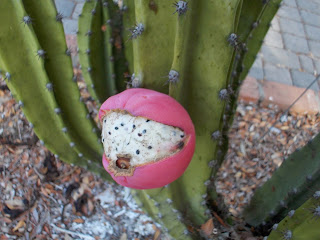
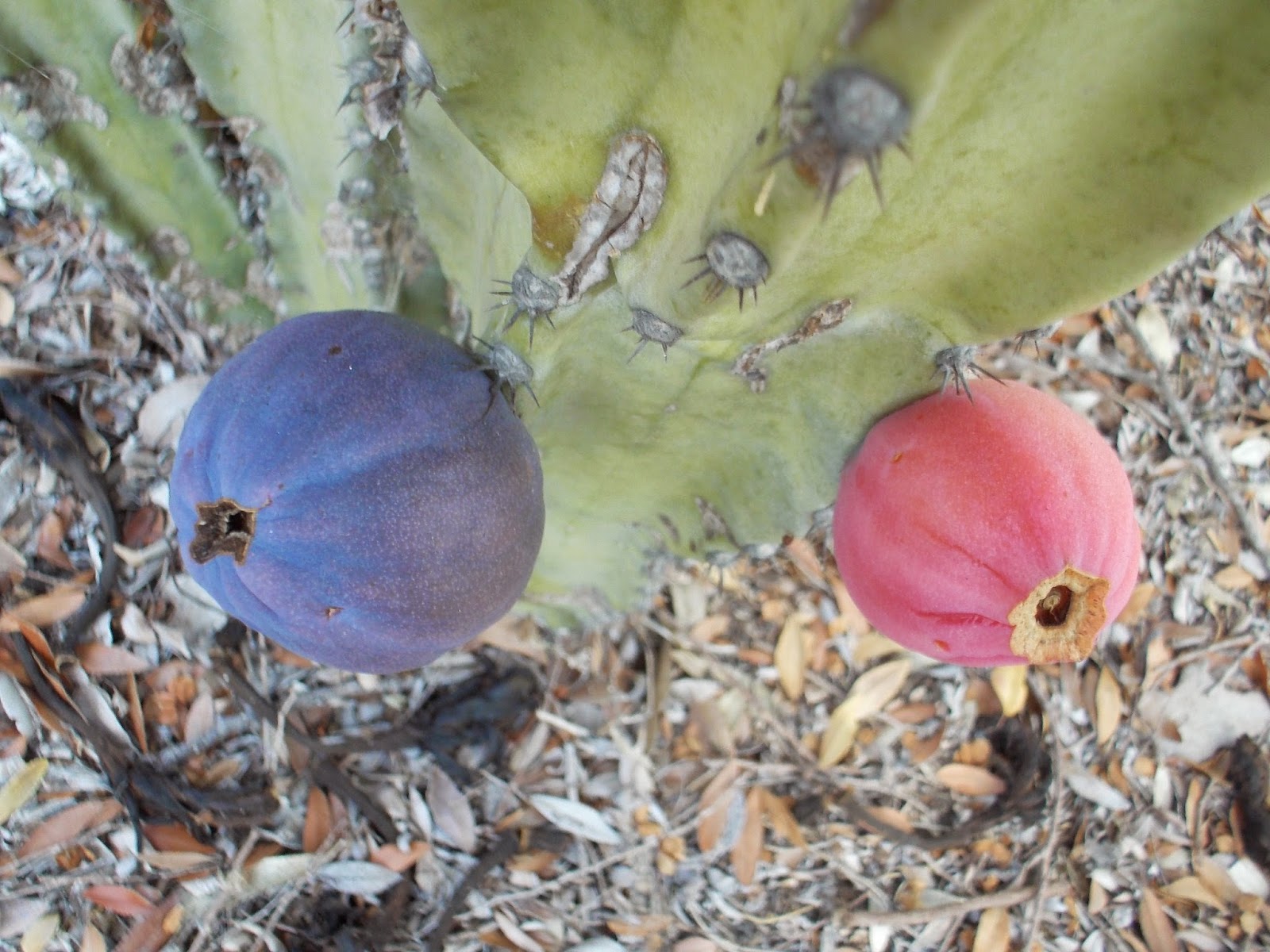
It was easy to find the photos, which I'd stored on the Internet on August 22, 2014. Let's look at them:


On the left is an unripe cereus fruit, and on the right a ripening fruit. The black things on the ground are dead blossoms, and the holes in the blossom ends of the fruits are where the pistil hung for several days after the other parts of the flower had dropped off. I know it's hard to believe that the darker fruit is the unripe one, but bear with me here.


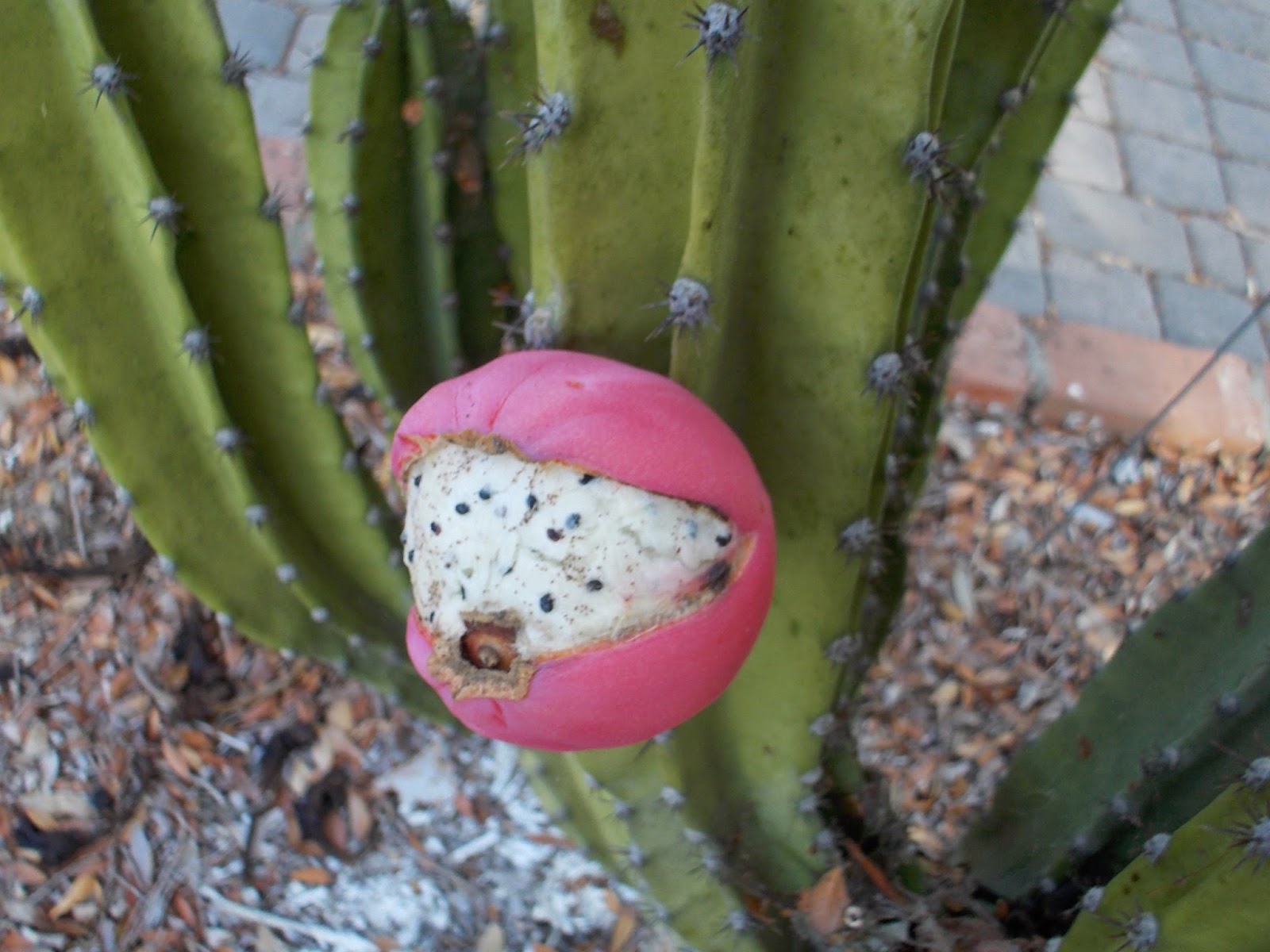
The stem end of the ripe fruit shown above has fattened up to strengthen its bond with the plant, and the fruit shown below has started to open up. I think it looks like some weird hors d'oeuvre (tomato stuffed with cream cheese and poppy seeds?), or maybe 'Pac-Man' rudely talking with his mouth full:


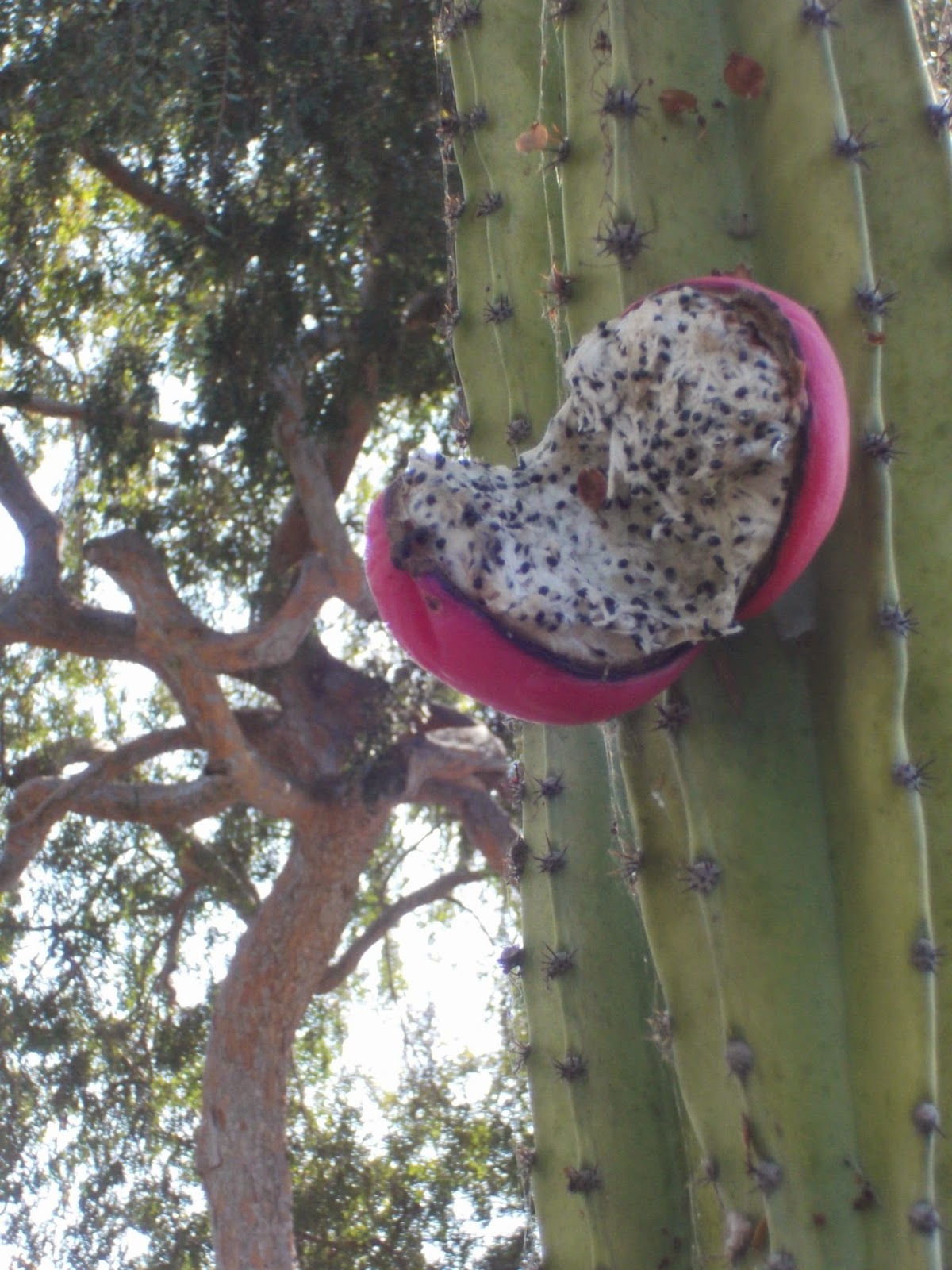
At last, the final shot, where our Pac-Man appears to be frothing at the mouth:


Steve bravely tasted the gooey substance and said it was quite sweet. I'm grateful that he lived to tell the tale and that Louise told me she hadn't read it.

Am I chagrined that I had not brought this story of plant procreation to light last year? Not especially. I think anyone who is serious about writing has a mental stash of texts, and sometimes there's a fine line between those that have actually been written and those that exist only as phantasms. 

For years I struggled to write a poem about the phenomenon of gardenias blooming in our garden in November and, after a lot of over-intellectualizing along with references to Platonism and Victorian literary theory, I came up with this haiku:

                  Spring bloom in fall month 
                  draws wonder and suspicion
                  yet smells sweet as June's.

- - - - - -
 * This venerable plant has appeared in two previous posts on this blog -- it's cereus (August 2012), and cereus business (November 2013)  -- but, as in so many of my botanical and horticultural ramblings, it merely provided a vehicle for other subjects: procrastination, the importance of theme in writing, the poetry of Thomas Gray, etc.

Wednesday, July 22, 2015

return of the sisters

Fantasy and failure marked my gardening efforts in 2010. I bought a plethora of seeds, set out innumerable tomatoes, and reaped almost nothing. Perhaps my most pathetic failure was the Native American three sisters tableau (corn, beans, squash) I started in the front garden, where only the pervasive, quasi-perennial scarlet runner beans (SRB) survived to haunt me this year.

Older and wiser, I sorted my seeds this spring and found many from 2010's shopping spree. All these, along with any purchased before 2014, have gone to the landfill to sprout or rot as conditions allow. I envision a tangle of SRB infesting someone's moldy sneaker.

Last fall, as you may be aware, I had an epiphany on the value of companion planting, and this, followed by my attempts to grow chayote squash and my success with Peruvian red lima beans (I try to remember to pronounce it LEE-mah, but cannot overcome my central Ohio heritagein the general area of LYE-muh). Thus when I transplanted three struggling chayote plants to where they could climb a south-facing wooden fence, I purposely created a pre-Columbian environment for them by giving each one a companion Peruvian lima bean. Additional pole beans and cukes have joined the party, which may also accommodate a few stalks of corn when all is said and done.

Where the chayotes had originally been planted along a north-facing fence, I have gone almost whole hog with the three sisters concept: corn, bush beans, miniature pumpkins, and yellow crookneck squash. I say "almost whole hog" because half of the bush beans are edamame, native to Japan. According to Wikipedia, "The earliest documented reference to the term edamame dates from the year 1275, when the Japanese monk Nichiren wrote a note thanking a parishioner for the gift of edamame he had left at the temple." Pre-Columbian, indeed! Could it be that beans, carried along by the south-bound immigrants who grew them and passed them along to the Conquistadors, were brought to the Western Hemisphere via the prehistoric land bridge from Asia? But, if so, why didn't they take the edamames?


"History ain't what it used to be.*" When most of us were in school, American history started with Columbus, east was east and west was west, and we knew where our beans came from. 
- - - - -

*I'd like to attribute these words to someone, but the best I can do is refer you to Another History Blog. If you think Yogi Berra said it, you're close. His words were similar in style but different in content: "The future ain't what it used to be."


Saturday, July 18, 2015

nasturtiums restrained

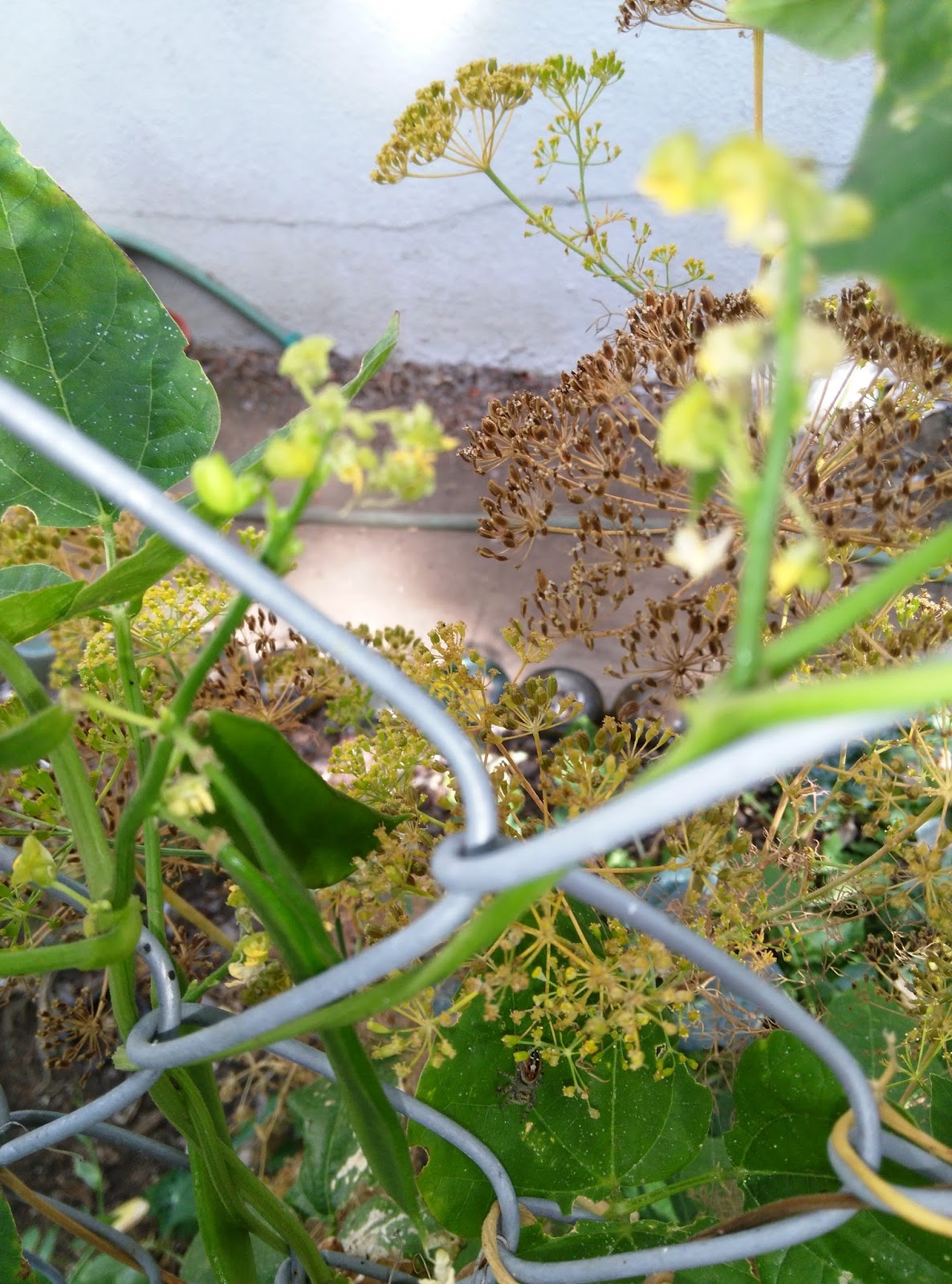
In April of 2012, I learned that the 'Weed Watch' campaign includes nasturtium (Tropaeolum majus) among the species NOT to plant if we are to "Stop the Invasion" of plants that "fuel wildfires, degrade grazing land, contribute to soil erosion, clog streams and rivers, and increase the risk of flooding." Therefore I have exercised considerable restraint in allowing nasturtiums to appear in my garden. In winter and spring I let them take over the strip devoted to herbs and veggies and climb to the top of our chain link fence. When peas, beans, and tomatoes need the space, I rip the nasturtiums out and let their bouncy seeds fall to the ground, where they will almost immediately germinate. This 'second coming' of nasturtium plants is thinned repeatedly but allowed to play their traditional role as companion plants to attract pests away from wanted plants.

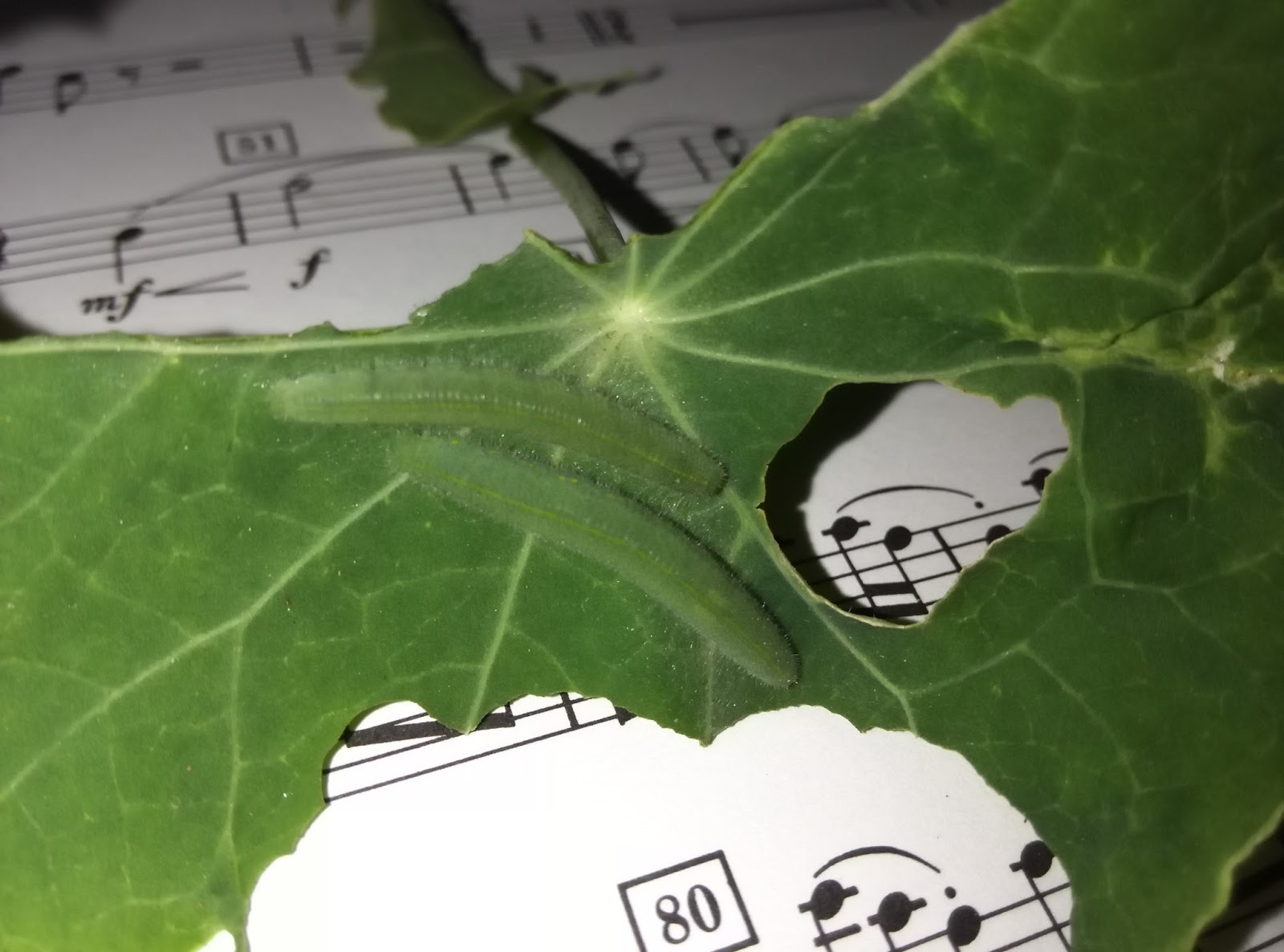
In the photo below, you can see how this works. Two well-camouflaged green worms appear to be relaxing on the nasturtium leaf at upper left, possibly dreaming of the day they will morph into white moths. Meanwhile the tomato leaf at upper right remains untouched.


Though it shows oregano, tarragon, and marjoram to good advantage, I do not like this photo. The sun was so bright that all I could see on the screen of my smart phone was my own reflection. I showed the worms and the photo to Steve, and he wisely offered a solution: "Why don't you take off the leaf?" Why, indeed? So I carried the leaf and its little sunbathers inside and placed them on a piece of band music. What a lovely setting:


After snapping this photo, I gently placed the nasturtium leaf, worm-side down, in a compost digester. A couple of hours later, the worms had vanished while the leaf was virtually unchanged.

Though I often choose a politically correct option when facing a moral dilemma, I feel no guilt about harboring nasturtiums. I have repented my old way of letting them run rampant, but I have have never believed that, in the context of my urban, self-contained garden, they would "fuel wildfires, degrade grazing land, contribute to soil erosion, clog streams and rivers, and increase the risk of flooding." Even so, I keep an eye on them. A good way to see a flower or two.


This photo, taken earlier this morning before the sun hit this part of the garden, shows at least two nasturtiums keeping watch over some small Swiss chard. Unfortunately in this case the pests seem to prefer the chard.

Saturday, July 11, 2015

year of the bean

I haven't blogged about growing beans since June of 2010, when I wrote look at them beans in the misguided state of euphoria I experienced after getting scarlet runner beans and hyacinth beans to grow on our chain link fence. By January of 2012, I had given up my fascination with hyacinth beans and their alleged magic, and today I view the scarlet runner bean (SRB) as a threat to civilization as we know it.

When I re-read look at them beans this morning, I was astounded to see that I had bought four SRB plants as soon as we finished putting up the fence in 2009, and had saved the seed to plant the next year and, indeed, just about every year since. In other words, all the SRBs I have grown here are descendants of four plants. I still love to see their blossoms appear on our side gate:


The huge pods, however, attract a thick powdery mildew that fills me with fear and loathing. The photo of the ungainly specimen below was taken after I had cut the vine at ground level so that the nearby leaves had totally shriveled:


The green leaves at the right belong to a much better variety of bean, the Worcester Indian Red Pole Lima (aka Peruvian Lima), grown from seed I had ordered on line from Amishland Seeds in 2012. According to Amishland's descriptive catalog, the Incas dried these beans and ground them into flour. I let them dry on the vine and then use them to make soup or stew along with other veggies, usually spiced with East Indian sambar masala. I enjoy the juxtaposition of a pre-Columbian New World bean with an Old World spice.

When I ordered bean seeds from Amishland Seeds, they were offering a promotion: one free variety with four. How could I resist? I don't remember which was the free one, but I was delighted when I received five packets of 10 seeds each in the mail: Peruvian Lima, Amish Gnuddel, Lazy Wife, Anellino, and Cascade Giant. Of course I should have planted them right away, but for some reason I waited till fall of 2014 and then chose the Peruvian Lima.

It was in fall 2014 that I first planted veggies following the principles of companion planting and crop rotation. Previously I had relied solely on aesthetic principles: if I had four boysenberry plants, I spaced them evenly along the fence. Same thing with tomato plants and bean or pea seeds. It didn't work very well, and so last fall I moved the boysenberry plants into the same section of of the bed. But beans are supposed to be good companions for any other veggie, and besides they 'fix' nitrogen. And so I started my saved SRB seeds and my new Peruvian Lima seeds indoors in toilet paper tubes and planted them evenly all along the fence in November or December. They soon started producing tiny white and yellow blossoms:

Fortunately 100% of the Peruvian Lima seeds germinated, and they turned out to be extremely prolific. I pick some dried pods practically every day, and when I get enough to cook I make sure to save at least 15 for seed. Here's today's harvest:


Of those saved for seed, some have become companions for chayotes, and some for gourds. Because the seed pods 'shatter' when mature, some have come up volunteer on both sides of the fence. I cannot imagine planting a garden without Peruvian Limas, though I've learned that boysenberries dislike pole beans. I took out all the pole beans from the berry patch and I think the problem was competition for space on the fence. Anyway the boysenberries are looking happier, even with tomatoes encroaching a bit.

What of the other four Amishland bean varieties? Due to my having aged them so long, the germination was spotty at best. I currently have ONE Amish Gnuddel plant, THREE Lazy Wife plants, and THREE that may be either Cascade Giants or Anellinos. A report on their progress, if any, must wait until another day.


Monday, June 15, 2015

poppy progress


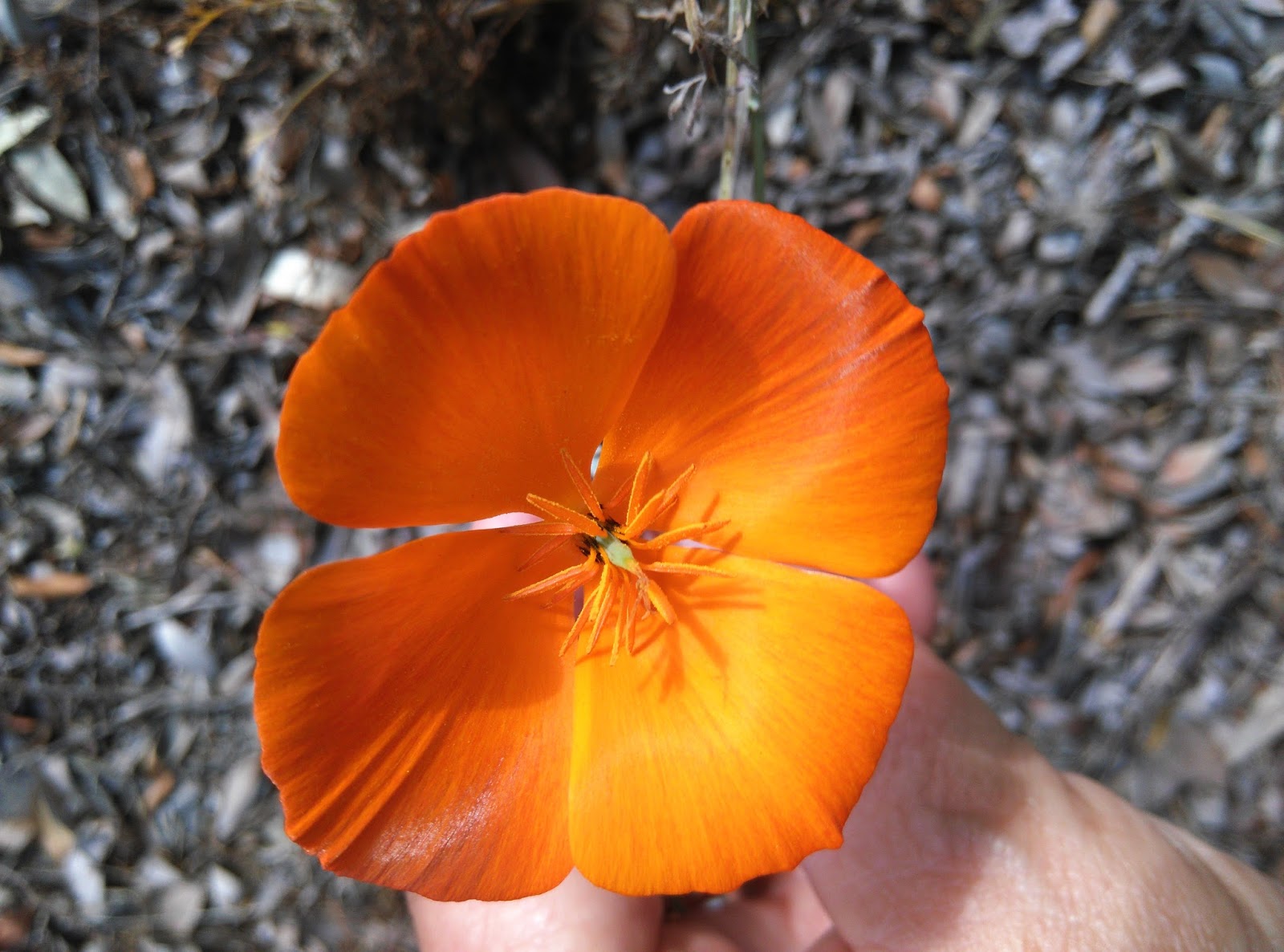
In spring surprises . . ., posted on April 22, I lamented the total absence of California poppy blossoms or even buds in our front garden, yet "darling buds of May"* finally appeared and produced four lonely blossoms -- one at a time. Last Saturday, June 13, I photographed the laggard fifth. Somewhat darker than official state-flower standard, it had descended from the plants in a four-inch pot of mixed-color poppies we'd bought along with a pot of standard poppies at least four years ago at the Theodore Payne Foundation.


Meanwhile, the previous four blossoms had produced mature seedpods, and I started thinking about how best to ensure a good crop of poppies for 2016. It shouldn't be difficult, with the strong possibility of a rainy El Niño season ahead. I decided to pick two pods and scatter their seeds, and leave two to scatter their own seeds naturally. Here are the harvested two:


Maybe it's wishful thinking, but these pods seem to me to be longer than most, and so I included the quarter as a gauge of their size. Thomas Jefferson, our horticulturalist president, would surely approve, and the coin's 'heads' position invokes his blessing on the experiment. The pod on the left, BTW, is from the only one of 2015's new plants that has bloomed.

Finally, I used my thumb nail to open the pods onto the manila file folder where they had posed for their picture. The seeds rolled easily into the folder's central crease, which would have made it easy to pour them into a container.

Over dinner, Steve and I debated the merits of waiting for rain before scattering the seeds. He finally convinced me that the remaining pods wouldn't wait for rain before they opened. Feeling a bit like I was feeding the birds, I flapped my manila folder over a bare but well mulched patch where several poppy seedlings had appeared in February and March. If birds do eat any of the seeds, of course each one will be replanted along with a small portion of organic fertilizer.

Now to let nature take her course.
- - - - -
*Shakespeare's Sonnet #18 ("Shall I compare thee to a summer's day?")

Saturday, June 13, 2015

holey calandrinia!


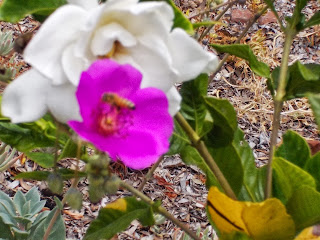
Two years ago I wrote about "white gardenias . . . mingling with cerise calandrinias" as bedfellows in our front garden. Above at left is a photo from that post. Below, at right, is a photo I took last Saturday, June 6:


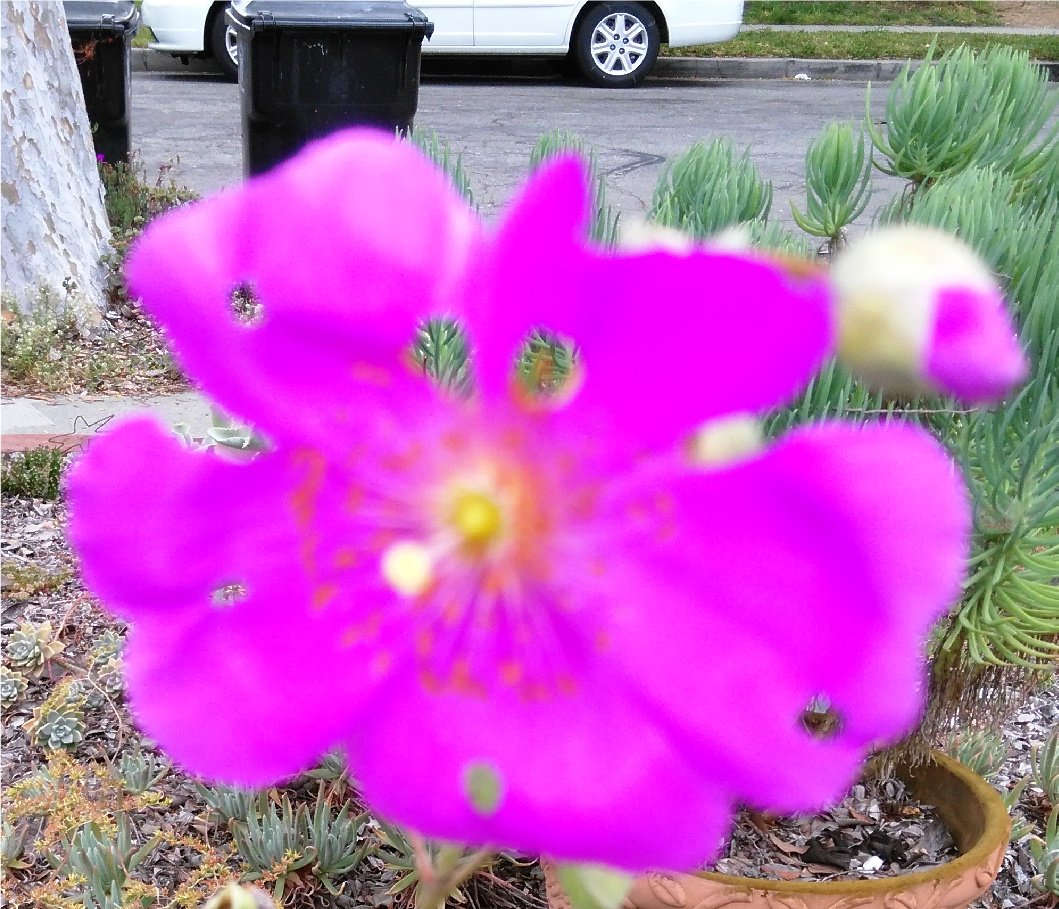
The most obvious difference here is that the second gardenia hasn't opened yet, but let's look more closely at the two calandrinias. A honey bee graces the upper one, camouflaging herself cleverly against stamens and stigma, while a perfectly round hole in the lower one (look at 10:30) suggests that a less beneficent insect has come and gone.

It took me several days to figure out what had happened.

Early last week I was sitting at our little bistro table, contentedly watching a calandrinia blossom bob up and down on its long stem. I noticed what appeared to be a white spot on one of the petals. Closer inspection revealed that the spot was actually a hole framing a white object in the distance, possibly a white car parked on the street. On Friday (I can identify the day because there are trash bins at the curb), I spotted the ultimate calandrinia perforation: six holes spaced evenly among the flower's five petals. Each of the larger two was about 1/8" in diameter, while the smaller four averaged about 1/16" in diameter:


On Saturday, the day after sighting the holey calandrinia shown above, I decided to survey the entire calandrinia population: possibly eight flowers open at that time, each one on a long, separate stalk. That was when I found and photographed the one-holed blossom shown at the top of this page. None of the others seemed to be afflicted. The perforated calandrinia shown above had folded up and been replaced by the bud that's peering over its shoulder in the picture. But wait! There was something strange about that new flower. A little yellow-green grasshopper was perched on it. I tried to take a picture, but the insect was too fast for me. I was happy to have scared him away from a flower that was still unscathed, but strongly suspected that he would return as soon as my back was turned.

My next stop, of course, was the Internet, where I Googled 'grasshopper damage.' I learned that not all grasshopper damage consists of small holes, and that not all small holes in leaves and flowers are made by grasshoppers. Industry-standard grasshopper eradication, moreover, requires more than one season, as an expensive fungus must be made available when eggs are hatching in early spring. The pesticides favored by organic gardeners -- bacillus thuringiensis (b.t.) and hot pepper in a soap or wax base -- do not claim to deter grasshoppers. Maybe some of the damage to the kale in my little vegetable garden has been caused by grasshoppers rather than the cabbage worms I've been trying to fight with alternating applications of pepper spray and b.t. We live and learn.

I also learned that the best biological control for grasshoppers and many other insects, especially in a small-scale operation, is a little flock of chickens. My friend Michelle has four or five 'rescue' hens who spend much of their time hunting down and devouring insects which are then converted into delicious eggs. I don't remember whether Michelle has any calandrinias, but if she does I'll bet they aren't as holey as mine.

Wednesday, April 22, 2015

spring surprises: the wild and the tame

In long dry spell, I touted my high expectations for spring 2015's showing of California poppies: "big drifts of California poppy seedlings have appeared in our cactus and succulent bed and, for the first time, in our parking strip. I have committed myself to keeping them alive until they can bloom and set seed for 2016." To meet this commitment, I have actually started watering our front garden beds for about 10 minutes, using city water from the hose when no saved rain water or 'gray' water is available, in any week when there has been no rain. That is, most weeks, but only ONCE a week!

On April 11, I returned from Idaho to find NO poppy seedlings in the parking strip and NO buds on any of the old or new poppy plants in our cactus and succulent bed. It was obvious that Steve had kept up the new watering regimen, for volunteer sweet peas were sprawling seductively over the phased-out freesias in our bulb bed and the struggling sweet alyssums in the parking strip.

I was not alone in my disappointment over the 2015 poppy season, but I did not know it until last weekend, which is when Antelope Valley's wildflowers are supposed to be at their peak of bloom and when the annual California Poppy Festival takes place. On March 17, a local television station had reported that acres of poppy blooms had been destroyed by a "record-breaking late winter heat wave."

Fortunately, California poppies develop a strong perennial taproot which enables them to survive an annual spring trampling by tourists, followed by a long hot summer when they typically go dormant unless they happen to grow close to the coast as ours do. I hope that at least some of my 2015 seedlings have made taproots and that 2016 will be a better year for poppies.

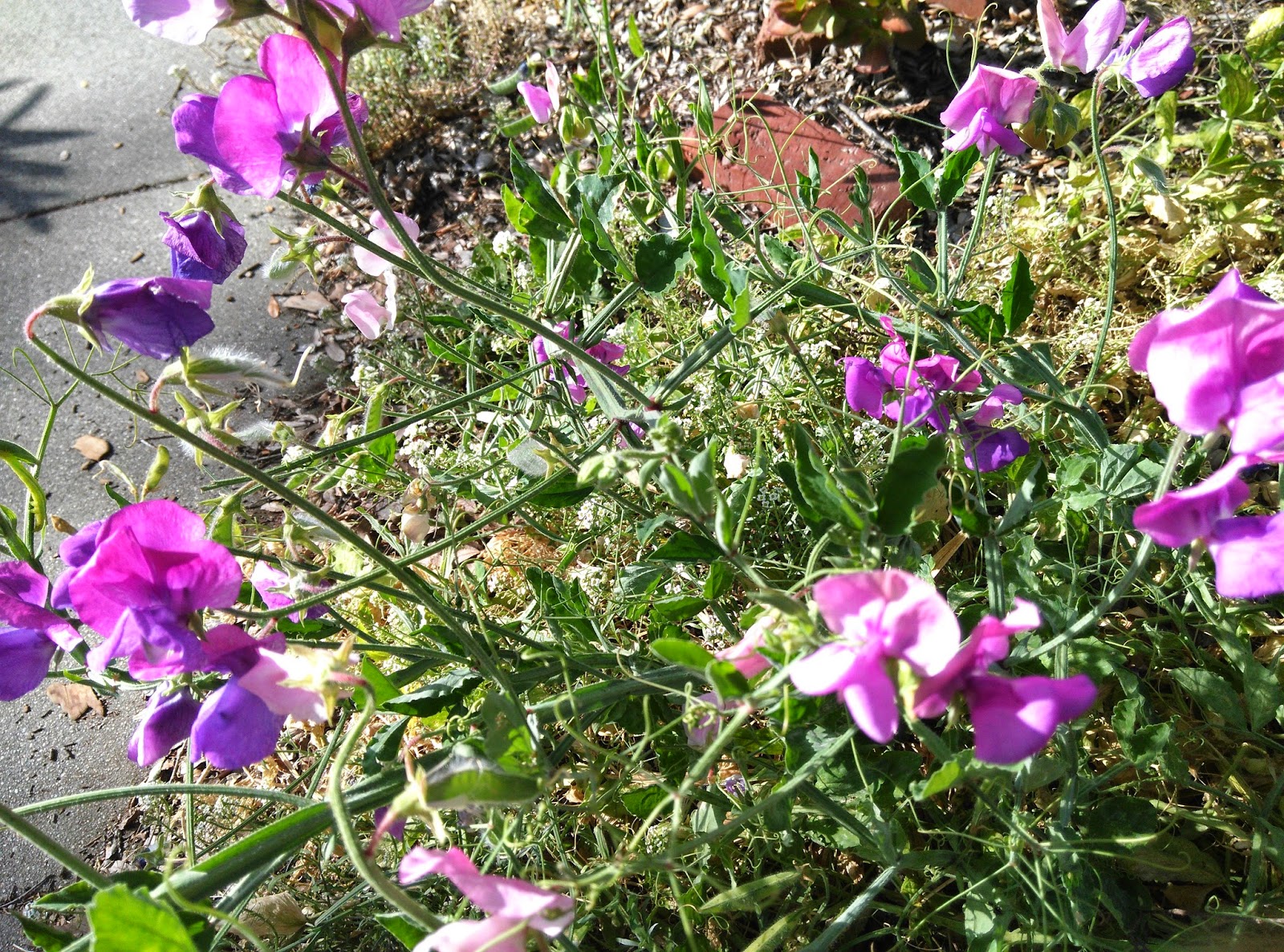
Meanwhile, I am enjoying my best-ever showing of volunteer sweet peas. I have not planted a sweet pea seed since 2011 but they continue to come up because I pick very few of the flowers and then use the spent vines (along with their mature seeds) as mulch. One might fear that sweet peas would be trampled in the parking strip, where people walk to and from their cars every day. No doubt a few have succumbed, but when they start blooming everyone (dogs and toddlers included) gives them a wide-enough berth, even if they're hanging out over the sidewalk to bask in late afternoon sun.


If you're interested in the history of my efforts to grow sweet peas, see you, gregor mendel (2013), paltry in pink (2012),  a plethora of purple (2011), and perennial sweet pea (2010). In the oldest of these postings, I expressed the utterly misguided opinion that: "The frilly, fluttery annual sweet pea is a prima donna with a short, spectacular life. I expect her perennial cousin to be a somewhat frumpy but more dependable companion." So where have all the perennial sweet peas gone? Back to the east coast where they grow wild, I guess.

What flower seems tamer than a sweet pea? And yet it is going wild for me while the quintessential wildflower resists my attempts to tame it.
- - - -
P.S. (added April 23): I was so excited about sweet peas sprawling along the ground and encroaching on the sidewalk that I failed to notice one that had climbed up through the lower stems of a five-foot jade plant:


In the photo, the sweet pea blossom looks white against dark green leaves and crispy brown flowers (another heat-wave casualty). It's actually a very pale pink. I'll deadhead the jade plant and everything will look better.


Creative Commons License
POSToccupations by Frances Talbott-White is licensed under a Creative Commons Attribution-Noncommercial-No Derivative Works 3.0 United States License